

Key Takeaways
Our Verdict
Top-down budgeting suits organizations that need speed, centralized control, and tight alignment with executive strategy. Bottom-up budgeting delivers greater operational accuracy and stronger departmental ownership, making it valuable for larger or more complex organizations. A hybrid approach often captures the strengths of both, and many mature businesses move in that direction as they scale.
| Best for | Recommended |
|---|---|
| Startups or businesses needing rapid budget cycles | Top-Down Budgeting |
| Organizations prioritizing forecast accuracy and team accountability | Bottom-Up Budgeting |
| Mid-to-large enterprises balancing strategy with operational complexity | Hybrid Approach |
What Each Approach Actually Means
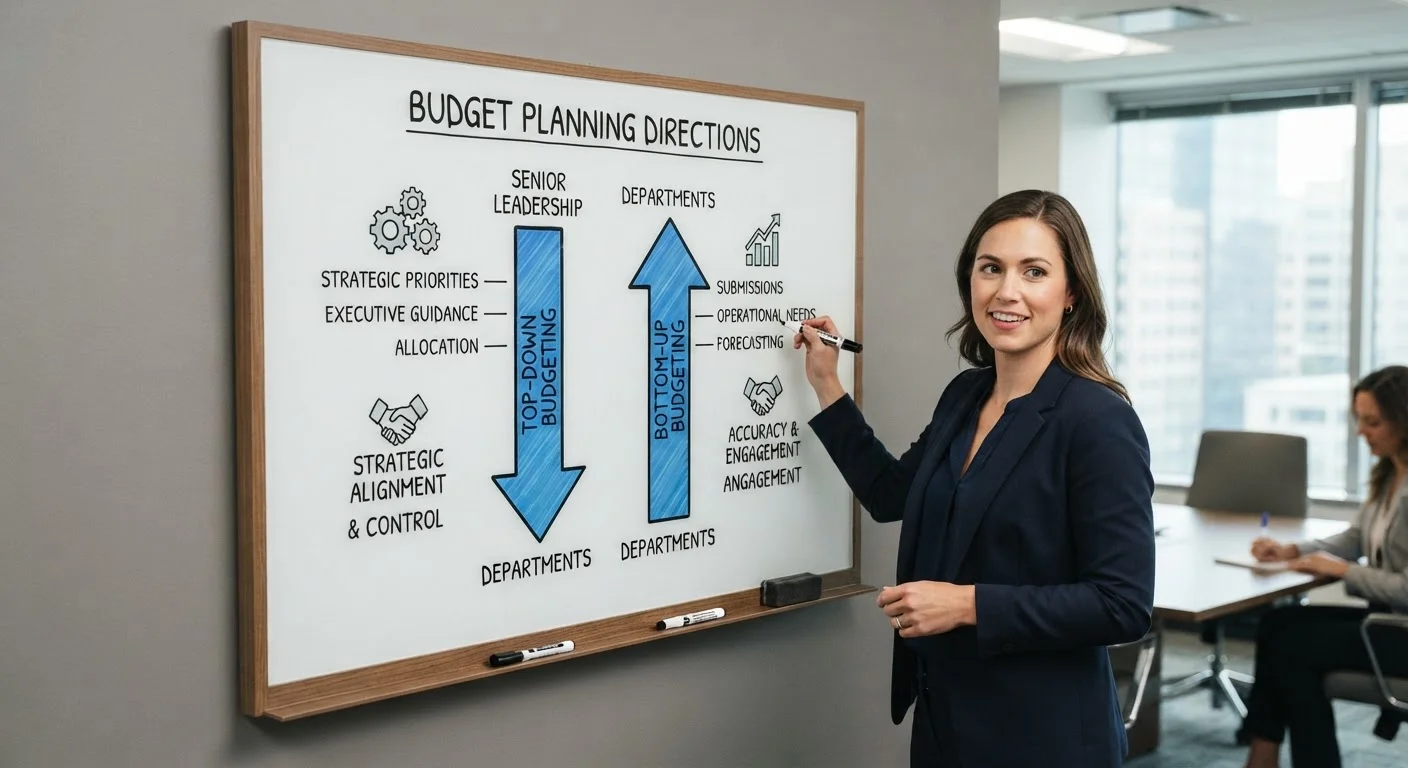
Before comparing performance, it helps to understand what each method does structurally. In top-down budgeting, executive leadership sets overall spending limits and revenue targets - often derived from strategic goals or investor expectations - and then allocates figures down to departments and cost centers. Departments receive a number to work within rather than contributing to how it was derived.
In bottom-up budgeting, the process runs in reverse. Individual teams and department managers build detailed estimates of what they expect to spend and earn in the coming period. Those figures roll up through layers of the organization until they consolidate into a company-wide budget. For a fuller overview of foundational concepts, see Business Budgeting from the Ground Up.
The distinction is not merely procedural - it reflects fundamentally different assumptions about where reliable financial knowledge lives in an organization.
Head-to-Head: How the Two Methods Compare
Evaluating these approaches across consistent criteria reveals real trade-offs that should influence which method a business chooses or how it structures a hybrid model.
| Top-Down Budgeting | Bottom-Up Budgeting | |
|---|---|---|
| Speed of process | Fast - leadership drives the cycle | Slower - requires multi-team input |
| Strategic alignment | High - directly tied to executive goals | Moderate - must be reconciled upward |
| Operational accuracy | Lower - may miss on-the-ground costs | Higher - built from actual cost drivers |
| Team buy-in | Lower - teams receive, not participate | Higher - teams shape their own targets |
| Risk of budgetary slack | Low - limits are externally imposed | Higher - managers may pad estimates |
| Best organizational fit | Smaller firms or fast-moving cycles | Larger or more complex organizations |
For a detailed breakdown of how individual budget components interact - including fixed costs, variable expenses, and reserves - see The Anatomy of a Business Budget.
Where Each Method Tends to Break Down
Top-down risks: When leadership sets targets without consulting operational managers, the resulting budget can be misaligned with actual cost structures. A transportation company, for example, may receive a fuel budget based on last year's average that fails to account for route changes or new compliance requirements. Departments then spend the cycle managing around a flawed constraint rather than executing efficiently.
Top-Down Targets Without Context Create Risk
Issuing spending limits without sharing the assumptions behind them can leave managers unable to flag when a target is unrealistic. If a department cannot meet its target without cutting costs that affect service quality or compliance, leadership needs that information early - not at year-end. Build in a structured feedback window so managers can surface concerns before the budget is finalized.
Bottom-up risks: The process is time-intensive. When every department builds from scratch, consolidation and reconciliation can extend the budget cycle by weeks. There is also a well-documented tendency for managers to pad estimates - a form of budgetary slack - to protect themselves from shortfalls, which distorts the final figures upward. Departmental Budgeting: Coordinating Finances Across Teams explores how to structure multi-team budgets that minimize this problem.
The Hybrid Model: Combining Both Directions
Many organizations find that neither pure approach is sustainable at scale. A hybrid model - sometimes called a guided bottom-up or iterative budgeting process - begins with leadership establishing high-level parameters (total revenue targets, capital availability, strategic priorities) and then invites departments to build detailed plans within those guardrails.
This structure preserves strategic alignment while incorporating ground-level expertise. The result typically requires fewer revision cycles than a pure bottom-up process and generates fewer operational surprises than pure top-down mandates.
Make the Guardrails Explicit Early
When running a hybrid process, communicate leadership's financial parameters to department managers before they begin building estimates. Clearly defined ceilings and priorities prevent wasted effort on proposals that will never be approved. A short pre-planning brief from the CFO or finance team - outlining top-line targets and any strategic constraints - can significantly shorten the iteration cycle.
The hybrid approach also integrates more naturally into broader financial planning frameworks, where annual budgets must link to multi-year growth strategies. For a comprehensive view of how budgeting fits within the full planning cycle, see Business Budgeting: A Complete Framework from Planning to Review.
It is also worth noting that budgeting method interacts with budgeting philosophy. Zero-Based Budgeting vs. Incremental Budgeting addresses a separate but related choice about whether prior-year figures anchor new budgets - a question relevant regardless of which directional approach a business uses.
This article provides general financial information for educational purposes and does not constitute personalized financial or business advice. Consult a qualified financial professional for guidance specific to your organization's circumstances.