

Key Takeaways
Option A
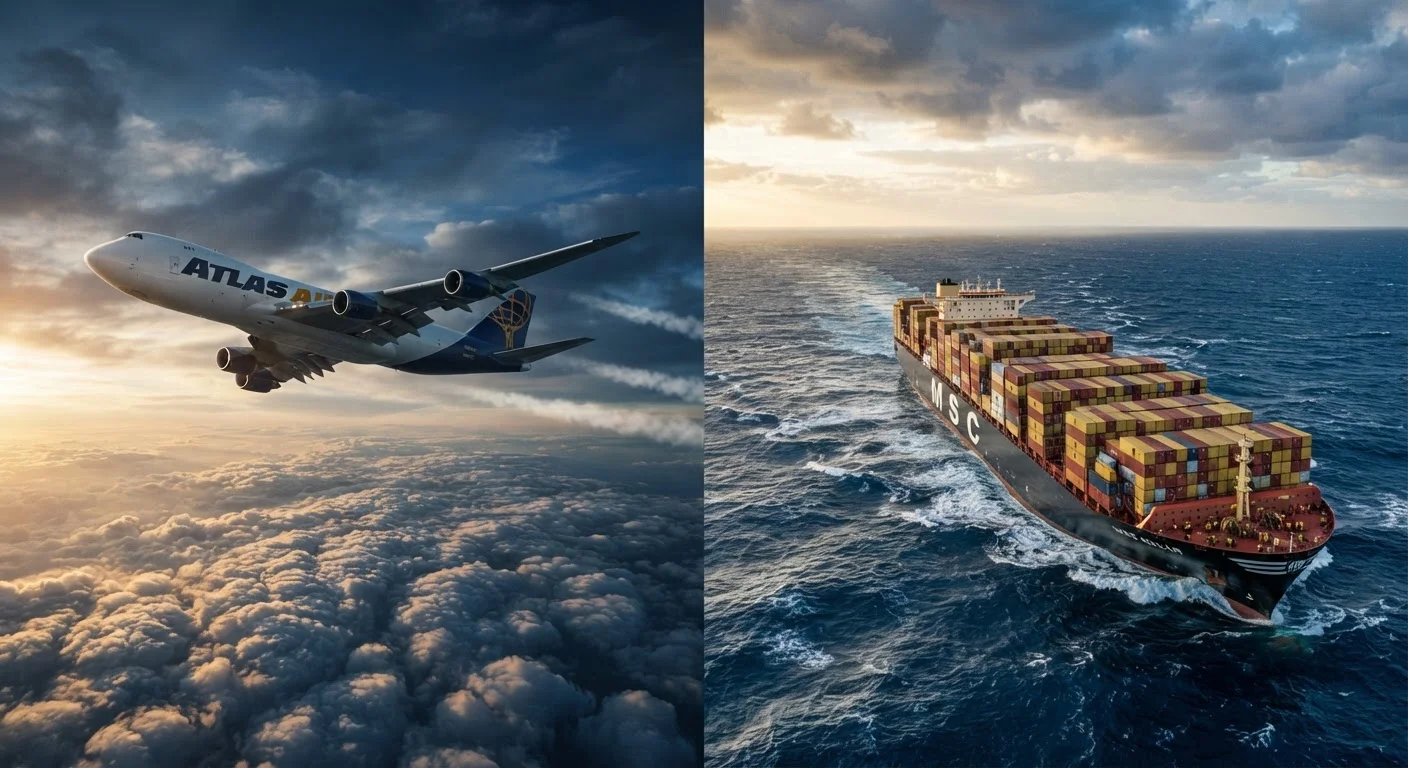
Air Freight
The fast, premium option for time-critical cargo.
Best for: Best for high-value, low-volume, or perishable shipments where speed and reliability outweigh cost.
Option B
Ocean Freight
The economical backbone of global trade.
Best for: Best for large, heavy, or non-urgent cargo where cost efficiency and volume capacity take priority.
If your cargo is time-sensitive or perishable
Air Freight
Air freight delivers in days rather than weeks, making it the only viable option for pharmaceuticals, fresh produce, or just-in-time manufacturing components.
If you're moving large volumes of non-urgent goods
Ocean Freight
Ocean freight offers dramatically lower per-unit costs and virtually unlimited capacity for full and less-than-container loads.
If your goods are high-value and low-weight
Air Freight
The premium freight cost is often justified when cargo value is high and inventory carrying costs or stockout risks are significant.
If your supply chain can absorb longer lead times with advance planning
Ocean Freight
With proper demand forecasting and safety stock planning, ocean freight's lower cost base can improve product margins meaningfully.
If you face a sudden stockout or missed production deadline
Air Freight
Air freight is the standard recovery mode when ocean shipments are delayed and production lines or retail shelves are at risk.
The Core Trade-Off: Speed vs. Cost
For US businesses shipping internationally, the choice between air and ocean freight comes down to a fundamental trade-off: how quickly do you need your goods, and how much are you willing to pay to get them there? Neither mode is universally superior - each serves a distinct operational role depending on cargo type, supply chain structure, and margin sensitivity.
Air freight moves cargo between major international hubs in one to five business days. Ocean freight, by contrast, typically takes 14 to 40 days depending on the origin-destination pair and routing. That speed differential is enormous, and it comes at a price: air freight rates are commonly five to seven times higher per kilogram than ocean freight rates on equivalent lanes, though the exact ratio fluctuates with fuel costs, capacity, and demand cycles.
Understanding where each mode fits requires looking beyond the headline rate. Landed cost - the total cost of getting a product to its destination, including freight, insurance, duties, and carrying costs - often tells a more complete story than the freight invoice alone. For a primer on key shipping terminology, see Freight Terms Decoded to understand concepts like FOB, CIF, and drayage that affect how costs are allocated between buyer and seller.
| Criterion | Air Freight | Ocean Freight |
|---|---|---|
| Transit Time | 1-5 business days | 14-40 days |
| Cost per kg (relative) | 5-7x higher | Baseline rate |
| Capacity | Limited, volatile | Very high, scalable |
| Cargo Types | High-value, light, perishable | Bulk, heavy, all types |
| Schedule Reliability | Generally high | Subject to port congestion |
| Key Document | Air Waybill (AWB) | Bill of Lading (B/L) |
| Carbon Footprint | Significantly higher | Lower per unit |
| Best Lead Time Requirement | Under 1 week | 3 weeks or more |
Cargo Suitability and Capacity Realities
Not every shipment is a candidate for both modes. Air freight is structurally suited to goods that are light, compact, high in value, or time-sensitive. Pharmaceuticals, electronics, luxury goods, and perishable foods are common air cargo categories. Ocean freight, on the other hand, accommodates virtually any cargo type - from bulk commodities and raw materials to oversized industrial equipment - at a scale aircraft simply cannot match.
A single large container ship can carry tens of thousands of twenty-foot equivalent units (TEUs). A freighter aircraft carries a fraction of that. This capacity difference has direct implications during peak shipping periods. Air cargo capacity tightens significantly during Q4 consumer goods surges and around major holidays, driving rates sharply higher. Ocean freight markets also experience volatility, but shippers with contractual allocations have greater rate predictability. For more on how rate structures work across freight modes, spot vs. contract rate dynamics provide useful context on locking in capacity versus accessing the open market.
~35%
Global trade value moved by air
The International Air Transport Association (IATA) estimates air cargo carries roughly 35% of world trade by value, despite representing under 1% by volume.
80%+
Global trade volume moved by sea
The United Nations Conference on Trade and Development (UNCTAD) reports that over 80% of global merchandise trade by volume is carried by sea.
4-6 weeks
Typical Asia-to-US West Coast ocean transit
Major transpacific lanes from East Asia to US West Coast ports generally transit in four to six weeks, depending on routing and transshipment stops.
Cargo packaging requirements also differ. Ocean shipments must withstand longer transit, humidity, and stacking forces - requiring more robust packaging that adds weight and cost. Air shipments benefit from faster transit, which reduces some packaging burden, though aviation security screening adds compliance requirements that shippers must account for.
Reliability, Risk, and Documentation
Air freight's shorter transit window generally translates into greater schedule predictability, assuming no capacity bottlenecks or weather disruptions at major hubs. Ocean freight is subject to port congestion, vessel schedule changes, and adverse weather over longer voyages - all of which can extend quoted transit times unpredictably. That said, major ocean carriers operate on published schedules and offer tracking visibility that has improved considerably in recent years.
Both modes require specific documentation. Air shipments use an Air Waybill (AWB), while ocean shipments use a Bill of Lading (B/L) - a negotiable document that also serves as proof of ownership in many trade finance arrangements. Importers using letters of credit or documentary collections need to understand which document type their bank requires. Customs compliance obligations are essentially equivalent across modes; the Harmonized System (HS) code, commercial invoice, and packing list are required regardless of how cargo moves.
Insurance considerations also differ. The shorter exposure window of air freight reduces transit risk, but higher cargo values typical of air shipments mean adequate marine cargo insurance remains essential. Ocean shipments face longer exposure to weather, piracy on certain lanes, and handling at multiple transshipment ports. Businesses should consult a licensed insurance professional to assess appropriate coverage levels for their specific cargo and routes - general information here does not substitute for tailored advice.
For businesses evaluating how these modes fit into a broader supply chain design, intermodal freight strategies offer a middle path that can reduce cost while maintaining acceptable transit times on certain corridors. A broader overview of US freight modes is available in Freight Shipping in the US.
Hybrid Freight Strategies Are Common
Many US importers do not choose exclusively between air and ocean - they use both strategically. High-volume, stable SKUs typically move by ocean under contract rates, while air freight is reserved for seasonal replenishment surges, new product launches, or emergency stock recovery. Building this flexibility into procurement and logistics planning can provide cost control without sacrificing responsiveness when supply chain conditions shift unexpectedly.