

Key Takeaways
Option A
Secured Business Credit
Collateral-backed credit with lower rates and defined lender protection.
Best for: Established businesses with tangible assets seeking higher credit limits and more favorable interest terms.
Option B
Unsecured Business Credit
Creditworthiness-driven access without pledging specific assets.
Best for: Businesses with strong credit profiles seeking flexible access to capital without encumbering their assets.
If your business holds significant tangible assets
Secured Business Credit
Pledging assets as collateral typically unlocks larger credit facilities and lower rates, making secured credit more cost-effective when assets are available.
If you need flexible, fast access to capital without tying up assets
Unsecured Business Credit
Unsecured facilities offer quicker approval processes and no collateral requirements, suited to businesses with strong credit histories that want operational flexibility.
If your business is in an asset-heavy industry such as logistics or hospitality
Secured Business Credit
Equipment, real estate, and fleet assets can serve as collateral, allowing businesses in capital-intensive sectors to leverage what they already own.
If you are a younger business with limited physical assets but solid revenue
Unsecured Business Credit
Businesses without substantial collateral can still access credit through unsecured facilities, provided their credit scores and financials meet lender thresholds.
The Core Structural Difference
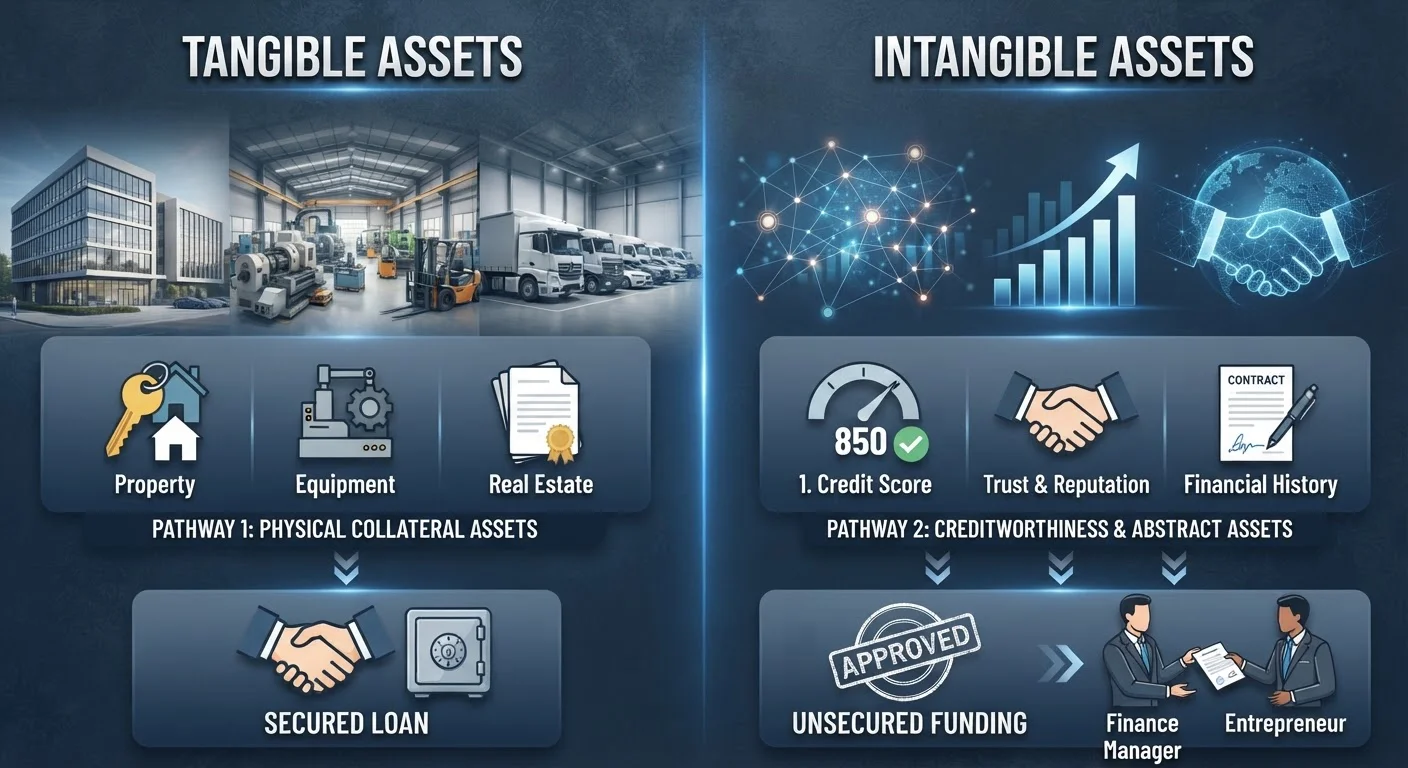
The distinction between secured and unsecured business credit is fundamentally about how a lender manages its risk. With secured credit, the borrower pledges a specific asset - such as commercial real estate, equipment, inventory, or accounts receivable - as collateral. If the borrower defaults, the lender has a legal claim to that asset. With unsecured credit, no specific asset is pledged; instead, the lender extends credit based on the business's creditworthiness, financial history, and, in many cases, a personal guarantee from a business owner.
This distinction shapes virtually every term attached to the credit facility: the interest rate, the credit limit, the repayment structure, and the consequences of default. Neither structure is inherently superior - each reflects a different risk allocation between lender and borrower.
To understand how these structures fit into broader financing options, see a comparison of common business loan structures, which covers how term loans, lines of credit, and invoice financing each operate.
| Criterion | Secured Business Credit | Unsecured Business Credit |
|---|---|---|
| Collateral required | Yes - specific asset pledged | No - relies on creditworthiness |
| Typical interest rates | Generally lower | Generally higher |
| Credit limits | Often higher | Often more conservative |
| Qualification criteria | Asset value is a key factor | Credit score and financials primary |
| Default consequence | Asset seizure by lender | Legal action, credit damage |
| Personal guarantee common? | Sometimes | Frequently required |
| Best suited for | Asset-rich, established businesses | Strong credit, asset-light businesses |
Risk, Rates, and Credit Limits
Lenders price credit according to perceived risk. Because secured credit gives the lender recourse to a specific asset, the lender's downside is limited - and that reduced risk is typically passed to the borrower in the form of lower interest rates and higher borrowing limits. A manufacturing firm pledging its production facility, for example, may access a substantially larger credit line at a lower cost than an equivalent firm seeking unsecured financing.
Unsecured credit carries a higher effective cost for lenders, since recovery in a default scenario depends on legal action rather than asset liquidation. Lenders compensate with higher interest rates and more conservative credit limits. They also apply stricter qualification criteria - often requiring stronger business credit scores, longer operating history, and demonstrated revenue stability.
~60%
Small businesses using some form of credit
According to the Federal Reserve's Small Business Credit Survey, approximately 60% of small businesses applied for or used credit products in a recent survey year.
1-6%+
Interest rate differential between secured and unsecured
Industry data suggests unsecured business credit facilities commonly carry rates several percentage points higher than equivalent secured products, reflecting the lender's elevated risk.
It is worth noting that many unsecured credit facilities still require a personal guarantee. This means that while no specific business asset is formally pledged as collateral, the business owner's personal assets may remain at risk if the business defaults - a point that deserves careful consideration before signing.
Default Consequences and Practical Obligations
The consequences of default differ meaningfully between the two structures. On a secured facility, default typically triggers a lender's right to seize and liquidate the pledged asset. Depending on the jurisdiction and the loan agreement, this process may be relatively swift, particularly when clearly defined collateral - such as a vehicle or piece of equipment - is involved. The business may lose a critical operational asset, with significant downstream effects on continuity.
On an unsecured facility, the lender cannot immediately claim a specific asset. Instead, recovery typically proceeds through collection efforts, credit reporting, and - in more serious cases - civil litigation. This process is generally slower and more costly for the lender, which is one reason unsecured credit is priced higher. However, the reputational and credit-score damage from default on either type of facility can be severe and lasting.
For context on how these credit events affect your standing with lenders, see how business credit scores are calculated and reported.
Personal Guarantees and Unsecured Credit
Many lenders offering unsecured business credit still require a personal guarantee from one or more owners. This means that while no business asset is formally pledged, the owner's personal financial standing can be affected by a business default. Review all guarantee provisions carefully with a qualified adviser before committing to any unsecured facility.
Businesses in capital-intensive sectors - transportation, hospitality, construction - often find secured credit more accessible simply because they hold assets that lenders can evaluate and accept as collateral. Service-oriented businesses with fewer tangible assets tend to rely more heavily on unsecured structures, making their credit profiles especially important to maintain. For a broader view of how secured and unsecured credit apply specifically to loan products, a dedicated comparison of secured versus unsecured business loans provides further detail on collateral requirements and typical terms.
This article is for general informational purposes only and does not constitute personalised financial, legal, or credit advice. Credit terms, qualification requirements, and consequences of default vary by lender and jurisdiction. Consult a qualified financial adviser or licensed credit professional before making decisions about your business's financing arrangements.