

Key Takeaways
Option A
Static Budget
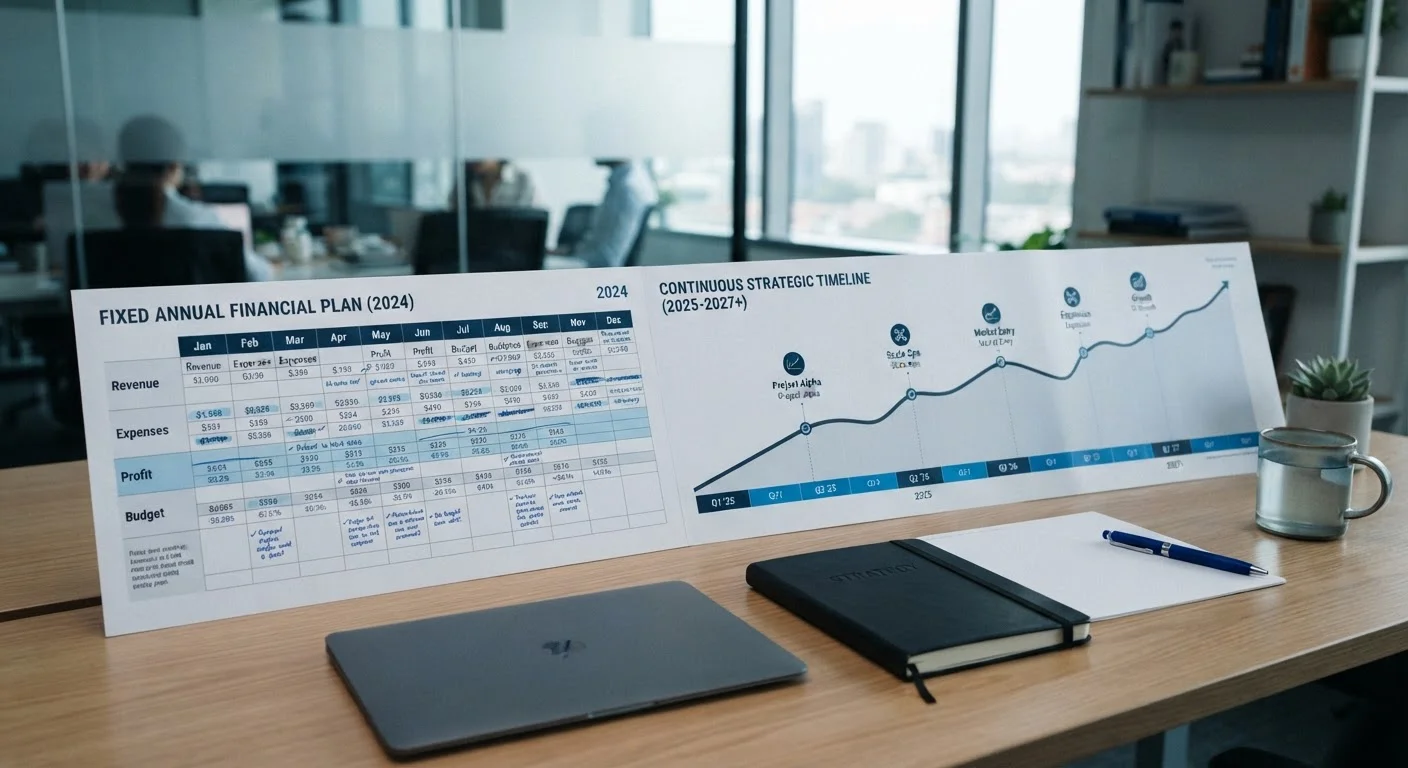
The established, structured annual plan.
Best for: Businesses with predictable revenue cycles and stable operating environments that benefit from fixed financial benchmarks.
Option B
Rolling Forecast
The adaptive, continuously updated outlook.
Best for: Businesses operating in volatile or fast-moving sectors that require frequent course corrections and forward visibility.
If your business operates in a highly regulated or stable industry with predictable costs
Static Budget
Fixed benchmarks simplify accountability and make variance analysis straightforward when conditions are unlikely to shift significantly mid-year.
If your business faces seasonal swings, rapid growth, or significant market uncertainty
Rolling Forecast
Continuous updates keep your financial outlook grounded in current realities, reducing the risk of acting on assumptions that no longer hold.
If you need to satisfy board or investor reporting requirements with a defined annual plan
Static Budget
A fixed annual budget provides the structured baseline that stakeholders typically expect for governance and performance review purposes.
If you want to improve cash flow visibility and avoid mid-year financial surprises
Rolling Forecast
Rolling forecasts surface emerging shortfalls or opportunities earlier, giving finance teams more time to respond before issues become critical.
If your business is mature with robust finance team capacity and needs both structure and adaptability
Static Budget
A hybrid approach - anchoring to a static budget while layering in rolling forecasts - captures the strengths of both methods without fully abandoning either.
Understanding the Core Difference
A static budget is prepared once - typically at the start of a fiscal year - and remains unchanged regardless of how actual business conditions evolve. Revenue targets, expense ceilings, and resource allocations are locked in, and performance is measured against those original figures throughout the period. This is the most widely used budgeting model across established businesses, particularly in sectors with predictable cost structures. For a deeper look at how a static budget is structured from the ground up, see The Anatomy of a Business Budget.
A rolling forecast, by contrast, is a living financial model. Rather than fixing a twelve-month plan at year-start, a rolling forecast extends its horizon continuously - usually by adding a new month or quarter each time the most recent period closes. A business running a 12-month rolling forecast always has a full year of forward visibility, regardless of where it sits in the calendar.
The fundamental trade-off is between stability and control on one side, and accuracy and adaptability on the other. Static budgets create clear benchmarks; rolling forecasts prioritise relevance.
| Criterion | Static Budget | Rolling Forecast |
|---|---|---|
| Update frequency | Once per year | Monthly or quarterly |
| Planning horizon | Fixed 12-month period | Continuous (e.g. always 12 months ahead) |
| Adaptability | Low - targets remain fixed | High - assumptions revised regularly |
| Resource requirement | Lower - set once, monitor throughout | Higher - ongoing data input and analysis |
| Governance suitability | Strong - clear annual baseline | Moderate - less fixed accountability |
| Best fit | Stable, predictable environments | Volatile or fast-growing businesses |
| Variance analysis | Against original annual plan | Against most recent forecast revision |
Where Static Budgets Work Best
Static budgets are most effective when a business's revenue and cost base are relatively predictable. Sectors such as commercial real estate, regulated utilities, or established professional services firms often find that annual budgets function well because their major cost drivers - lease commitments, staff salaries, contracted vendor fees - change slowly and are known well in advance.
They also serve a governance function. Boards, lenders, and investors frequently expect a defined annual financial plan against which management can be held accountable. Static budgets provide that structured baseline. When results diverge from plan, budget variance analysis becomes the primary diagnostic tool for understanding what went wrong and why.
The main limitation is rigidity. If market conditions shift materially mid-year - a key customer is lost, input costs spike, or a new growth opportunity emerges - a static budget offers no mechanism to recalibrate. Teams can end up chasing targets that no longer reflect reality, which distorts decision-making.
~45%
Finance leaders using rolling forecasts
Surveys by the Association for Financial Professionals have consistently found that rolling forecasts are used by a significant minority of organisations, with adoption rising among larger firms.
12-18 months
Typical rolling forecast horizon
Most businesses that adopt rolling forecasts maintain a forward window of 12 to 18 months, updated on a monthly or quarterly cadence.
The Case for Rolling Forecasts
Rolling forecasts are increasingly favored by businesses operating in dynamic sectors: technology, logistics, hospitality, and advertising, among others. Their core advantage is that they keep financial plans tethered to current data rather than assumptions made months earlier.
Because rolling forecasts are rebuilt or updated regularly - often monthly - they incorporate actual performance, revised market assumptions, and updated pipeline data. This makes them particularly valuable for cash flow forecasting, where timing mismatches between income and outgoings can surface quickly and require prompt action.
Rolling forecasts also integrate naturally with scenario planning - allowing finance teams to model best-case, base-case, and downside outcomes on an ongoing basis rather than treating scenarios as a once-a-year exercise. For businesses exploring which scenarios deserve attention, Scenarios Every Business Budget Should Plan For provides a useful framework.
The trade-off is resource intensity. Maintaining a rolling forecast requires consistent data inputs, analytical bandwidth, and finance team discipline. Smaller businesses without dedicated FP&A (financial planning and analysis) capacity may find the overhead difficult to sustain.
Rolling Forecasts and Business Credit
Lenders and credit providers increasingly value forward-looking financial documentation when assessing business creditworthiness. A well-maintained rolling forecast can demonstrate proactive financial management and support applications for credit facilities or working capital lines. For broader context on how financial planning intersects with access to capital, explore business credit fundamentals.
Choosing - or Combining - the Right Approach
The choice between static budgets and rolling forecasts is not always binary. Many mid-sized and larger businesses operate a hybrid model: a static annual budget serves as the formal accountability framework for governance and reporting, while a rolling forecast runs in parallel to support operational decisions and near-term resource allocation.
This approach is explored further in Static vs. Rolling Budgets: Choosing the Right Planning Cycle, which examines how businesses structure planning cycles around their specific needs. It's also worth reviewing how budgeting assumptions affect both methods - because flawed inputs undermine any forecast, rolling or static.
For comparison with other planning method trade-offs, Zero-Based Budgeting vs. Incremental Budgeting examines a different but equally important planning dimension.
Ultimately, the right method depends on your industry's volatility, your organization's analytical capacity, and the expectations of your key stakeholders. Both approaches have merit - the goal is to select a planning rhythm that supports better decisions, not just better-looking spreadsheets.
This article provides general financial education for informational purposes only and does not constitute personalised financial, accounting, or business advisory advice. Consult a qualified financial professional before making planning decisions specific to your business circumstances.