

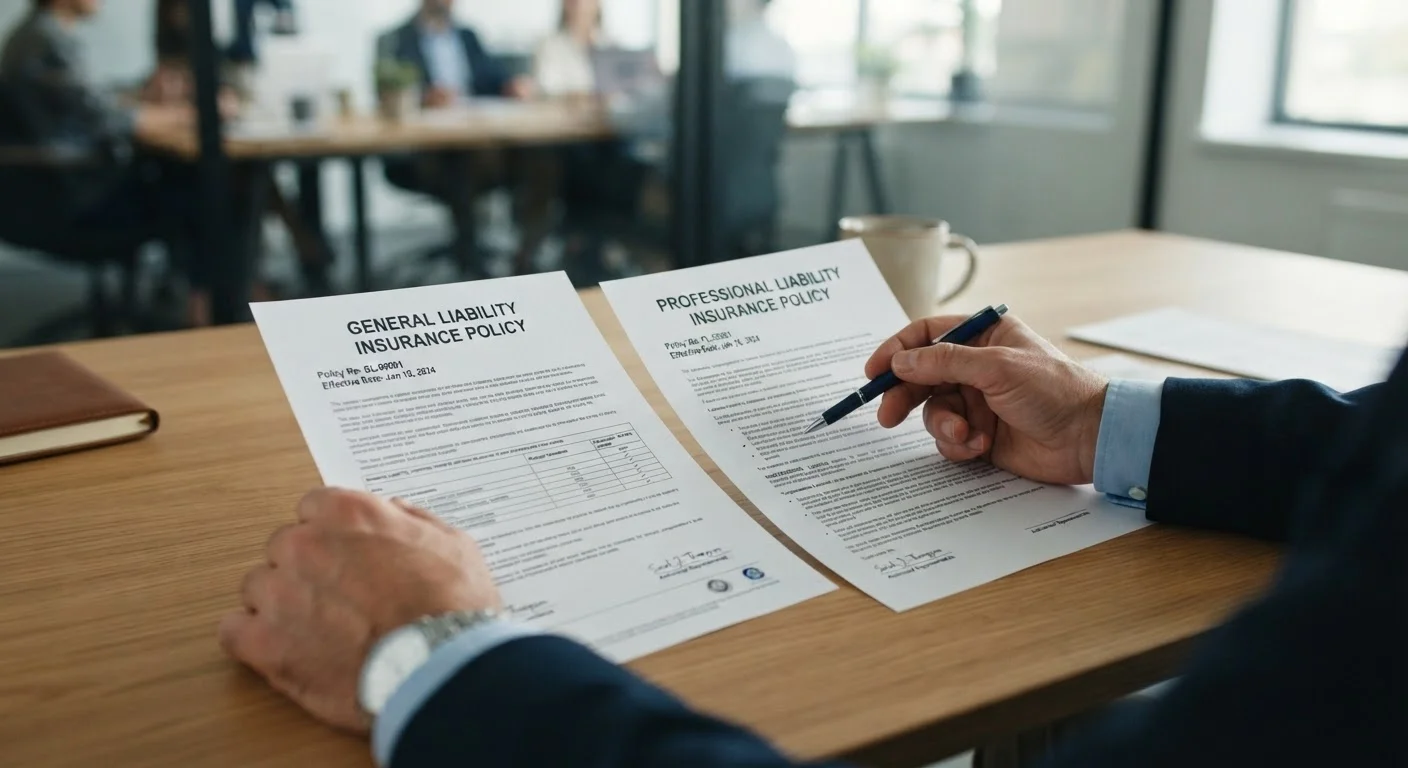
Key Takeaways
Option A
General Liability Insurance
The foundational coverage for physical and third-party risks.
Best for: Service businesses that interact with clients on-site, rent commercial space, or have employees working at client locations.
Option B
Professional Liability Insurance
Specialized protection for the quality of your professional work.
Best for: Consultants, advisers, healthcare providers, and other professionals whose advice or services could result in a client's financial or reputational harm.
If your team visits client sites or welcomes clients to your premises
General Liability Insurance
Slip-and-fall injuries, accidental property damage, and similar physical incidents are general liability exposures - professional liability does not respond to these claims.
If you provide advice, consulting, design, or specialized expertise for a fee
Professional Liability Insurance
Client allegations that your work was negligent, incomplete, or caused financial harm fall under professional liability, which general liability policies specifically exclude.
If you run a full-service professional firm with physical client interactions
Both Policies
A law firm, accounting practice, or marketing agency faces both physical-premises risk and errors-and-omissions exposure - one policy without the other leaves meaningful gaps.
If you are a solo freelancer working entirely remotely
Professional Liability Insurance
Remote freelancers rarely face premises liability but remain fully exposed to claims that their deliverables caused a client harm, making professional liability the primary priority.
What Each Policy Actually Covers
Despite sharing the word "liability," these two policies respond to fundamentally different categories of risk. Understanding where each begins and ends is essential before any service business can assess whether its coverage is adequate.
General liability insurance protects against claims of bodily injury, third-party property damage, and personal and advertising injury - for example, a client who trips and falls in your office, a contractor who accidentally damages a client's equipment on-site, or a competitor alleging that your marketing materials constitute trade libel. For a fuller breakdown of what this policy addresses, see what general liability actually covers.
Professional liability insurance - also called errors and omissions (E&O) insurance or, in healthcare, malpractice insurance - responds when a client claims your professional services were negligent, inaccurate, or failed to meet the standard of care. This could include a consultant whose flawed market analysis contributed to a client's strategic losses, or an IT firm whose software implementation caused a data disruption. General liability policies contain explicit exclusions for professional services, which is why a separate policy is required.
| Criterion | General Liability | Professional Liability |
|---|---|---|
| Primary risk covered | Physical injury, property damage | Negligence, errors, omissions in services |
| Policy trigger basis | Occurrence-based (typically) | Claims-made basis (typically) |
| Common claimants | Visitors, clients, third parties on premises | Clients alleging financial or reputational harm |
| Defense cost structure | Often outside policy limit | Often within policy limit |
| Mandatory for most businesses | Yes - commonly required by landlords, clients | Required in regulated professions; increasingly common in contracts |
| Covers professional advice | No - explicitly excluded | Yes - core purpose of the policy |
| Also known as | CGL (Commercial General Liability) | E&O, malpractice insurance |
Key Structural Differences Between the Two Policies
Beyond what each policy covers, the two instruments are structured differently in ways that affect how and when claims are paid.
Trigger basis: General liability is typically written on an occurrence basis - meaning the policy in force when the incident happened responds, even if the claim is filed years later. Professional liability is usually written on a claims-made basis - the policy active when the claim is filed responds, not necessarily the one in force when the work was performed. This distinction matters when switching insurers or allowing a policy to lapse.
Defense costs: Many professional liability policies include defense costs within the policy limit, which can erode the amount available for settlements. General liability policies more commonly provide defense outside the limit, though policy terms vary significantly by insurer and product.
For a broader view of the liability landscape these policies inhabit, a map of business liability categories is a useful reference. Consulting a licensed insurance broker who specializes in your industry is the most reliable way to evaluate specific policy terms against your actual risk profile.
Claims-Made Policies and Tail Coverage
When a claims-made professional liability policy is cancelled or not renewed, claims arising from past work may no longer be covered. Insurers often offer 'tail coverage' (extended reporting period endorsements) to bridge this gap. If you are switching professional liability insurers or winding down a business, discuss tail coverage options with a licensed broker before any policy lapses.
Sector-Specific Considerations for Service Professionals
Which policy takes priority - and whether both are truly necessary - depends heavily on your profession and how you deliver services.
Healthcare practices represent a clear case where general liability alone is insufficient. Malpractice (a form of professional liability) is typically the dominant exposure, but premises liability remains real for any clinic or practice with patient foot traffic. Why general liability alone is rarely enough for healthcare practices explores this gap in detail.
Consulting, legal, and financial services firms carry high professional liability exposure because their core deliverable is advice. A financial adviser whose recommendation contributed to a client's losses, or an attorney who missed a filing deadline, faces claims that fall entirely outside a general liability policy.
Marketing agencies, design studios, and tech firms straddle both worlds: they may have client-facing offices (general liability exposure) while also delivering creative or technical work where errors can be costly (professional liability exposure).
It is also worth noting that some client contracts - particularly those with enterprise clients or government entities - may contractually require specified limits of both policies before work commences. Reviewing contract indemnification clauses with legal counsel is advisable. See Legal & Compliance resources for related guidance on business legal obligations.
This article provides general insurance education and is not personalized advice. Coverage terms, exclusions, limits, and eligibility vary by insurer and jurisdiction. Consult a licensed insurance professional and review actual policy documents before making coverage decisions.