

Key Takeaways
Option A
In-House HR
The embedded, company-controlled people function.
Best for: Organizations that need deep cultural alignment, real-time responsiveness, and direct oversight of sensitive employee matters.
Option B
HR Outsourcing
The flexible, third-party HR delivery model.
Best for: Businesses seeking to reduce fixed HR overhead, access specialist compliance expertise, or scale HR capacity without headcount.
If you're a small business without a dedicated HR professional
HR Outsourcing
Outsourcing gives small businesses access to structured HR processes and compliance support without the cost of a full-time hire.
If your workforce is large, complex, or heavily unionized
In-House HR
In-house teams can respond immediately to sensitive employee relations issues and build the institutional knowledge complex workforces require.
If you're scaling rapidly and need flexible HR capacity
HR Outsourcing
Outsourced providers can absorb increased HR volume - onboarding, benefits enrollment, compliance filings - without requiring proportional headcount growth.
If company culture and employer brand are strategic priorities
In-House HR
Internal HR teams are positioned to embed culture consistently across hiring, performance management, and employee development programs.
If you want to manage payroll and benefits administration cost-effectively
HR Outsourcing
Payroll and benefits administration are well-suited to outsourcing - these functions are process-driven, compliance-sensitive, and expensive to manage manually in-house.
How Each HR Model Is Structured
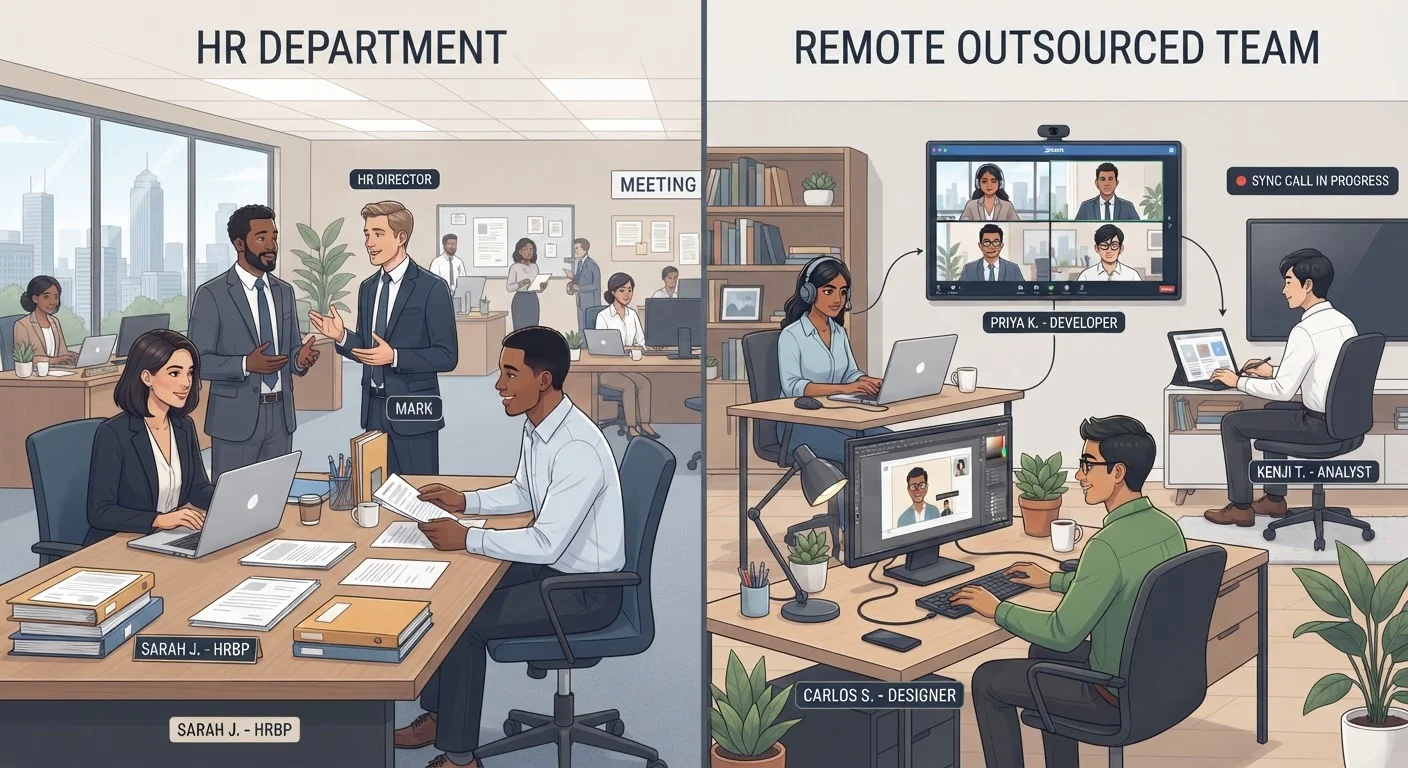
In-house HR means your organization employs dedicated HR professionals directly. They sit within your business, report through your management hierarchy, and are responsible for everything from hiring and onboarding to performance management, benefits administration, and compliance. The function is fully integrated - which means HR decisions are made with direct knowledge of your culture, people, and operations.
HR outsourcing transfers some or all of those responsibilities to an external provider. Outsourced arrangements range from narrow task-based contracts - such as payroll processing or background screening - to comprehensive models where a third party manages the bulk of HR operations. A Professional Employer Organization (PEO) is one specific outsourcing structure; understanding how PEOs work is useful context if you're evaluating full-service outsourcing. Across all outsourcing arrangements, the provider delivers HR services using their own systems, processes, and staff.
The structural difference matters because it determines where accountability lives, how quickly HR decisions are made, and what your fixed versus variable HR costs look like.
| Criterion | In-House HR | HR Outsourcing |
|---|---|---|
| Cost structure | Fixed - salaries, benefits, software | Variable - per-employee or contract fees |
| Control over HR decisions | High - internal, direct oversight | Moderate - governed by provider frameworks |
| Compliance expertise | Depends on team's knowledge and training | Typically strong - dedicated compliance staff |
| Scalability | Requires proportional headcount growth | Scales with workforce without added hires |
| Cultural alignment | Strong - embedded in day-to-day operations | Limited - external staff, standardized processes |
| Response time to employee issues | Immediate - team is on-site or internal | Variable - dependent on provider SLA |
| Best suited for | Mid-to-large or culture-driven organizations | Small businesses or rapid-growth companies |
Cost, Control, and Compliance: The Three Core Trade-Offs
Cost: In-house HR carries predictable but relatively fixed costs - salaries, benefits, HR software subscriptions, and training. For smaller organizations, those fixed costs can be disproportionate relative to the HR workload. Outsourcing converts much of that cost to a variable or per-employee fee, which can improve efficiency at certain headcount thresholds. However, outsourcing fees accumulate, and multi-service contracts can grow expensive as your workforce scales. Mis-hires carry significant hidden costs regardless of which HR model you use, underscoring that neither approach eliminates people-related financial risk.
Control: Internal HR teams give leadership direct, real-time oversight. Policies are enforced through people who understand your organization's norms. Outsourced providers operate according to their own standardized frameworks, which may not always align with how your business prefers to handle nuanced employee situations. This is an important factor for businesses where employer brand, culture, and employee experience are strategic assets.
Compliance: Labor law compliance is a shared concern in both models. Outsourced providers typically maintain dedicated compliance teams with current knowledge of federal and state employment regulations - an advantage for businesses without in-house legal expertise. However, outsourcing HR functions does not transfer all legal liability to the provider; employers generally retain responsibility for many compliance obligations. For context, the trade-off mirrors the decision between in-house counsel and outside law firms, where access to expertise must be weighed against accountability and responsiveness.
~$4,700
Average cost per new hire in the US
According to SHRM research, the average cost-per-hire in the United States has been estimated at approximately $4,700, factoring in recruiter time, advertising, and onboarding resources.
~40%
Small businesses outsourcing at least one HR function
Industry surveys have consistently found that a substantial share of small and mid-sized businesses outsource at least one HR function, most commonly payroll processing.
Up to 1-3x
Annual salary cost of replacing an employee
Workforce analysts have estimated replacement costs for a departed employee can reach one to three times that employee's annual salary, depending on seniority and role complexity.
When the Hybrid Approach Makes Sense
Many organizations don't choose exclusively between in-house and outsourced HR - they build hybrid models that apply each approach where it creates the most value. Payroll processing and benefits administration are frequently outsourced even by companies with robust internal HR teams, because these functions are process-intensive, compliance-sensitive, and well-suited to third-party platforms. Recruitment support is another common hybrid: internal HR may manage culture-fit assessment and final hiring decisions while staffing agencies or recruiting firms handle sourcing and initial screening.
HR technology also shapes how the boundary between in-house and outsourced HR is drawn. Cloud-based HR platforms can give small internal teams the systems capabilities previously available only through large outsourced providers. Core HR systems for small businesses - including payroll software and applicant tracking - have made it more feasible for lean in-house teams to manage a wider scope of HR functions without full outsourcing.
The right configuration depends on your organization's size, workforce complexity, budget constraints, and how much strategic weight your leadership places on internal people management. Neither model is universally superior - both require deliberate design and ongoing evaluation as your business grows. Consulting a qualified HR or legal professional is advisable before making significant structural changes to how you manage your workforce.
This article is for general informational purposes only and does not constitute legal, HR, or business advice. Consult a qualified professional for guidance specific to your organization's circumstances.