

Key Takeaways
Our Verdict
Neither on-premise nor cloud infrastructure is universally superior. The right choice depends on a business's size, regulatory environment, workload variability, and long-term financial planning. Most organizations benefit from carefully assessing total cost of ownership alongside compliance requirements before committing to either model.
| Best for | Recommended |
|---|---|
| Organizations with stable, predictable workloads and strict data sovereignty requirements | On-Premise Infrastructure |
| Businesses prioritizing rapid scalability, remote access, and lower upfront capital investment | Cloud Infrastructure |
| Enterprises with mixed workload types and evolving compliance needs | Hybrid Model |
Understanding the Two Models
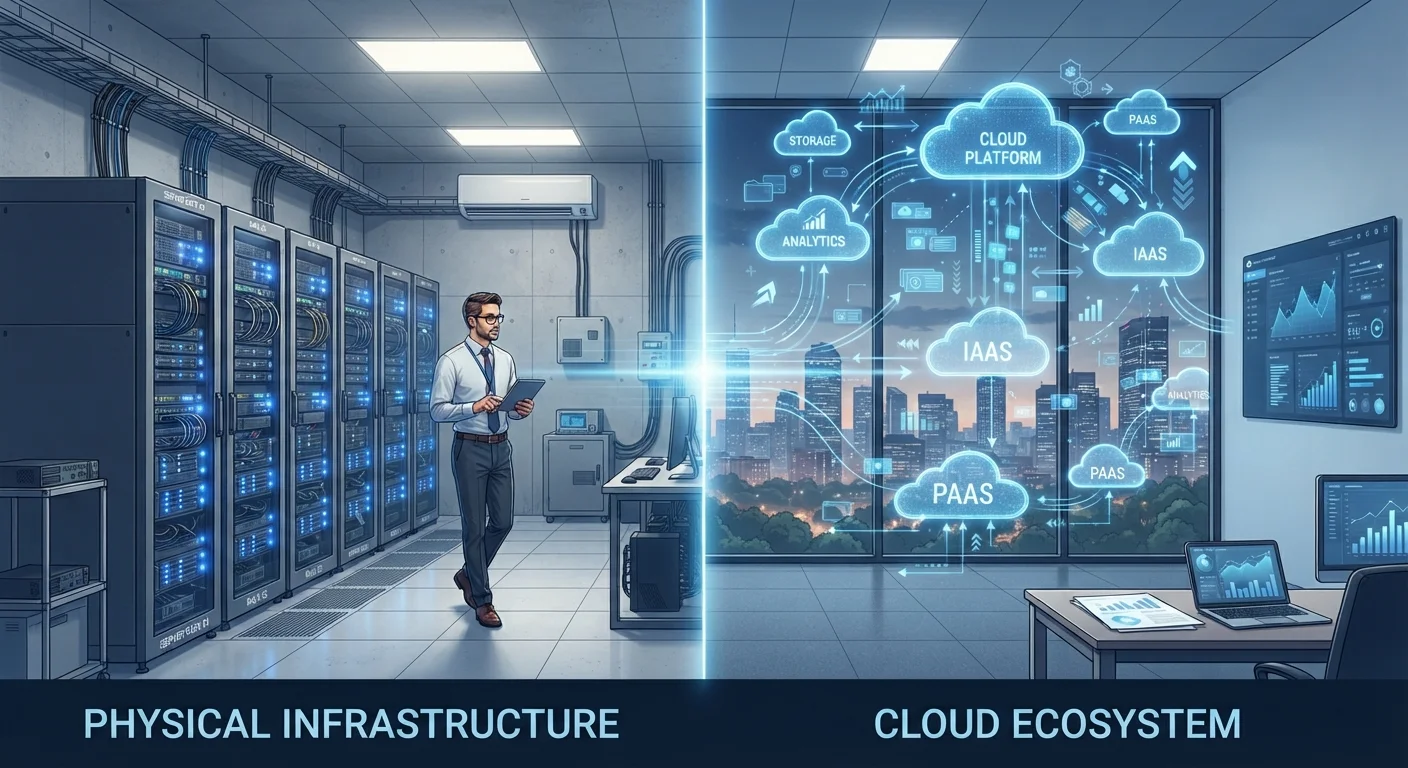
Before evaluating trade-offs, it helps to understand what each approach actually involves. IT infrastructure encompasses servers, networking, storage, and the software that keeps business operations running. The fundamental distinction is where and how that infrastructure lives.
On-premise infrastructure refers to hardware and software physically housed within a company's own facilities and managed by its internal team. The business purchases, maintains, and retires equipment on its own timeline.
Cloud infrastructure means computing resources - servers, storage, and networking - are hosted by a third-party provider and accessed over the internet. Businesses pay for capacity on a subscription or consumption basis. For a breakdown of specific cloud delivery models, see SaaS, PaaS, and IaaS defined.
Comparing the Key Dimensions
Decision-makers typically weigh four core factors when choosing between these models: cost structure, control, scalability, and security. Each organization will weight these differently based on its industry, size, and risk tolerance.
| Criterion | On-Premise | Cloud | |
|---|---|---|---|
| Upfront Cost | High capital expenditure required | Low to none; subscription-based | |
| Ongoing Cost | Fixed: power, staff, maintenance | Variable: scales with usage | |
| Scalability | Slow; requires procurement cycles | Rapid; provision on demand | |
| Data Control | Full physical and logical control | Shared responsibility with provider | |
| Security Configuration | Entirely managed internally | Provider handles platform layer | |
| Compliance Fit | Easier for strict data residency | Depends on provider certifications | |
| Disaster Recovery | Requires separate DR investment | Often built-in with redundancy options |
A hybrid approach - maintaining on-premise systems for sensitive or performance-critical workloads while using cloud services for variable or collaborative functions - has become a common middle path for mid-size and enterprise organizations.
Cost Structure: Capital vs. Operational Spending
On-premise infrastructure demands significant upfront capital expenditure (CapEx): purchasing servers, networking hardware, cooling systems, and physical security. Ongoing costs include power, maintenance contracts, and the staff required to manage it all. These expenses are largely fixed regardless of how intensively the equipment is used.
Cloud infrastructure converts much of this to operational expenditure (OpEx), billed monthly or by consumption. While this lowers the barrier to entry, costs can escalate if usage is poorly governed. Organizations with steady, high-utilization workloads sometimes find on-premise total cost of ownership lower over a multi-year horizon.
Model Total Cost of Ownership First
When comparing on-premise and cloud costs, go beyond the initial price tag. Factor in staffing, hardware refresh cycles, power and cooling, and potential over-provisioning. A multi-year TCO analysis often reveals a different winner than a first-year cost comparison suggests.
Infrastructure decisions intersect directly with long-term financial planning strategy. Businesses should model total cost of ownership over a three-to-five-year window rather than comparing only first-year figures.
Control, Security, and Compliance Considerations
On-premise environments give IT teams granular control over every configuration layer - from firewall rules to physical access. For industries subject to strict data residency or privacy regulations (such as healthcare or financial services), keeping data on owned hardware may simplify compliance documentation and audit trails.
Cloud providers operate under shared-responsibility models: the provider secures the underlying infrastructure, while the customer remains responsible for data classification, access controls, and application-level security. This division requires careful policy design but also means the provider continuously patches and hardens the platform.
Shared Responsibility Requires Active Management
Migrating to the cloud does not transfer full security responsibility to the provider. Misconfigured access controls, unencrypted data, and inadequate identity management remain among the most common causes of cloud data incidents. Businesses must define and enforce their own security policies at the application and data layer regardless of which cloud platform they use.
For businesses evaluating how staffing models affect infrastructure management, managed IT services vs. in-house IT explores how the decision about who manages your systems is as consequential as the infrastructure model itself.
Scalability and Operational Flexibility
Cloud infrastructure scales on demand - additional compute and storage can typically be provisioned within minutes. This elasticity is valuable for businesses with seasonal traffic spikes, rapid growth phases, or geographically distributed teams.
On-premise scaling requires procurement lead times, physical installation, and capital approval cycles - often measured in weeks or months. However, on-premise environments may offer more consistent, low-latency performance for workloads that require it, such as real-time manufacturing systems or high-frequency transaction processing.
~94%
Enterprises using cloud services in some capacity
Flexera's State of the Cloud Report has consistently shown that the vast majority of enterprises operate at least some workloads in the cloud.
3-5 years
Typical TCO comparison horizon
Industry analysts generally recommend modeling total cost of ownership over three to five years to accurately compare on-premise and cloud investments.
Before entering any infrastructure service agreement, reviewing key criteria for evaluating IT service providers - including SLA terms and technical competency - is an important step regardless of which model a business selects.
This article provides general educational information about IT infrastructure models and is not intended as technology, legal, or financial advice tailored to your specific situation. Consult qualified IT and financial professionals before making infrastructure decisions for your organization.