

Key Takeaways
Option A
Federal Business Grants
The large-scale, nationally standardized funding tier.
Best for: Businesses operating across multiple states or in specialized sectors like R&D, defense, agriculture, or advanced manufacturing.
Option B
State Business Grants
The locally tailored, regionally responsive funding option.
Best for: Businesses rooted in a specific state, particularly those in industries the state government is actively trying to grow or retain.
If your business is in research, technology, or defense sectors
Federal Business Grants
Federal agencies such as NSF, NIH, and DoD administer programs like SBIR and STTR specifically designed for innovation-driven businesses requiring substantial capital.
If your business serves a specific local market or community
State Business Grants
State economic development offices prioritize job creation and regional growth, making locally anchored businesses strong candidates for targeted state awards.
If you need funding quickly with fewer bureaucratic layers
State Business Grants
State programs generally operate on shorter review cycles and have fewer administrative requirements than federally administered competitions.
If your business operates across multiple states or exports nationally
Federal Business Grants
Federal programs are designed for national-scope activities and don't restrict funding to a single state's geography.
If you want to maximize total funding by pursuing both sources
Federal Business Grants
Start with a federal grant to establish credibility, then leverage that award in state applications - many state programs look favorably on federally vetted recipients.
How Each System Is Structured
Federal and state business grant programs both offer non-repayable funding, but they operate through entirely different administrative architectures. Understanding these structures is the starting point for any effective grant strategy. If you're new to how grants work at a foundational level, see our overview of business grants before diving into the comparison.
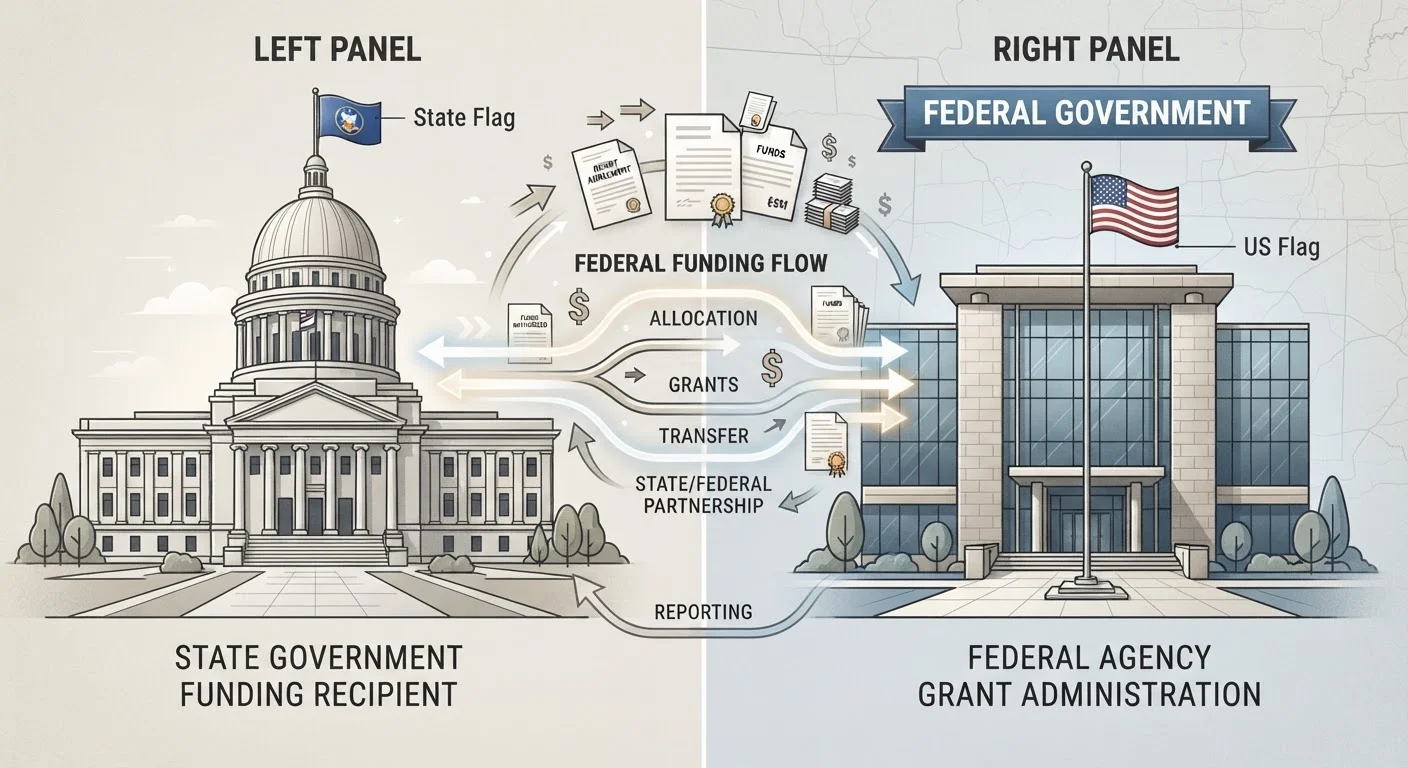
Federal grants flow from specific Congressional appropriations through federal agencies - the Small Business Administration (SBA), the U.S. Department of Agriculture (USDA), the National Science Foundation (NSF), and others. Each agency issues grants under its own statutory authority, applies uniform eligibility rules nationally, and publishes opportunities through Grants.gov. The federal system is standardized by design: the same program rules apply whether you're in Maine or Arizona. For a structured overview of major federal programs, see our federal grant field guide.
State grants are administered by state economic development agencies, workforce boards, or specialized offices. Funding may originate from state general funds, state-issued bonds, or federal block grants and formula funds passed through to states. Because each state controls its own economic development agenda, program design varies significantly across state lines - what exists in Texas may not exist in Vermont, and eligibility thresholds can differ substantially.
| Criterion | Federal Business Grants | State Business Grants |
|---|---|---|
| Administered by | Federal agencies (SBA, USDA, NSF, etc.) | State economic development offices |
| Typical award size | $50K-$2M+ depending on program | $5K-$100K, varies by state |
| Application complexity | High - multi-stage, technical proposals | Low to moderate - varies by program |
| Decision timeline | Several months to over a year | Weeks to a few months |
| Geographic scope | National - applies in all states | State-specific - residency often required |
| Compliance burden | High - federal audit standards apply | Moderate - varies by program |
| Common funding focus | R&D, agriculture, defense, export | Job creation, local industry development |
| Where to search | Grants.gov, agency program pages | State economic development agency sites |
Eligibility and Application Complexity
Federal grant eligibility criteria tend to be more precisely defined and more demanding to document. Programs like the Small Business Innovation Research (SBIR) program require businesses to meet specific size standards, demonstrate technical merit, and satisfy detailed reporting requirements. The application process typically involves multiple stages - concept papers, full proposals, and post-award compliance reporting.
State programs vary widely, but many are designed with accessibility in mind. Some states offer micro-grant programs with simplified applications, lower documentation thresholds, and faster review timelines - sometimes measured in weeks rather than months. However, state programs can also be narrowly targeted, restricting eligibility by industry, county, employee count, or revenue stage in ways that may exclude businesses that federal programs would accept.
26+
Federal agencies issuing business grants
Grants.gov lists opportunities from more than 26 federal grant-making agencies, each with distinct program mandates and eligibility rules.
$50B+
Annual federal grant obligations to businesses and nonprofits
Federal grant spending across all categories - including business, research, and community development - consistently exceeds $50 billion annually according to USASpending.gov data.
50
Separate state grant ecosystems to navigate
Each US state operates its own economic development programs, meaning eligibility criteria, award sizes, and application processes vary across all 50 states.
For businesses belonging to specific demographic categories, both federal and state layers offer dedicated pathways. Federal programs for women-owned businesses and minority-owned businesses have state-level equivalents with different eligibility structures. Geographic focus also matters - if your business is outside a metro area, rural grant programs span both federal and state tiers with distinct criteria at each level.
Award Sizes, Timelines, and Compliance Obligations
Federal grants typically carry larger award amounts. SBIR Phase I awards, for example, have ranged up to $275,000, with Phase II awards reaching into the millions for qualifying projects. Federal programs are designed to fund significant, often multi-year initiatives, which is reflected in their reporting requirements - recipients must track expenditures, submit progress reports, and comply with federal audit standards if cumulative awards exceed applicable thresholds.
State grants tend to be smaller in dollar value but faster to access. Many state economic development grants fall in the $5,000-$100,000 range, though competitive state programs can exceed that in specific sectors. The compliance burden is generally lower, though businesses should not assume state grants are obligation-free. Matching fund requirements, job creation targets, and geographic operating restrictions are common conditions attached to state awards.
Regardless of which tier you pursue, accepting any grant without fully reviewing its terms creates financial and legal risk. For a broader comparison of how grant structures relate to loan-based funding, see our article on grants vs. business loans.
Stacking Federal and State Grants
Businesses are not restricted to one grant source at a time. It is possible - and often advantageous - to hold both a federal and a state grant simultaneously, provided the funds are used for distinct, allowable purposes and both grantors are informed. However, using the same expenditure to satisfy cost-sharing requirements across multiple grants (known as 'double-dipping') is prohibited. Always disclose all active grants to each awarding agency and review terms carefully before combining funding sources.
This article provides general educational information about grant program structures and is not personalized financial, legal, or tax advice. Grant programs, eligibility rules, and award terms change over time. Consult a qualified advisor and review official program documentation before making funding decisions.