

Key Takeaways
Option A
Full-Service Hotels
The comprehensive, amenity-rich operation.
Best for: Operators targeting business travelers, group bookings, and guests who expect on-site dining, concierge services, and extensive amenities.
Option B
Limited-Service Hotels
The streamlined, efficiency-driven property.
Best for: Operators focused on lean cost structures, value-conscious leisure travelers, and markets where occupancy and RevPAR consistency matter most.
If you are entering a market with strong corporate travel demand
Full-Service Hotels
Business travelers expect meeting facilities, on-site dining, and dedicated concierge support - amenities that full-service properties are structured to deliver profitably.
If you are prioritizing lean operations and predictable margins
Limited-Service Hotels
Consolidated staffing roles and the absence of F&B complexity allow operators to maintain tighter control over labor and operating costs.
If your property will depend heavily on event and group revenue
Full-Service Hotels
Banquet facilities, catering operations, and dedicated events staff are core to full-service hotels and essential for capturing group and conference bookings.
If you are scaling a portfolio across multiple markets quickly
Limited-Service Hotels
Lower staffing complexity and standardized operations make limited-service properties easier to replicate and manage across a growing portfolio.
Defining the Two Models
The distinction between full-service and limited-service hotels is not simply about star ratings or room count - it is fundamentally about the breadth of services delivered and the operational infrastructure required to support them. Understanding this difference is foundational for anyone involved in hotel ownership, financing, or management. For a broader operational context, see this complete hotel management overview.
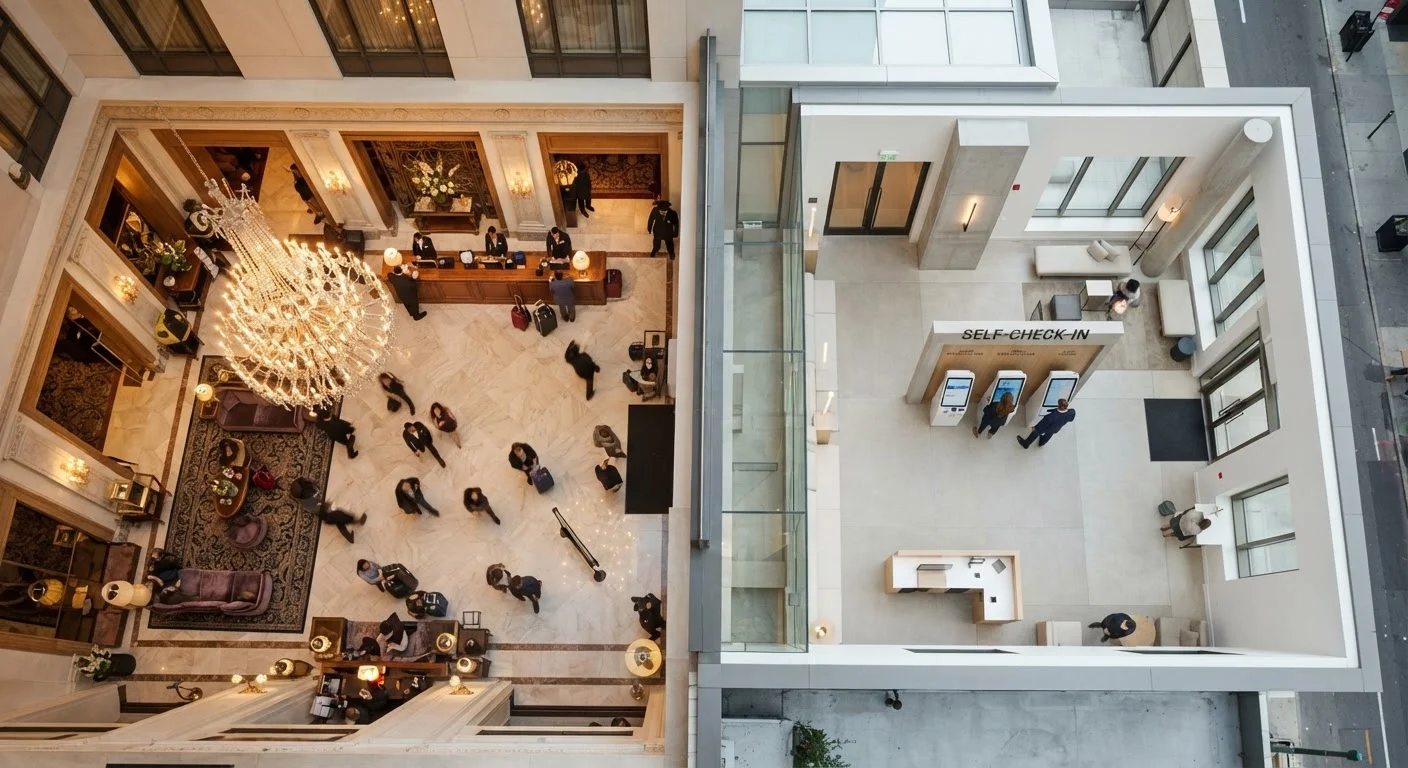
Full-service hotels typically offer on-site food and beverage outlets, room service, concierge, bell services, valet parking, fitness and spa facilities, and dedicated meeting or banquet space. Guests pay a premium for integrated convenience, and the property is staffed and equipped accordingly.
Limited-service hotels provide a defined core - a comfortable room, possibly a complimentary breakfast, and efficient check-in - without the supporting departments that full-service operations require. This model is dominant in the select-service and economy segments, where consistent occupancy and operational simplicity drive financial performance.
| Criterion | Full-Service Hotels | Limited-Service Hotels |
|---|---|---|
| Staffing depth | Multiple specialized departments | Consolidated, cross-trained roles |
| Food & beverage | Restaurant, bar, room service, banquets | Complimentary breakfast or none |
| Labor cost as % of revenue | Typically higher (35-50%) | Typically lower (25-35%) |
| Capital investment per key | Significantly higher | Substantially lower |
| Revenue streams | Rooms, F&B, events, spa, parking | Primarily rooms revenue |
| Target guest segment | Business travelers, groups, leisure | Value-focused leisure and transient |
| Management complexity | High - multi-department coordination | Lower - streamlined operations |
Staffing Structure and Labor Costs
Labor is where the operational gap between these two models becomes most visible and most financially significant. Full-service hotels maintain distinct departments - front office, housekeeping, food and beverage, engineering, security, sales and catering, and often a dedicated human resources function. Each department carries its own management layer, creating a supervisory structure that adds depth but also payroll complexity.
Limited-service properties consolidate many of these functions. A front desk agent may handle guest inquiries, light concierge tasks, and breakfast supervision within a single shift. Housekeeping supervisors often carry dual responsibilities. This role compression is by design - it keeps the labor-to-revenue ratio lean.
For operators considering how to structure workforce planning, shift structures and scheduling principles for hotels outlines practical approaches applicable to both models. Additionally, choosing between staffing agencies and recruiting firms can inform how operators fill specialized or seasonal roles.
35-50%
Labor cost share at full-service hotels
Industry benchmarks from hotel management consultancies consistently place full-service labor costs in this range as a percentage of total revenue.
25-35%
Labor cost share at limited-service hotels
Consolidated staffing models and reduced amenity overhead allow limited-service properties to maintain a leaner labor cost structure.
25-40%
F&B share of total revenue at full-service hotels
Food and beverage operations can represent a substantial revenue portion at full-service properties, though margins vary significantly by outlet type.
Food and Beverage: The Defining Operational Variable
No single department creates more operational complexity in a full-service hotel than food and beverage. A full-service property may run a restaurant open to the public, a lobby bar, room service, and a banquet operation simultaneously - each with its own inventory, staffing schedule, health code compliance obligations, and margin profile. F&B revenue can represent 25-40% of total hotel revenue at full-service properties, but margins are typically thinner than rooms revenue and require active management to protect profitability.
Limited-service hotels sidestep this complexity almost entirely. Where food is offered - commonly a complimentary breakfast - it is structured as a fixed cost with minimal labor rather than a revenue-generating outlet. This distinction has direct implications for capital planning, vendor relationships, and day-to-day management bandwidth.
Food and beverage operations inside a hotel details the margin pressures and interdependencies F&B creates within full-service properties.
Cost Structures, Financing, and Investment Considerations
Full-service hotels carry substantially higher capital costs at development and higher fixed operating costs through their lifecycle. Per-key construction costs for full-service properties can be two to three times higher than limited-service builds, driven by F&B infrastructure, meeting space, and the mechanical systems required to support them. This has direct implications for how these properties are financed.
Owners and developers evaluating hotel financing should understand how the service model affects debt serviceability and equity requirements. Debt versus equity financing for hospitality ventures explores how capital structure decisions interact with operational risk profiles. Separately, short-term versus long-term lending structures covers how operators match financing terms to their cash flow characteristics.
Limited-service properties, with their lower overhead and more predictable revenue composition, often present a more accessible entry point for first-time hotel owners or investors scaling a portfolio. However, their revenue ceiling is also lower, and competitive market dynamics - particularly in highway corridor or airport submarkets - can compress RevPAR quickly.
Select-Service: A Middle Ground
Between full-service and limited-service sits the select-service segment, which has grown significantly over the past two decades. Select-service hotels typically offer a limited food outlet - often a grab-and-go or small restaurant - along with a fitness center and modest meeting space, without the full F&B and banquet infrastructure of a true full-service property. For operators, this model attempts to capture incremental revenue without the full complexity of F&B management, though it introduces its own planning trade-offs.
This article is for informational purposes only and does not constitute financial, investment, or legal advice. Consult a qualified professional before making decisions specific to your property or portfolio.