

Key Takeaways
Option A
Strategic Sourcing
The long-horizon, relationship-driven approach to procurement.
Best for: Organizations aiming to reduce total cost of ownership, manage supplier risk, and align procurement with broader business objectives.
Option B
Tactical Purchasing
The execution-focused process of fulfilling immediate procurement needs.
Best for: Operations teams that need to place orders quickly, restock inventory, or respond to short-term production demands.
If your business is renegotiating supplier contracts or diversifying your supply base
Strategic Sourcing
Strategic sourcing provides the framework for evaluating total cost of ownership, supplier capabilities, and long-term risk - exactly what contract decisions require.
If your team needs to replenish stock or fulfill a purchase order this week
Tactical Purchasing
Tactical purchasing is designed for speed and execution, enabling teams to place orders, track deliveries, and manage invoices within existing supplier agreements.
If you're building or restructuring a procurement department from scratch
Strategic Sourcing
Establishing a sourcing strategy first creates the supplier relationships and category plans that make day-to-day purchasing more efficient and cost-effective over time.
If you operate in a high-volume, low-variation procurement environment
Tactical Purchasing
Where supplier relationships are already established and products are standardized, streamlining tactical processes typically delivers the greatest operational efficiency.
Defining the Two Approaches
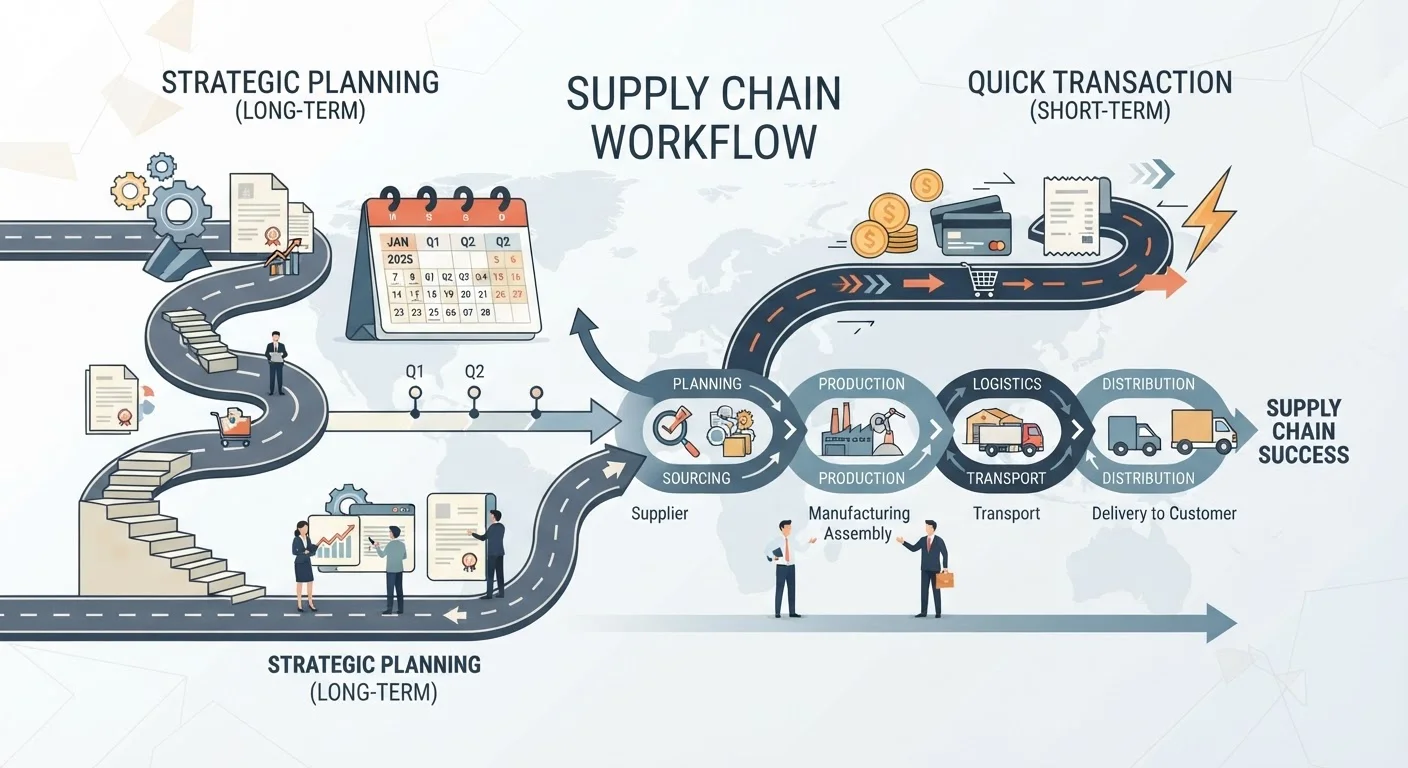
Procurement is not a single activity - it spans a spectrum from high-level strategy to daily transactional work. Strategic sourcing and tactical purchasing represent opposite ends of that spectrum, and confusing the two leads to misallocated resources, supplier risk, and missed cost opportunities.
Strategic sourcing is an analytical, cross-functional process focused on evaluating the supply market, understanding total cost of ownership, and building supplier relationships that support long-term organizational goals. It asks: Who should we be buying from, under what terms, and why?
Tactical purchasing, by contrast, is the operational execution of procurement decisions already made. It involves placing purchase orders, confirming deliveries, processing invoices, and resolving short-term supply gaps. It asks: How do we fulfill this requirement, now?
Both are legitimate and necessary - but they require different skills, different timeframes, and different organizational ownership. For a grounding in supply chain terminology, see the Supply Chain Glossary covering foundational procurement terms.
| Criterion | Strategic Sourcing | Tactical Purchasing |
|---|---|---|
| Primary focus | Total value and supplier strategy | Order fulfillment and execution |
| Timeframe | Months to years | Days to weeks |
| Typical output | Supplier contracts and category plans | Purchase orders and delivery confirmations |
| Decision level | Organizational and category-wide | Individual transaction |
| Key metric | Total cost of ownership, supplier performance | Order accuracy, lead time, invoice matching |
| Risk of error | High - structural, long-lasting impact | Moderate - usually recoverable quickly |
| Cross-functional involvement | Finance, operations, legal, leadership | Purchasing team and direct suppliers |
Where Each Function Lives in the Supply Chain
Strategic sourcing typically operates at the category or commodity level. A sourcing manager might analyze global freight markets, benchmark supplier pricing across regions, or conduct a formal request-for-proposal (RFP) process over several months. The output is usually a supplier agreement - a framework contract that defines terms, pricing bands, quality standards, and performance expectations.
Tactical purchasing operates within those agreements. A purchasing agent issues a purchase order (PO) against an existing contract, tracks shipment status, and resolves discrepancies when invoice amounts don't match delivery records. The timeframe is hours to weeks, not months.
60-80%
Spend committed through strategic sourcing contracts
Industry estimates suggest that most large organizations route the majority of their spend through pre-negotiated agreements, leaving tactical purchasing to execute within established terms.
3-12 months
Typical strategic sourcing cycle duration
A full sourcing event - from spend analysis through supplier selection and contract execution - generally requires several months, depending on category complexity and market conditions.
This layered structure matters because tactical efficiency depends on strategic decisions being made well upstream. If sourcing has negotiated poor contract terms or selected unreliable suppliers, no amount of tactical execution will compensate. This interdependence is explored in depth in the Supply Chain Management foundation guide.
Key Differences in Scope, Timeframe, and Impact
The most practical way to distinguish these functions is across three dimensions:
- Scope: Strategic sourcing examines an entire spend category - packaging materials, logistics services, raw inputs - and asks whether the current supply strategy is optimal. Tactical purchasing handles individual transactions within that category.
- Timeframe: Strategic sourcing decisions unfold over quarters or years; supplier relationships, once established, shape procurement for extended periods. Tactical purchasing cycles in days or weeks.
- Impact: Mistakes in strategic sourcing - choosing the wrong supplier, accepting unfavorable contract terms - compound over time and can take years to unwind. Tactical errors are usually recoverable: a delayed shipment is a problem; a misaligned supplier relationship is a structural vulnerability.
Before committing to any supplier relationship through the sourcing process, procurement teams should conduct thorough due diligence - the Supplier Evaluation Criteria guide outlines the financial, operational, and ethical factors worth examining.
When the Lines Blur: Spot Buying
In practice, some procurement activity falls outside established contracts - this is called spot buying or maverick spending. It occurs when a required item isn't covered by an existing agreement and a purchase must be made outside the sourcing framework. While occasionally unavoidable, frequent spot buying signals gaps in the strategic sourcing program and typically results in higher costs and greater supplier inconsistency.
Integrating Both Functions Effectively
High-performing procurement organizations treat strategic sourcing and tactical purchasing as complementary disciplines rather than substitutes. The strategic function sets the boundaries - approved suppliers, negotiated price tiers, quality thresholds - and the tactical function operates efficiently within them.
Common failure modes arise when organizations collapse these roles. Teams under short-term pressure often default to purely tactical behavior: buying from whoever can deliver fastest, at whatever price is available. This reactive approach erodes the supplier relationships and cost structures that sourcing is designed to build. The tension mirrors broader business planning challenges - the guide on balancing short-term and long-term financial goals addresses similar trade-offs in financial planning contexts.
To protect both functions, operations teams should also maintain a clear picture of supply chain risk. The Supply Chain Risk Assessment Checklist offers a structured framework for identifying vulnerabilities before they escalate.
This article is for informational and educational purposes only. It does not constitute procurement, legal, or financial advice. Business professionals should consult qualified advisers when making significant sourcing or supplier decisions specific to their organization.