

Key Takeaways
The Bullwhip Effect
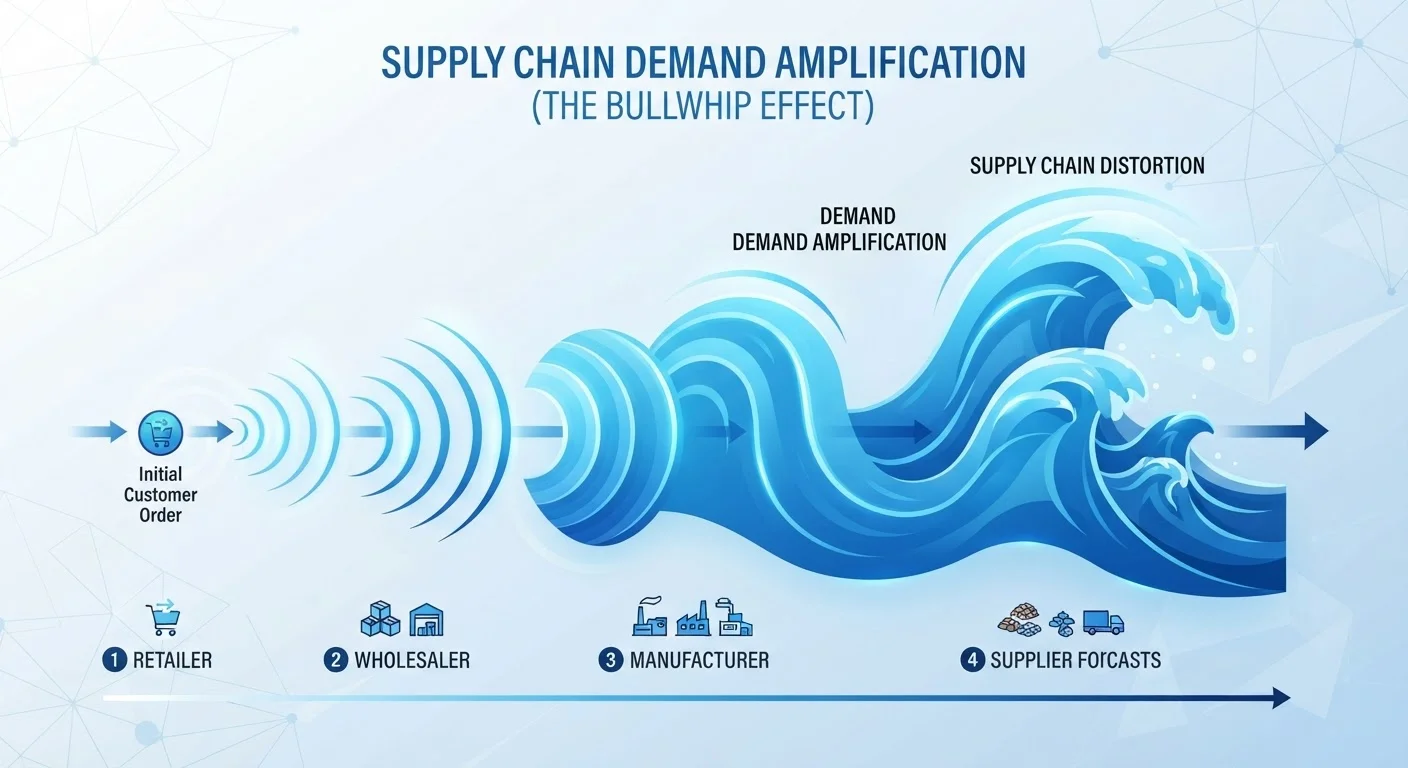
The bullwhip effect describes how minor fluctuations in consumer demand get progressively amplified as orders move upstream through a supply chain - from retailer to wholesaler to distributor to manufacturer. Each tier tends to over-order relative to actual end demand, creating inventory distortions that grow larger at every step. The result is costly cycles of overstock and shortage that bear little resemblance to what customers actually bought.
First formally described by Jay Forrester in the 1950s and later named by Hau Lee and colleagues at Stanford, the bullwhip effect is quantified as the ratio of upstream order variance to downstream demand variance - a ratio that consistently exceeds 1 in most supply chain configurations.
Why a Small Ripple Becomes a Wave
Imagine a retailer notices a modest 10% uptick in sales for a product. Uncertain whether the trend will hold, the store orders 20% more stock than usual to avoid a stockout. The wholesaler, seeing that larger order, assumes demand has jumped significantly and places an even larger order with the distributor. By the time the signal reaches the manufacturer, the order volume may be double or triple the original consumer demand increase - which was just 10%.
This is the bullwhip effect in action: a chain of individually rational decisions producing a collectively irrational outcome. Each player acts on local information and their own uncertainty, layering buffer on top of buffer until the upstream signal bears almost no resemblance to what customers actually purchased.
The consequences run in both directions. During the upswing, manufacturers ramp production aggressively. When real demand stabilizes or dips, the entire chain is suddenly sitting on excess inventory - triggering order freezes, markdowns, and idle production capacity. Then the cycle repeats.
2-5×
Typical order variance amplification across supply tiers
Academic research consistently finds that order variability at the manufacturer level is two to five times greater than actual consumer demand variability at the retail level.
30%+
Potential inventory cost reduction from demand sharing
Supply chain studies have estimated that sharing downstream demand data with upstream partners can reduce excess inventory costs by over 30% in some configurations.
4
Core drivers identified in foundational bullwhip research
Hau Lee, V. Padmanabhan, and Seungjin Whang identified four primary causes of the bullwhip effect in their widely cited 1997 research published in Management Science.
The Four Core Drivers
Researchers have identified four primary mechanisms that generate and sustain the bullwhip effect:
- Demand signal distortion: Each tier forecasts from orders it receives, not from actual consumer sales. Forecast errors compound at every link in the chain.
- Order batching: Firms often place large, periodic orders rather than ordering continuously, creating artificial spikes in apparent demand. Weekly or monthly ordering cycles are common culprits.
- Price fluctuations: Promotions and volume discounts encourage buyers to forward-buy - purchasing more than needed now to take advantage of lower prices. This inflates orders during promotional windows and collapses them afterward.
- Shortage gaming: When supply is constrained, buyers inflate order quantities expecting rationing. Suppliers then overestimate true demand, and when the shortage resolves, cancellations flood in simultaneously.
Understanding which driver is most active in a specific supply chain is the starting point for targeted mitigation. For context on related inventory distortions, see why safety stock calculations go wrong.
Focus on the Signal, Not Just the Order
The most effective step an operations manager can take is to push demand visibility as far upstream as possible. If your suppliers are forecasting from your orders rather than from your actual sales data, you are already generating bullwhip conditions - even before demand fluctuates. Sharing even basic sell-through data with key suppliers is a low-cost starting point.
Inventory Decision-Making Under Amplified Uncertainty
The bullwhip effect directly degrades the quality of inventory decisions at every tier. When order data is distorted, safety stock calculations become unreliable - firms either hold too much inventory or expose themselves to stockouts. For a structured look at the methods businesses use to manage stock levels, explore common inventory management approaches and their trade-offs.
Lean strategies like just-in-time inventory can inadvertently increase bullwhip exposure. By carrying minimal buffer stock, a firm has little absorption capacity when distorted upstream signals arrive. This is one reason JIT works best when paired with high-frequency, high-visibility demand data - not in isolation. For a nuanced look at these trade-offs, see common myths about just-in-time inventory.
Inventory positioning decisions - whether to centralize or distribute stock - also interact with bullwhip dynamics. Centralized inventory tends to aggregate and smooth demand signals more effectively than fragmented, decentralized stock. Centralised vs. decentralised inventory trade-offs are worth reviewing in this context.
Practical Approaches to Reducing Amplification
No supply chain eliminates the bullwhip effect entirely, but several structural and operational practices consistently reduce its magnitude:
- Demand data sharing: Sharing point-of-sale data directly with upstream partners - sometimes called CPFR - replaces distorted order signals with actual consumer demand figures.
- Order cycle compression: Moving from monthly to weekly ordering (or continuous replenishment) reduces the batching effect and smooths demand signals.
- Vendor-managed inventory (VMI): Giving suppliers direct visibility into a buyer's inventory levels allows them to replenish based on consumption rather than orders, bypassing a key distortion layer.
- Stabilized pricing: Reducing reliance on promotions and volume discounts removes a major forward-buying incentive and normalizes order patterns.
- Allocation policies during shortages: Capping allocations based on historical sales rather than current orders reduces the incentive for shortage gaming.
Building supply chain resilience more broadly - including response plans for demand shocks - complements these tactical measures. Supply chain resilience practices offers a wider frame for thinking about disruption vulnerability.
This article provides general educational information about supply chain concepts and is not a substitute for professional advice tailored to your specific operations, financial situation, or business context. Consult qualified supply chain, financial, or operations professionals before making significant decisions.