

Key Takeaways
Paid Search Advertising
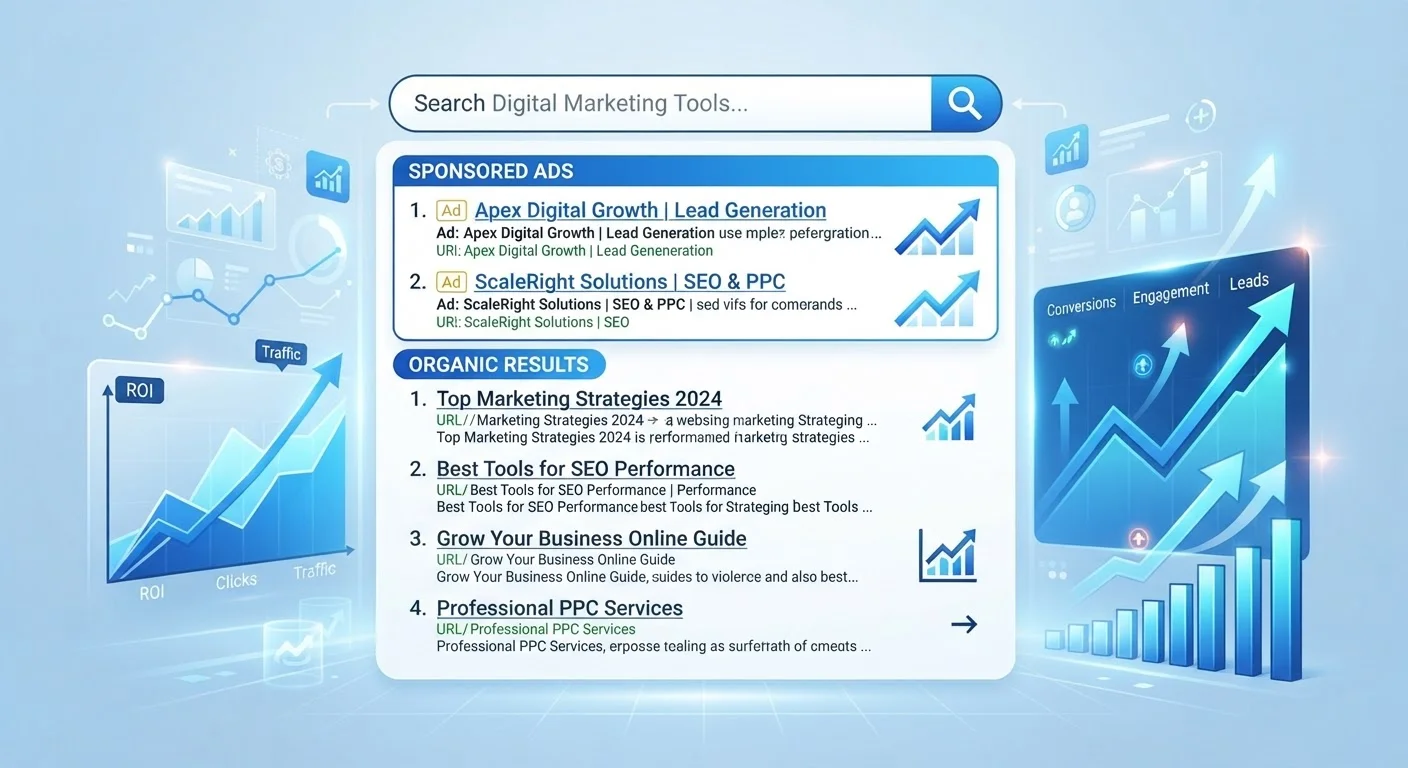
Paid search advertising is a form of digital advertising where businesses pay to have their ads displayed on search engine results pages (SERPs) when users enter specific keywords. Advertisers bid on keywords relevant to their products or services, and the search engine displays their ads alongside organic results. You pay only when a user clicks your ad - a model known as pay-per-click (PPC).
Ad placement is determined by an auction that weighs both the bid amount and Quality Score - a metric reflecting ad relevance, expected click-through rate, and landing page experience. Higher Quality Scores can lower the cost per click while improving placement.
How the Paid Search Auction Works
Every time a user enters a query, the search engine runs a real-time auction among advertisers who have bid on relevant keywords. The winner is not simply the highest bidder. Placement is determined by Ad Rank - a score combining your bid and your Quality Score, which the engine calculates based on ad relevance, historical click-through rate, and the quality of the landing page users reach after clicking.
This structure has two important implications. First, a well-optimized campaign can outrank a higher-spending competitor if its ads are more relevant to the query. Second, poor relevance is penalized with higher costs and lower placement regardless of budget. Advertisers pay the minimum amount needed to maintain their position - not necessarily their full bid - so efficient campaigns often pay less than the ceiling they've set.
Understanding this auction dynamic is foundational to budget planning. See the Ad Channel Glossary for definitions of CPC, ROAS, and other key metrics that help you evaluate campaign performance.
~65%
Share of high-intent clicks going to paid ads
Industry research consistently finds that paid search ads capture a substantial majority of clicks on high-commercial-intent queries, where users are close to a purchase decision.
$2:$1
Average revenue return per dollar spent on search ads
Google's own economic impact research has cited an average $2 return for every $1 spent, though outcomes vary significantly by industry, campaign quality, and market conditions.
What Drives Costs - and What Controls Them
Keyword competition is the primary driver of cost per click. Industries where each converted customer is extremely valuable - insurance, financial services, legal representation, enterprise software - see the highest CPCs because many advertisers are willing to pay a premium for the same high-intent queries. Geographic targeting, match type selection, and time-of-day bidding adjustments all give advertisers levers to manage spend without simply raising or cutting the overall budget.
Keyword match types control how closely a search query must align with your keyword before your ad is eligible to appear. Broad match captures more volume with less precision; exact match prioritizes control over reach. Most campaigns use a combination, with tighter match types applied to keywords with proven conversion records and broader types used to discover new intent signals.
Negative keywords - terms you explicitly exclude - are equally important. Without them, ad spend leaks to irrelevant queries. A business selling commercial refrigeration equipment, for example, would typically exclude residential or DIY-related searches to avoid wasted spend.
Start With Tightly Scoped Keyword Lists
New campaigns benefit from launching with a focused set of high-intent, specific keywords rather than broad terms that generate volume but limited conversions. As conversion data accumulates, you can expand strategically. This approach keeps early spend efficient and builds a clear performance baseline before scaling.
When Paid Search Pays Off - and When It Doesn't
Paid search performs best under specific conditions. The channel is built to capture existing demand - it reaches users who are already searching for a solution. If your market doesn't yet know it needs what you offer, paid search works against you: there's nothing to capture. In those cases, awareness-building channels may be a better first step. The Advertising Channel Landscape guide provides a broader framework for matching channel to objective.
The economics must also stack up. If your average cost per click is $8 and your conversion rate is 2%, you're paying $400 per acquisition. Whether that's sustainable depends entirely on customer lifetime value and margin - not on the click cost in isolation. Businesses with long customer relationships or high-ticket services tend to find paid search more forgiving on these economics than those with thin margins and one-time purchases.
Paid search also requires active management. Campaigns need ongoing keyword refinement, bid adjustments, and ad copy testing to maintain efficiency. For businesses without the internal capacity or expertise to manage this, unmanaged campaigns frequently underperform. For a comparison with how another major digital channel approaches acquisition, see Paid Social vs. Paid Search.
Integrating Paid Search Into a Broader Strategy
Paid search rarely operates optimally in isolation. It captures users who are close to a decision but may not reach those earlier in the buying process. Pairing it with upper-funnel channels - display, video, or social - builds the awareness that eventually drives those high-intent search queries. Building a multi-channel strategy without diluting budget requires clear prioritization based on where your audience is in the decision journey.
Conversion tracking is non-negotiable. Without accurately attributing sales, leads, or sign-ups back to specific keywords and ads, it is impossible to distinguish what's working from what's wasting money. Businesses should ensure their measurement infrastructure - whether through platform-native tools or a third-party analytics stack - is in place before scaling spend.
Paid search also generates first-party data through search term reports, which reveal exactly what language your customers use to describe their needs. This insight has value beyond the channel itself, informing content strategy, product messaging, and even how sales teams frame conversations.
This article is for general informational purposes only and does not constitute financial, legal, or marketing advice tailored to your specific business circumstances. Consult a qualified marketing or financial professional before making significant advertising budget decisions.