

Key Takeaways
Option A
Branded House
The unified, master-brand-driven model.
Best for: Businesses that want to concentrate marketing investment, build a single powerful reputation, and scale efficiently across product lines under one identity.
Option B
House of Brands
The portfolio model with independently positioned brands.
Best for: Organizations with diverse offerings targeting distinct customer segments, where brand separation reduces risk and maximizes segment-level relevance.
If you serve a consistent customer base across all your products
Branded House
A unified master brand lets every new product launch benefit from existing trust, reducing the investment needed to build awareness from scratch.
If your products target meaningfully different customer segments or price tiers
House of Brands
Independent brand identities allow precise positioning for each audience without the constraints or baggage of a single parent identity.
If you are an early-stage or resource-constrained business
Branded House
Consolidating equity under one brand is more capital-efficient - you build one reputation rather than funding multiple brand-building programs simultaneously.
If you have acquired or plan to acquire brands with strong existing equity
House of Brands
Preserving an acquired brand's existing customer recognition is often more valuable than subsuming it into a parent identity, particularly if it competes in a different category.
If brand reputation risk is a significant concern across diverse categories
House of Brands
When one product operates in a high-risk or controversy-prone category, separating it from the parent brand shields other portfolio products from reputational spillover.
What Each Model Actually Means
Brand architecture - the way a company organizes its portfolio of brands, products, and divisions - shapes how customers perceive your business, how you allocate marketing budgets, and how you manage reputation. The two most discussed structures are the branded house and the house of brands. Understanding the difference is foundational before you can choose intelligently.
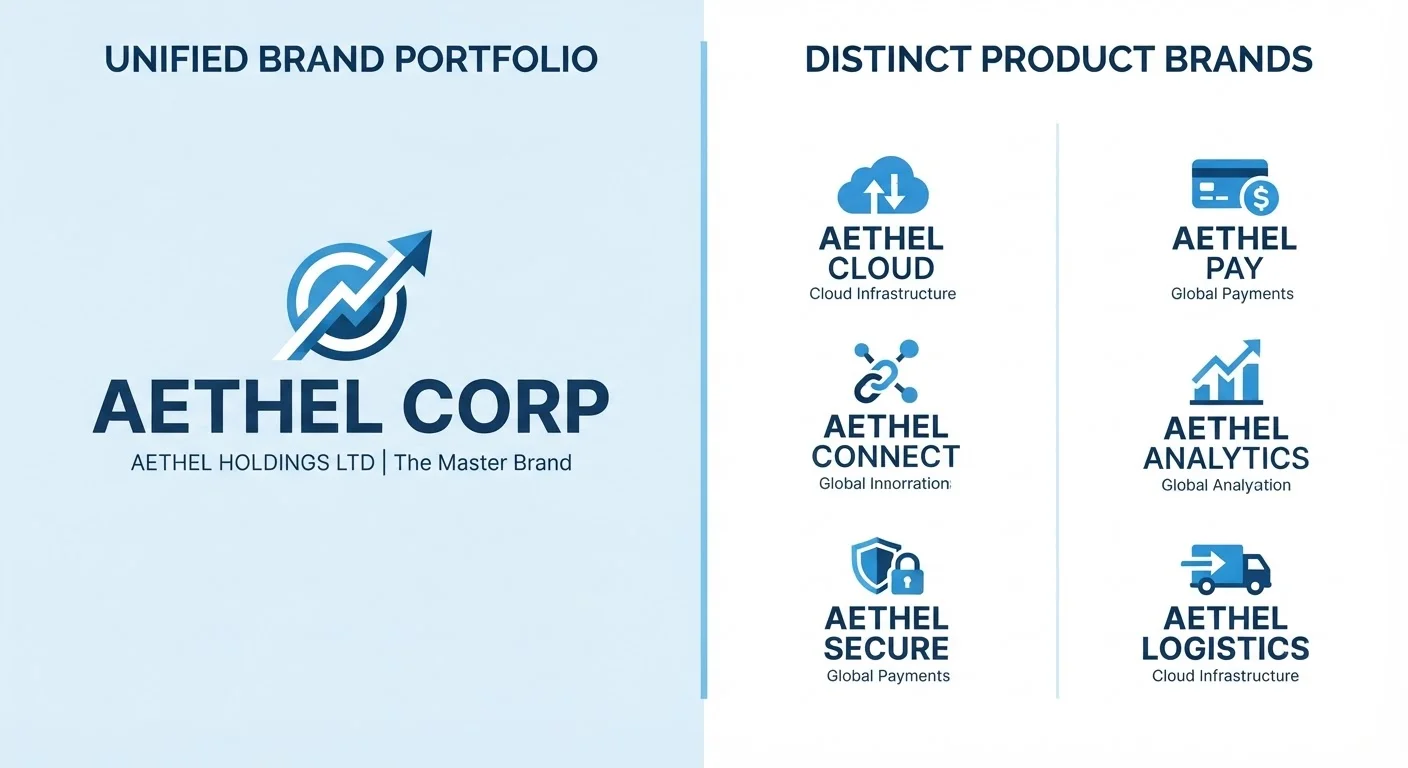
In a branded house, a single master brand sits at the center of everything. Sub-products carry the parent name or are so closely associated with it that the master brand does the heavy lifting. Think of a professional services firm that markets every service line under one name, or a technology company whose products are extensions of a single recognizable identity.
In a house of brands, the parent company operates in the background while individual product brands each have their own identity, positioning, and audience. The parent may be entirely invisible to the end consumer. This structure is common in consumer packaged goods, hospitality, and retail, where targeting precision and competitive insulation are priorities.
For a broader grounding in how these models fit within brand portfolio strategy, see Brand Architecture Explained, which covers the full spectrum of structural options.
| Criterion | Branded House | House of Brands |
|---|---|---|
| Brand investment focus | Single master brand | Multiple independent brands |
| Marketing efficiency | High - shared equity across products | Lower - separate budgets per brand |
| Audience targeting flexibility | Limited by master brand positioning | High - each brand targets independently |
| Reputational risk containment | Low - risk spreads across portfolio | High - risk isolated to individual brand |
| Complexity to manage | Lower organizational overhead | Higher - multiple brand systems needed |
| Best suited to | Consistent category, single customer type | Diverse categories, distinct audiences |
| New product launch advantage | Borrows established master brand trust | Must build brand equity from scratch |
The Core Trade-Offs: Efficiency vs. Flexibility
The central tension between these two structures comes down to marketing efficiency versus strategic flexibility.
A branded house concentrates every dollar of marketing investment behind a single identity. Each new product launch rides the coattails of existing brand awareness, which lowers customer acquisition costs over time. That efficiency compounds: brand equity built today reduces the cost of tomorrow's launch. The trade-off is constraint - every product must fit within the master brand's personality, positioning, and customer promise. Introducing a product that conflicts with the master brand's image is difficult and can dilute the overall brand.
A house of brands trades that efficiency for flexibility. Each brand can be positioned precisely for its target segment, priced independently, and communicated through channels that resonate with its specific audience - without any other brand in the portfolio limiting its options. The cost is significant: you are building brand equity multiple times over, which demands both budget and organizational capacity. Multi-channel advertising strategy becomes considerably more complex when each brand requires its own channel mix.
3-5×
Cost multiplier for multi-brand portfolio management
Industry marketing practitioners generally estimate that maintaining independent brand programs multiplies overhead versus a single master brand - the exact figure varies by category and organization size.
~60%
Brand extensions that underperform as standalone entities
Research in brand extension literature suggests the majority of new product launches benefit measurably from parent brand equity, underscoring the efficiency argument for the branded house model.
There is also a risk dimension. Under a branded house, a single product crisis can damage the entire portfolio - because customers associate all offerings with one name. Under a house of brands, damage is more likely to be contained to the affected brand. For businesses operating in categories with distinct regulatory, reputational, or audience risk profiles, that containment can be strategically valuable.
Choosing the Right Structure for Your Business Stage
The right answer is rarely permanent. The model that fits a business at founding may not serve it at scale - and a poorly timed transition can be disruptive and expensive. Consider the following factors when making or revisiting this decision.
Customer Segmentation
If your products serve essentially the same buyer with consistent needs, a branded house creates coherence. If your portfolio spans genuinely different buyer personas - different income levels, industries, or usage occasions - independent brand identities allow you to speak authentically to each without compromise.
Competitive Dynamics
Some markets require a brand to occupy a clear, narrow position to win. If you are competing in a crowded category where credibility depends on specialist positioning, a standalone brand may outperform a sub-product of a generalist master brand.
Growth Path
Organic growth through new product development within a consistent category tends to favor the branded house. Growth through acquisition, particularly when you are acquiring brands with existing equity in new categories, often favors the house of brands approach - preserving what the acquired brand has already built. Before committing to an architecture, conduct a honest assessment of your brand's current standing. A brand audit is a practical starting point for understanding whether your master brand has the credibility and clarity to anchor a broader portfolio.
Resource Availability
Running multiple independent brands requires organizational infrastructure: separate teams, agencies, or at minimum clearly defined brand guidelines for each. Businesses without that capacity risk under-investing in individual brands to the point where neither model works effectively.
Hybrid Models Are Common in Practice
Many real-world companies operate somewhere between a pure branded house and a pure house of brands - sometimes called an 'endorsed brand' or 'sub-brand' model, where individual brands carry their own identity but also visibly signal affiliation with the parent. This hybrid approach can capture some efficiency benefits while preserving positioning flexibility. However, it also introduces complexity in how each brand is communicated, and requires clear internal rules to prevent inconsistency. For more on how positioning and messaging interact within any architecture, see Brand Positioning vs. Brand Messaging.
Whatever model you choose, internal alignment matters as much as external presentation. Your team's understanding of brand boundaries directly affects consistency. See Internal vs. External Branding for guidance on keeping both sides of the equation working together.
This article is for general informational purposes only and does not constitute professional marketing, legal, or financial advice. Consult qualified advisers for decisions specific to your business circumstances.