

| Common names | Brand style guide, brand standards manual, brand book |
| Primary purpose | Ensure consistent brand presentation across all channels and teams |
| Typical core sections | Brand foundation, logo, color, typography, voice/tone, imagery, application examples |
| Recommended review cycle | At minimum annually, or after any significant brand change |
| Who should have access | All internal team members, agency partners, and vendors producing brand materials |
What a Brand Style Guide Actually Does
A brand style guide - sometimes called a brand standards manual or brand book - is the single authoritative reference that defines how your brand looks, sounds, and presents itself across every channel and touchpoint. It is not a creative wishlist; it is an operational document that enables designers, copywriters, marketers, and external partners to make consistent brand decisions without requiring review from a central authority every time.
For US businesses at any growth stage, consistency has measurable value. Inconsistent branding fragments recognition and erodes trust, while a coherent identity reinforces the same impression whether a customer encounters your brand on a billboard, a social post, or an invoice. The style guide is the mechanism that makes consistency scalable.
A thorough guide also accelerates onboarding. New team members and agency partners can self-serve answers to most branding questions, reducing back-and-forth and keeping creative production moving. If you are building or refreshing your brand, this document should be treated as a core business asset - not an afterthought. See the full scope of brand building for how a style guide fits into the broader brand strategy.
| Common names | Brand style guide, brand standards manual, brand book |
| Primary purpose | Ensure consistent brand presentation across all channels and teams |
| Typical core sections | Brand foundation, logo, color, typography, voice/tone, imagery, application examples |
| Recommended review cycle | At minimum annually, or after any significant brand change |
| Who should have access | All internal team members, agency partners, and vendors producing brand materials |
Core Sections Every Style Guide Should Include
While every guide is tailored to its organization, the following sections form the essential foundation:
Brand Foundation
Before addressing any visual or verbal element, the guide should articulate the brand's mission, vision, and core values. These orient every subsequent decision. Also include a positioning statement that summarizes who you serve, what you offer, and why it matters. This section answers the "why" behind all the rules that follow.
Logo Standards
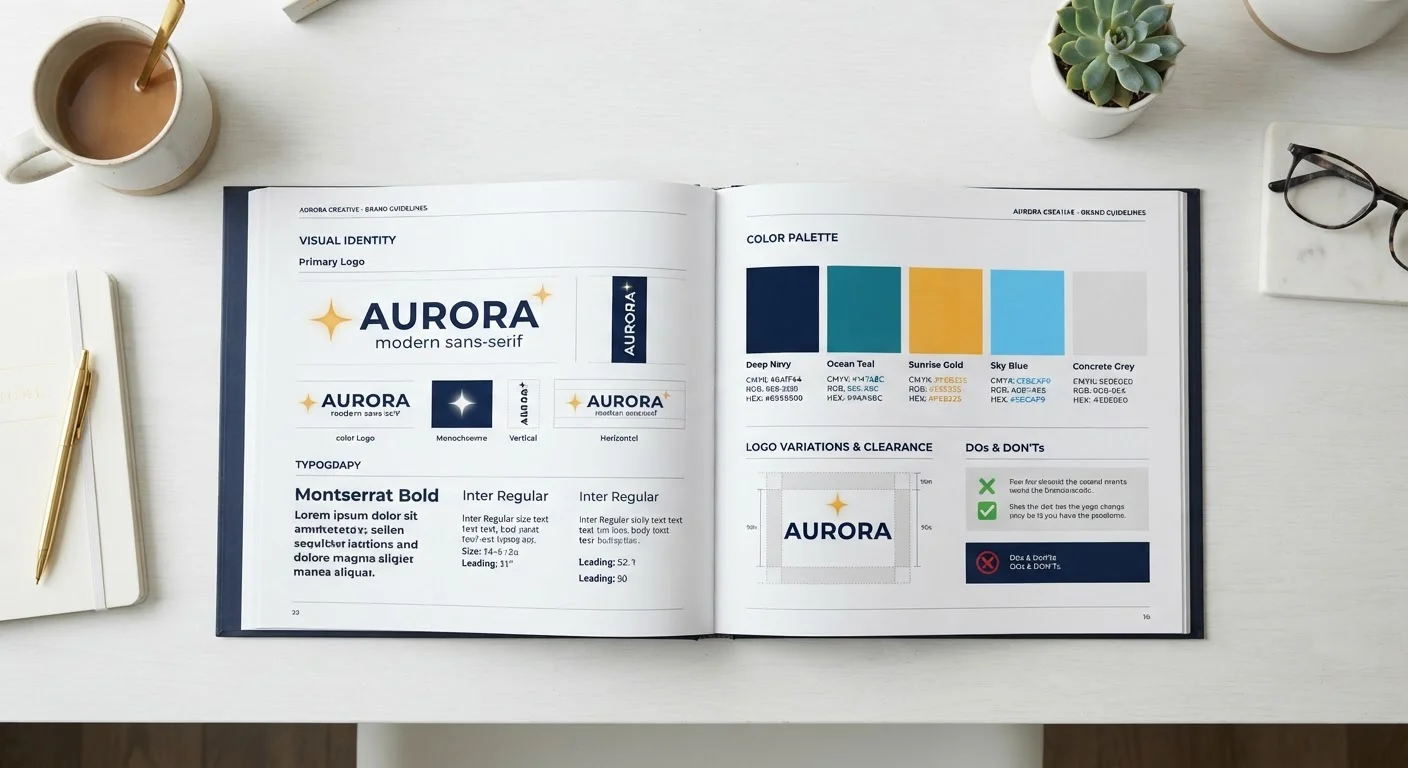
Document every approved logo variation - primary, secondary, monochrome, reversed - along with clear rules on minimum size, clear space requirements, and prohibited modifications. Showing what not to do (stretching, recoloring, placing on busy backgrounds) is just as important as showing approved uses.
Color Palette
Define primary and secondary colors using all necessary formats: HEX for digital, RGB for screen, CMYK for print, and Pantone for physical production. Specify when each color should be used and which combinations are off-limits.
Typography
List approved typefaces for headings, body copy, and any accent uses. Include hierarchy rules (H1 through body), approved weights, line spacing guidance, and fallback fonts for environments where primary typefaces may not load.
Brand Voice and Tone
Describe how your brand communicates in words. Define the voice - the consistent personality (e.g., authoritative, approachable, precise) - and clarify how tone shifts by context, such as more empathetic in customer service and more confident in advertising. Include word lists, writing do's and don'ts, and short before/after examples. This section is especially important for teams managing content across multiple advertising channels.
Imagery and Iconography
Specify the photographic style (e.g., candid versus staged, color grading preferences, subject matter guidelines), illustration style if relevant, and icon design principles. Provide examples of on-brand and off-brand visuals.
Brand style guide
A documented reference that defines the visual and verbal rules for how a brand presents itself across all channels. It serves as the authoritative source for design and communication decisions.
Brand voice
The consistent personality and character a brand expresses in its written and spoken communications. Unlike tone, voice remains stable across all contexts.
Tone
The variation in how a brand communicates depending on context, audience, or situation. A brand's voice stays constant while its tone adapts.
Color palette
The defined set of colors that represent a brand, specified in multiple formats (HEX, RGB, CMYK, Pantone) to ensure consistency across digital and print applications.
Typography hierarchy
The structured system of typeface styles and sizes used across brand materials, from headings down to body copy, that creates visual order and readability.
Clear space
The minimum area of empty space that must surround a logo to protect its visual integrity and prevent it from being visually crowded by other elements.
Application Examples
Show the guide in practice: branded social media posts, email headers, presentation templates, and business cards. Real examples bridge the gap between guidelines and execution.
Once your guide is documented, a brand audit can help you identify where current materials fall short of the standards you've set. And if your organization manages multiple product lines or divisions, brand architecture principles will help you extend those standards consistently across your portfolio.
Maintaining and Distributing Your Style Guide
A style guide has no value if people cannot find or use it. Store it in a shared, accessible location - a cloud-based document platform or a dedicated brand portal - and make access standard practice for every new hire and agency onboarding. The guide should be a living document: reviewed at least annually and updated whenever there is a significant brand evolution, such as a logo refresh, a new product line, or an expanded audience.
Assign clear ownership. Someone in marketing or brand management should be accountable for keeping the guide current and fielding questions. This ownership also matters when creating downstream documents like campaign briefs, which rely on the style guide as a foundational reference.
Finally, distinguish between internal brand standards - which may govern internal culture, communications, and team-facing materials - and external brand standards, which govern customer-facing output. Internal and external branding reinforce each other, and your style guide should address both dimensions explicitly.
This article is for general informational and educational purposes only. It does not constitute professional marketing, legal, or business advice. Consult a qualified marketing professional or brand strategist for guidance specific to your organization's circumstances.