

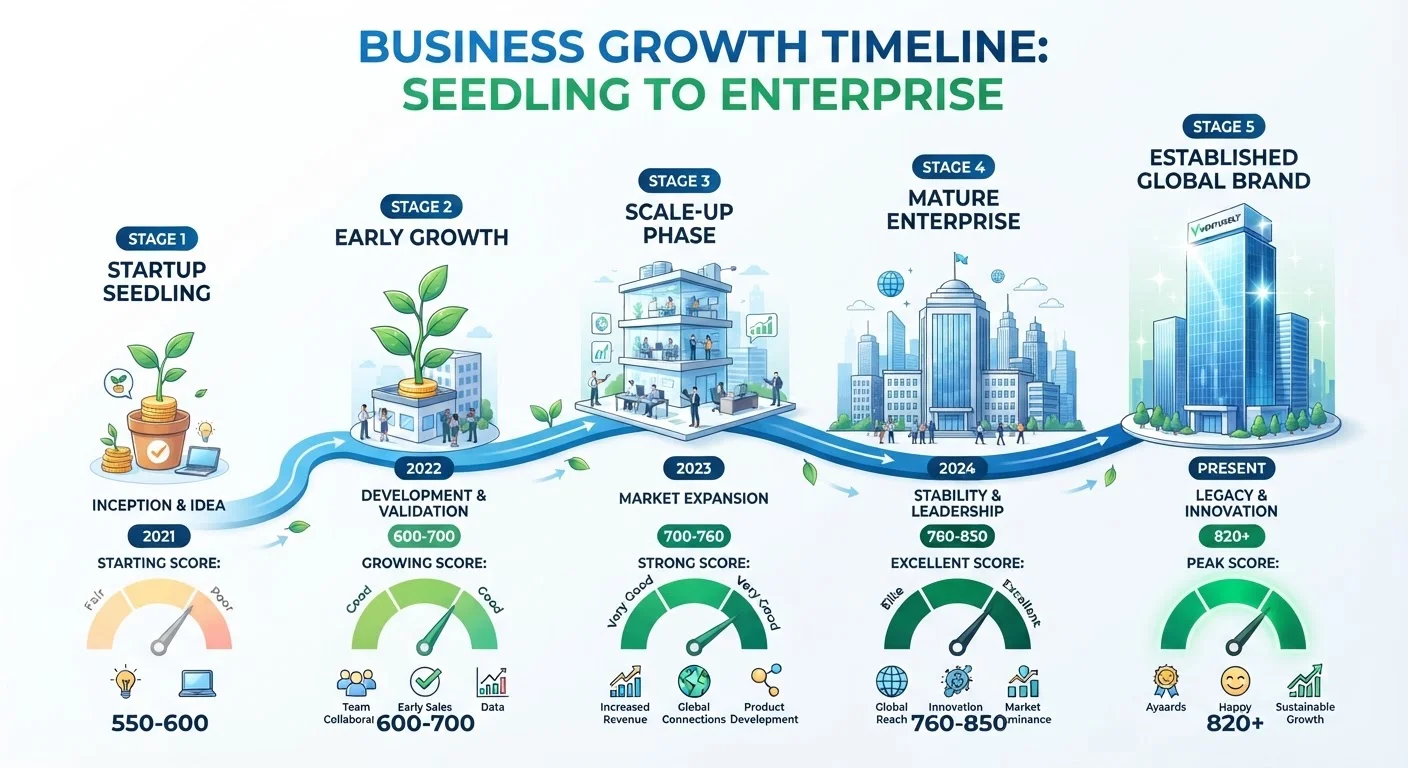
Key Takeaways
Why Business Credit Follows a Lifecycle
Business credit isn't a static asset - it's a dynamic profile that grows, plateaus, and deepens as your company matures. Just as a startup operates differently from a mid-market firm, its creditworthiness is evaluated through a different lens by lenders, suppliers, and partners at every stage of development.
Understanding the lifecycle helps business owners make proactive decisions rather than reactive ones. Applying for a bank line of credit before establishing any tradeline history, for example, is a common misstep that leads to declined applications and unnecessary hard inquiries. Mapping your credit strategy to your company's growth stage prevents those friction points.
Business credit scores - issued by major bureaus such as Dun & Bradstreet, Experian Business, and Equifax Business - are distinct from personal FICO scores. They use separate algorithms, are accessible to any third party without your consent, and respond to different inputs. For a foundational overview of the mechanics, see our guide on getting your business credit profile off the ground.
3
Major U.S. commercial credit bureaus
Dun & Bradstreet, Experian Business, and Equifax Business each maintain separate business credit files using different scoring models.
~30%
Small businesses lacking a credit profile
Industry estimates suggest a significant share of small businesses have no established commercial credit file, limiting their financing options.
Net-30
Most common starter tradeline term
Net-30 vendor accounts are typically the first reporting credit relationships accessible to businesses with no prior commercial credit history.
Stage 1: The Startup Phase - Establishing Identity
In the earliest phase, the primary objective is creating a credible, verifiable business identity in the eyes of credit bureaus and financial institutions. This means completing structural prerequisites: forming a legal entity (LLC, corporation, or other registered structure), obtaining an Employer Identification Number (EIN) from the IRS, opening a dedicated business bank account, and ensuring consistent use of your legal business name and address across all registrations.
At this stage, your business has no credit file - which is different from having a bad file. The challenge is generating enough data points for the bureaus to build a profile at all. Registering your business with Dun & Bradstreet (to obtain a DUNS Number) and with Experian Business can accelerate file creation.
Start With Bureau Registration Early
Register your business with Dun & Bradstreet to claim or create your DUNS Number before you open your first trade account. A missing or unverified business file can cause payment history to go unreported even when suppliers do report to the bureau. This small step at formation can significantly accelerate file development.
For businesses concerned about personal liability during this phase, our resource on building business credit without a personal guarantee outlines strategies for separating entity credit from personal financial history from the outset.
Stage 2: Early Growth - Building a Tradeline History
Once your business identity is established, the focus shifts to generating positive payment history through trade credit - net-term accounts with suppliers, vendors, and service providers who report to commercial bureaus. A net-30 account with an office supply vendor, for instance, creates a reportable transaction when paid on time.
During this phase, diversity of tradelines matters. A business with five reporting accounts across different categories (office supplies, fuel, telecommunications, equipment leasing) demonstrates broader creditworthiness than one with a single account. The goal is consistency: paying on or before terms, keeping utilization moderate, and allowing the file to age.
Before opening a trade account, call the vendor and ask directly which commercial bureaus they report to - this single question saves you from building invisible credit history.
Many suppliers offer net-term accounts but do not report to any bureau, meaning on-time payments generate zero credit-building benefit for the business.
Keep business credit utilization below 30% on revolving accounts during the growth phase, even if your limit allows more - bureau scoring models penalize high utilization similarly to personal credit.
Commercial scoring algorithms used by Experian Business and Equifax Business weight utilization as a meaningful factor, and early patterns set the trajectory for future score ranges.
Business credit cards issued in the company's name - not the owner's - also contribute during this stage, provided the issuer reports to commercial bureaus. Confirm reporting practices before applying, as not all issuers do. For a broader view of financing tools available alongside credit-building, explore our Loans & Lending hub.
Stage 3: Scaling - Accessing Institutional Credit
With a seasoned credit file and demonstrated payment history, a growing business becomes eligible for more substantial credit products: revolving lines of credit from banks, equipment financing, and SBA-backed loans. Lenders at this stage evaluate not just the credit score but also time in business, revenue trends, debt service coverage ratios, and industry risk.
A strong business credit profile can materially affect loan terms - interest rates, collateral requirements, and whether a personal guarantee is required. Businesses in capital-intensive industries like transportation and logistics or hospitality particularly benefit from robust credit profiles, since equipment and property financing are central to operations.
Personal Guarantees Remain Common in Scaling
Even businesses with solid commercial credit files are frequently required to sign personal guarantees on loans and credit facilities during the scaling phase. This means the business owner's personal credit and assets remain at risk if the business defaults. Understand what you're signing before committing, and work with a qualified attorney or financial adviser to assess the implications for your personal financial position.
This is also the stage where long-term financial planning becomes essential. Credit utilization decisions made during rapid scaling directly affect your ability to refinance or access emergency capital later. For a detailed walkthrough of borrowing mechanics at this phase, see our end-to-end business loan guide.
Stage 4: Established Enterprise - Optimizing and Protecting Credit
For established companies, business credit shifts from a growth tool to a strategic asset requiring active management. At this stage, businesses should be monitoring their commercial credit reports regularly - errors, outdated information, or unreported accounts can silently drag scores without the business noticing.
Optimizing at this stage means maintaining low revolving utilization, ensuring all favorable payment relationships are being reported, and periodically reviewing personal guarantee obligations with a view to renegotiating them as the company's standalone profile strengthens. It also means understanding how M&A activity, subsidiary structures, or significant new debt can affect the enterprise credit profile.
“A business credit profile is one of the few assets that grows in value the longer you manage it well - but it requires the same intentionality as any other strategic investment in the company.”
— Business Finance Editorial Team, Editorial analysts specializing in commercial credit and business finance
If scores plateau or decline despite responsible financial behavior, there are usually identifiable root causes - from bureau data gaps to high utilization spikes. Our article on what to do when business credit scores stall covers diagnostic and recovery approaches in detail.
Common Credit Pitfalls at Every Stage
Certain mistakes recur across businesses regardless of size. Commingling personal and business finances is the most prevalent - it blurs the credit separation that the lifecycle depends on and can undermine years of profile-building. Inconsistent business name or address usage across registrations causes bureau mismatches that suppress file accuracy.
Applying for multiple credit products in rapid succession generates hard inquiries that can temporarily suppress scores. And neglecting to verify that vendor relationships actually report to commercial bureaus means payment history that never helps the file. Awareness of these pitfalls - at each stage - prevents setbacks that can take months to reverse.
For businesses exploring non-credit funding alternatives alongside their credit strategy, financial aid options across the business lifecycle maps grant and aid options by growth phase, offering a complementary picture of capital access.
This article is for general informational and educational purposes only and does not constitute personalized financial, legal, or credit advice. Business credit decisions depend on individual circumstances. Consult a qualified financial adviser, accountant, or licensed credit professional before making decisions specific to your situation.