

Key Takeaways
Our Verdict
Neither policy structure is universally superior - the right choice depends on your industry, risk profile, and operational continuity. Occurrence-based policies offer lasting protection for past incidents without additional purchasing steps, while claims-made policies may carry lower initial premiums but require careful management to avoid coverage gaps over time.
| Best for | Recommended |
|---|---|
| Businesses seeking straightforward, long-term protection without ongoing policy management | Occurrence-based coverage |
| Professional service firms with predictable claim timelines and budget flexibility for tail coverage | Claims-made coverage |
| Industries where claims are typically discovered and filed shortly after an incident | Claims-made coverage |
| Businesses that change insurers frequently or operate across multiple risk sectors | Occurrence-based coverage |
The Core Distinction: When Coverage Is Triggered
Business insurance policies don't all respond to losses the same way. The most fundamental structural difference is the trigger mechanism - the conditions that must be met for a policy to respond to a claim. Two dominant structures exist in commercial lines: occurrence-based and claims-made.
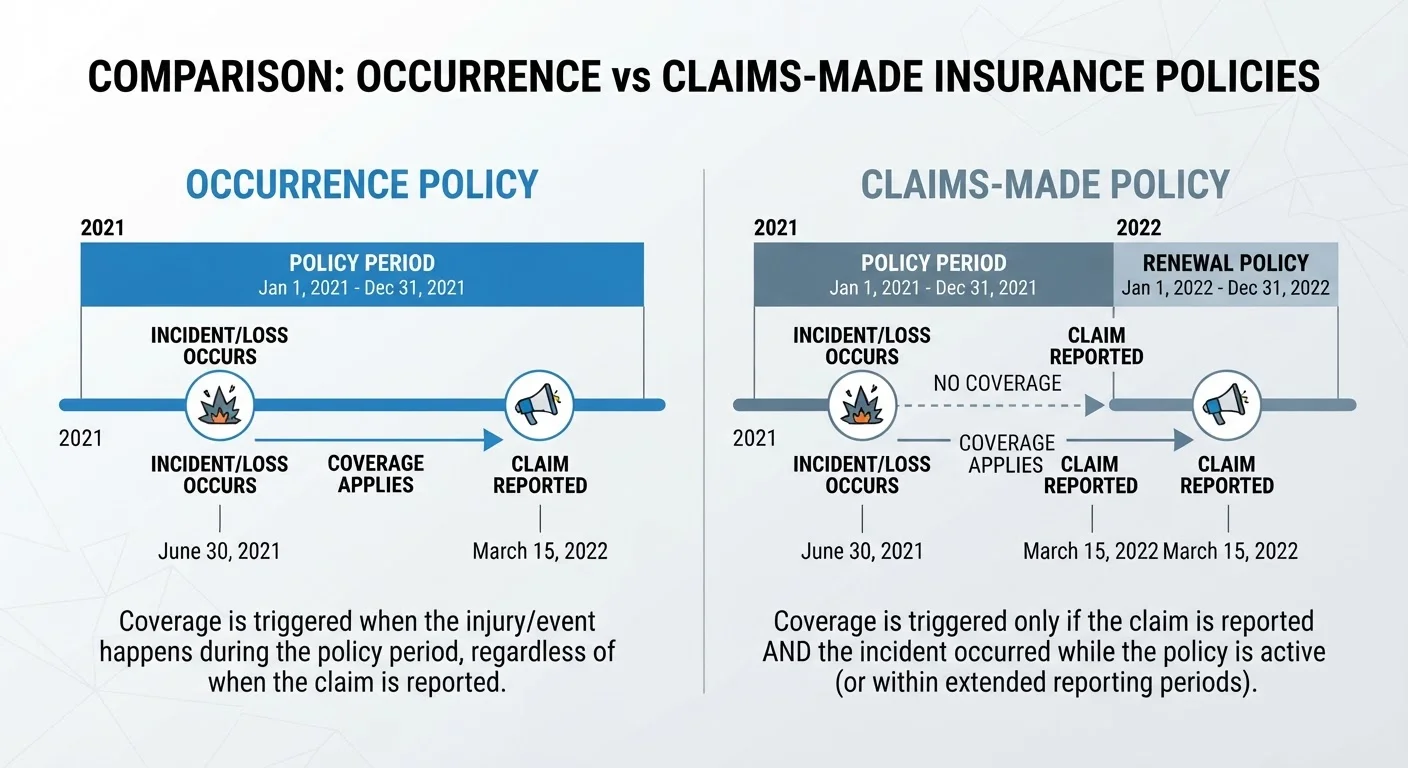
An occurrence-based policy covers any incident that happens during the policy period, no matter when the claim is ultimately filed. If a business was insured in a given year and a liability claim surfaces three years later from an event during that period, the old policy still applies.
A claims-made policy covers claims only when both the underlying incident and the formal claim filing occur within the active policy period - or within a defined reporting window. If the policy has lapsed by the time a claim is filed, coverage may not exist even if the triggering event happened while the policy was in force.
This distinction has real consequences. Businesses that assume any past coverage protects them indefinitely may be exposed. For a deeper look at how these gaps develop in practice, see why many businesses discover coverage gaps only after a claim.
| Occurrence-Based | Claims-Made | |
|---|---|---|
| Coverage trigger | Incident occurs during policy period | Claim filed while policy is active |
| Long-term protection | Remains in effect after policy expires | Ends when policy lapses unless tail purchased |
| Common policy lines | General liability, commercial auto | Professional liability, medical malpractice |
| Premium structure | Typically higher upfront | Often lower initially, rises over time |
| Policy management complexity | Lower - no ongoing tail decisions | Higher - retroactive dates and tail coverage apply |
| Risk of gap on cancellation | Low - prior incidents remain covered | High - gaps possible without tail coverage |
Where Each Structure Is Most Commonly Used
Policy structures tend to align with industry norms and the typical lag between an incident and a claim. General liability insurance - which covers bodily injury and property damage arising from business operations - is most commonly written on an occurrence basis. The causal events (a slip-and-fall, a product defect) are generally identifiable, and claims tend to surface within a reasonable timeframe.
Professional liability insurance (also called errors and omissions, or E&O) and medical malpractice coverage are typically structured on a claims-made basis. In these contexts, harm from professional advice or a medical procedure may not become apparent - or legally actionable - for months or years. The claims-made structure allows insurers to price risk more precisely by limiting their exposure to claims reported during active coverage.
Industry-specific insurance plans often have embedded norms around which structure is standard. If your business operates across sectors, you may hold both types simultaneously. Evaluating insurance needs when your business operates in multiple sectors provides a framework for assessing layered coverage scenarios.
Ask About Your Retroactive Date
When purchasing or renewing a claims-made policy, always confirm the retroactive date in writing. Ideally, it should match your original coverage start date so no historical incidents fall into an uninsured window. If you're switching insurers, verify that the new policy's retroactive date aligns with - or precedes - your previous carrier's date. A licensed insurance agent can help you identify and close this potential exposure.
Tail Coverage and Retroactive Dates: Critical Claims-Made Concepts
Two terms are essential for anyone holding a claims-made policy:
- Retroactive date: The earliest incident date a claims-made policy will cover. Any event occurring before this date is excluded, even if the claim is filed during the policy period.
- Extended reporting period (ERP) or tail coverage: An optional extension that allows claims to be reported after a policy expires, provided the incident occurred while the policy was active. Tail coverage must typically be purchased - it is not automatic.
When a business cancels or non-renews a claims-made policy without purchasing tail coverage, any incidents that occurred during the policy period but haven't yet been claimed become uninsured. This is one of the most common - and costly - coverage gaps that catch business owners off guard.
Cancelling Without Tail Coverage Creates Exposure
If you cancel or decline to renew a claims-made policy without purchasing an extended reporting period, you may be uninsured for incidents that occurred during your coverage period but are claimed afterward. This exposure is often overlooked during insurer switches or business wind-downs. Review any policy cancellation decision carefully with a licensed insurance professional before acting.
For a structured approach to evaluating what coverage your operations actually require, consult a checklist for assessing which coverage types your business actually needs.
This article is for general informational purposes only and does not constitute insurance, legal, or financial advice. Coverage terms, structures, and availability vary by insurer, policy, and jurisdiction. Consult a licensed insurance professional to evaluate options appropriate for your specific circumstances.