

Key Takeaways
Option A
Professional Liability Insurance
The specialized shield for expertise-based claims.
Best for: Service providers and professionals whose work product or advice could cause a client financial harm.
Option B
General Liability Insurance
The foundational coverage for physical and reputational risks.
Best for: Nearly any business that interacts with the public, occupies a physical space, or produces advertising materials.
If your business primarily interacts with the public in a physical location
General Liability Insurance
Slip-and-fall incidents, third-party property damage, and advertising injury claims are the core exposures general liability is designed to address.
If your business sells advice, expertise, or professional services to clients
Professional Liability Insurance
Errors in professional judgment or service delivery can lead to costly client claims that general liability typically excludes.
If your business both provides services and maintains a client-facing office or staff
Both Policies
Service-based businesses often face exposure on both fronts; carrying only one policy can leave significant gaps in protection.
If your business manufactures or sells physical products
General Liability Insurance
General liability typically includes products liability coverage for harm caused by goods your business produces or sells, though standalone product liability coverage may also be warranted.
Two Policies, Two Very Different Risk Profiles
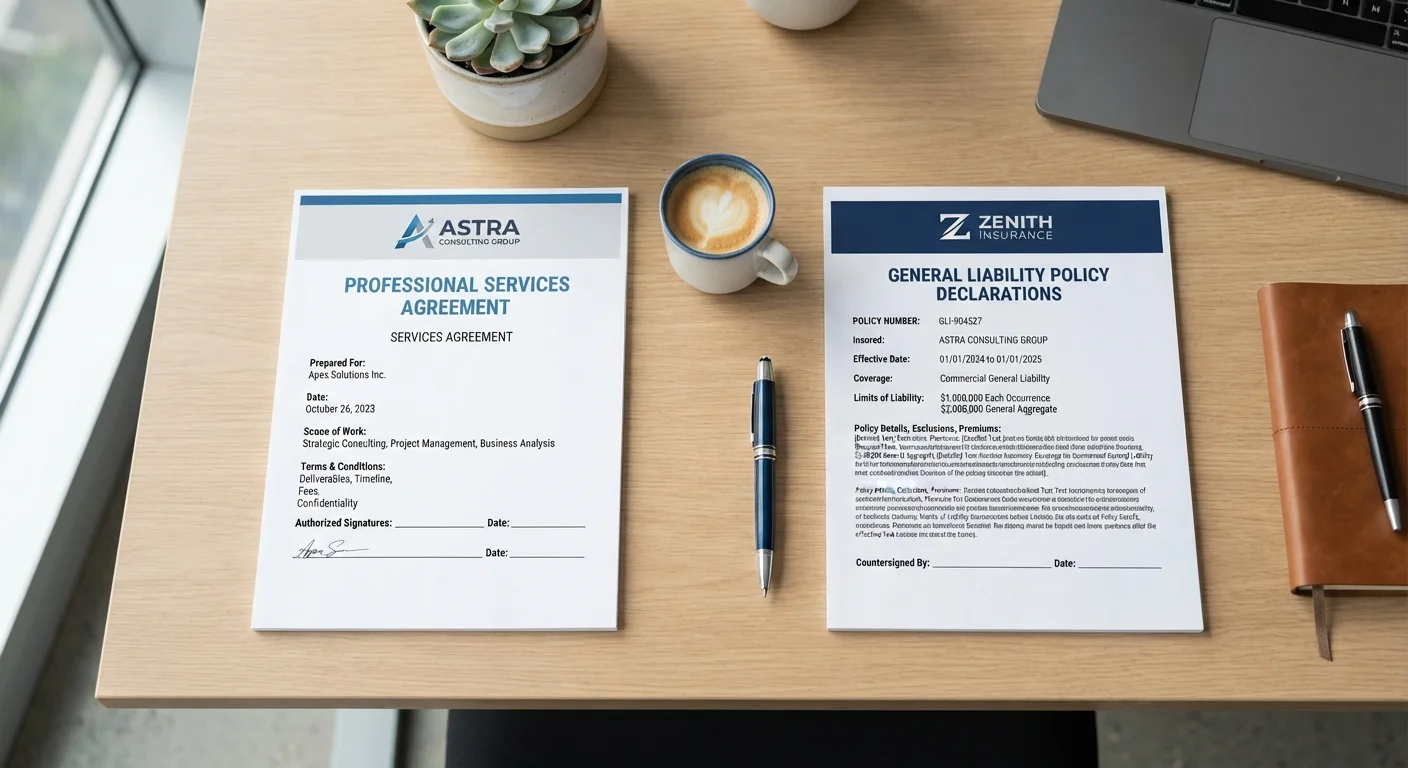
Business owners shopping for liability coverage often encounter these two policy types early in the process - and just as often conflate them. The distinction matters because each policy is engineered to respond to a specific category of claim. Buying only one when your business needs both can leave you exposed in ways that only become apparent after a loss.
General liability insurance (sometimes called commercial general liability, or CGL) protects businesses against third-party claims involving bodily injury, property damage, and certain advertising or personal injury harms - think a customer who slips on a wet floor, or a competitor who alleges your marketing campaign damaged their reputation. For a deeper look at what this policy actually covers, see what general liability insurance actually covers.
Professional liability insurance - also called errors and omissions (E&O) insurance, or malpractice insurance in certain licensed professions - responds to claims that your professional services, advice, or work product caused a client financial harm. A consultant who delivers a flawed market analysis, or an accountant whose filing error triggers a client penalty, faces the type of risk general liability does not cover.
| Criterion | Professional Liability | General Liability |
|---|---|---|
| Primary risk addressed | Errors, omissions, negligent professional services | Bodily injury, property damage, advertising injury |
| Typical policy trigger | Client financial harm from advice or work product | Third-party physical or reputational harm |
| Policy structure | Claims-made (in most cases) | Occurrence-based (typically) |
| Who typically needs it | Consultants, advisers, licensed professionals | Nearly all businesses with public-facing operations |
| Covers defense costs | Yes, usually within policy limits | Yes, often in addition to policy limits |
| Products liability included | No | Generally yes, subject to policy terms |
| Contractual disputes covered | Sometimes, if rooted in service negligence | Generally excluded |
What Each Policy Covers (and What It Doesn't)
Understanding the scope of each policy requires looking at both what triggers coverage and what is explicitly excluded.
General Liability: Physical and Reputational Harm
A standard general liability policy typically covers:
- Bodily injury to third parties caused by business operations or premises conditions
- Third-party property damage resulting from your business activities
- Personal and advertising injury, including libel, slander, copyright infringement in advertisements, and false arrest
- Products liability for harm caused by goods your business manufactures or sells (see product liability insurance for businesses with significant product exposure)
General liability does not cover professional errors, contractual disputes rooted in service quality, or financial losses a client suffers because of your advice or recommendations.
Professional Liability: Service Quality and Advice
A professional liability policy typically covers:
- Negligence claims arising from errors or omissions in professional services
- Failure to deliver promised professional services
- Misrepresentation in a professional capacity
- Defense costs, which can be substantial even when a claim lacks merit
Professional liability policies are generally written on a claims-made basis, meaning the policy in force when the claim is filed - not when the alleged error occurred - responds to the loss. This differs from the occurrence-based structure common in general liability policies and has significant implications for businesses that change insurers or let coverage lapse.
Claims-Made vs. Occurrence: A Critical Distinction
Professional liability policies are almost always written on a claims-made basis: coverage applies when the claim is reported during the active policy period, regardless of when the underlying error occurred. General liability policies are more commonly occurrence-based, meaning the policy in force at the time of the incident responds - even if the claim surfaces years later. When switching insurers or retiring a professional liability policy, businesses should ask about 'tail coverage' (extended reporting period endorsements) to avoid gaps for prior work.
For service-based businesses navigating both exposures, the comparison of these two policies for service businesses offers additional context on how the policies interact in practice.
Which Businesses Need Which Policy
The nature of your business operations - not simply your industry label - determines which coverage is essential.
~40%
Small businesses facing a liability claim annually
Insurance industry estimates suggest a significant share of small businesses encounter a liability claim or lawsuit in any given year, underscoring the importance of adequate coverage.
$75,000+
Average cost to defend a professional liability claim
Industry data indicates that defense costs alone for professional liability claims can reach or exceed this figure, even when the claim is ultimately resolved in the insured's favor.
Businesses that primarily face physical risk exposures (retail stores, contractors, event venues) tend to prioritize general liability. Businesses whose primary deliverable is expertise or a work product (consultants, architects, financial advisers, technology firms) typically require professional liability. For technology companies, the risk landscape extends further still - professional liability and cyber liability can overlap in ways that merit separate analysis.
Many businesses occupy both categories simultaneously. A marketing agency, for example, may face advertising injury claims under general liability and client allegations of campaign negligence under professional liability. A law firm leasing office space faces premises liability alongside malpractice exposure. Carrying both policies is common practice for service firms of any meaningful scale, and the broader map of business liability types illustrates how multiple exposures can coexist within a single operation.
This article is for general informational purposes only and does not constitute insurance, legal, or financial advice. Coverage terms, exclusions, eligibility, and premiums vary by insurer, policy, and jurisdiction. Consult a licensed insurance professional to evaluate coverage appropriate to your specific business circumstances and review actual policy documents before making coverage decisions.