

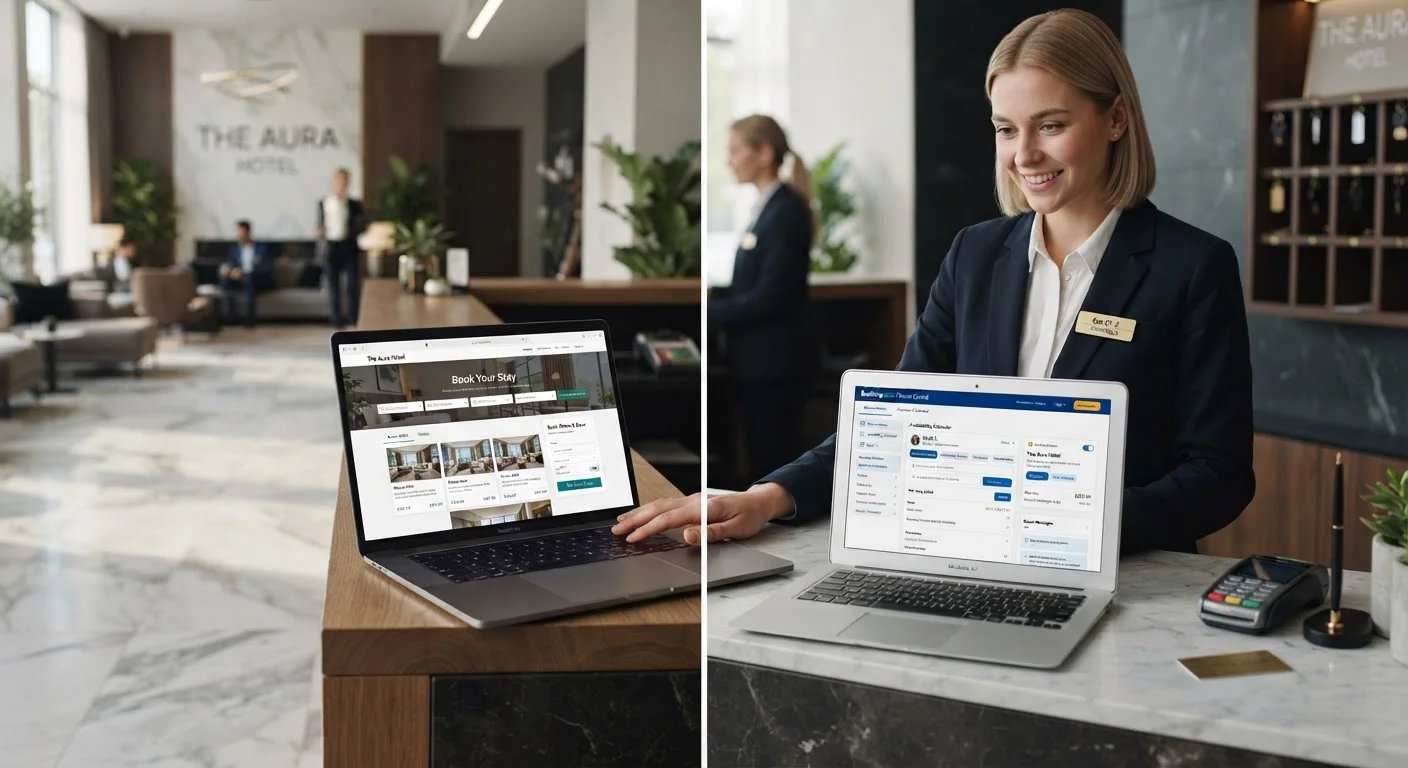
Key Takeaways
Option A
Direct Bookings
The margin-preserving, relationship-building channel.
Best for: Hotels investing in brand identity, repeat guest programs, and long-term revenue efficiency.
Option B
OTA Channels
The high-reach, demand-generation engine.
Best for: Properties looking to fill rooms quickly, reach new markets, and reduce internal marketing overhead.
If you're a new or independent hotel with limited brand awareness
OTA Channels
OTAs provide immediate visibility to millions of travelers without requiring upfront marketing spend, which is critical when your direct audience is still small.
If you have a returning guest base and established brand identity
Direct Bookings
A recognizable brand can convert loyalty into direct reservations, capturing the full room rate and enabling more personalized guest communication.
If you're managing occupancy during low-demand periods
OTA Channels
OTAs can expose unsold inventory to a broad traveler pool quickly, helping maintain occupancy when organic demand softens.
If you're focused on long-term profitability and cost efficiency
Direct Bookings
Eliminating third-party commissions on even a portion of total bookings substantially improves revenue per available room over time.
If you operate multiple properties or a full-service hotel
Direct Bookings
Full-service hotels benefit most from direct relationships - upselling amenities, packages, and experiences is far easier with a guest who booked directly.
Understanding the Economics of Each Channel
Every room booking carries a cost of acquisition - the question is how much, and who controls the relationship afterward. OTAs such as major global platforms provide significant demand aggregation, but they charge commissions that typically range from 15% to 25% of the booking value. On a $200 room night, that represents $30 to $50 per stay, before factoring in any additional marketing spend.
Direct bookings - made through a hotel's own website, phone, or email - eliminate that commission layer entirely. The trade-off is that generating those bookings requires investment: a reliable booking engine, an optimized website, paid search or retargeting campaigns, and often a loyalty program to incentivize repeat stays. For many independent operators, building that infrastructure represents a meaningful upfront cost.
| Criterion | Direct Bookings | OTA Channels |
|---|---|---|
| Commission cost | None (acquisition costs vary) | 15%-25% per booking |
| Guest data access | Full data owned by hotel | Limited; OTA retains data |
| Reach and discoverability | Limited to owned channels | Millions of global travelers |
| Brand control | Full control of experience | Filtered through OTA interface |
| Setup investment | Moderate to high (tech + marketing) | Low; list and go live quickly |
| Loyalty program integration | Seamless | Difficult or not supported |
| Rate flexibility | Full control | May be constrained by parity clauses |
Understanding revenue management principles is essential here - channel mix decisions directly affect RevPAR (revenue per available room) and net operating margins, not just gross room revenue.
What Hotels Give Up With OTA Dependency
Beyond commission costs, heavy reliance on OTAs creates structural vulnerabilities. Hotels that book a majority of their rooms through third-party platforms often receive limited guest data - email addresses, preferences, and stay history may not be passed back to the property. This data gap makes it difficult to build loyalty programs, personalize future stays, or market effectively to past guests.
OTA algorithms also favor properties that maintain competitive pricing and strong review scores. Rate parity clauses - contractual requirements to match or exceed OTA pricing on other channels - have historically constrained hotels from offering lower prices directly. While enforcement has evolved in various markets, operators should review their specific agreements carefully with qualified legal counsel.
Rate Parity: Know Your Contract Terms
Rate parity clauses require hotels to offer OTA platforms pricing that is at least as favorable as rates listed elsewhere. The enforceability and scope of these clauses vary by jurisdiction and have faced regulatory scrutiny in several markets. Before adjusting your pricing strategy across channels, review your specific OTA agreements with a qualified legal or commercial adviser to understand what restrictions apply to your property.
There's also a brand perception dimension. Travelers who discover a property through an OTA may have weaker brand recall and lower likelihood of returning directly. The OTA, not the hotel, owns that first-impression experience. This dynamic is explored further in our article on why strong reviews don't always convert into reservations.
Building a Direct Booking Strategy That Competes
Competing for direct bookings isn't simply a matter of having a website - it requires a deliberate investment in visibility and conversion. Local SEO tactics are one of the most cost-effective starting points, improving organic search placement without the ongoing cost of paid acquisition.
15%-25%
Typical OTA commission rate per booking
Industry estimates from hospitality consultancy research consistently place OTA commissions in this range, varying by platform and contract terms.
~50%
Share of hotel bookings via OTAs globally
Multiple hospitality industry reports indicate that online travel agencies account for roughly half of digital hotel bookings, underscoring their distribution power.
5-10x
Repeat guest value vs. first-time OTA guest
Hospitality research broadly supports that returning direct guests generate significantly higher lifetime value due to lower re-acquisition costs.
A well-structured direct channel strategy typically includes: a mobile-optimized booking engine with transparent pricing, a loyalty or perks program that rewards guests for booking direct, retargeting campaigns for visitors who browsed but didn't convert, and direct rate advantages such as complimentary breakfast or flexible cancellation - benefits that don't violate rate parity but still incentivize the direct path.
Hotels should also consider how seasonal pricing and promotions interact with channel strategy. During shoulder periods, direct promotions to past guests via email can fill rooms at lower acquisition cost than OTA-driven last-minute inventory.
The Case for a Blended Distribution Model
For most hotel operators, the choice is not binary. OTAs serve a genuine function: they aggregate demand, provide credibility through review systems, and reach international travelers who may never encounter a property's standalone website. Removing OTA presence entirely would, for most properties, create an occupancy gap that direct channels cannot immediately fill.
A practical blended approach treats OTAs as a demand-generation tool and the direct channel as the margin-preservation engine. Properties can use OTA visibility to attract first-time guests, then invest in converting those guests into repeat direct bookers through post-stay communication, loyalty incentives, and memorable service experiences.
This mirrors broader principles in multi-channel advertising strategy - prioritize channels with the strongest return, use secondary channels for reach, and avoid over-indexing on any single source. The specific channel mix will vary by property type; full-service and limited-service hotels have meaningfully different cost structures and guest expectations that shape which investments make sense.
This article is for informational purposes only and does not constitute financial, legal, or business advice. Hospitality operators should consult qualified advisers when making distribution, contract, or technology investment decisions specific to their property.