

| Document Type | Freight Invoice (Freight Bill) |
| Primary Charge | Base (line-haul) rate |
| Fuel Surcharge Basis | % of base rate or per-mile add-on (US DOE weekly diesel index commonly used) |
| Common Dispute Trigger | Carrier re-weigh differing from quoted weight |
| Accessorial Examples | Liftgate, residential delivery, detention, redelivery |
| Hazmat Handling | Requires additional DOT-compliant fee line |
What a Freight Bill Actually Is
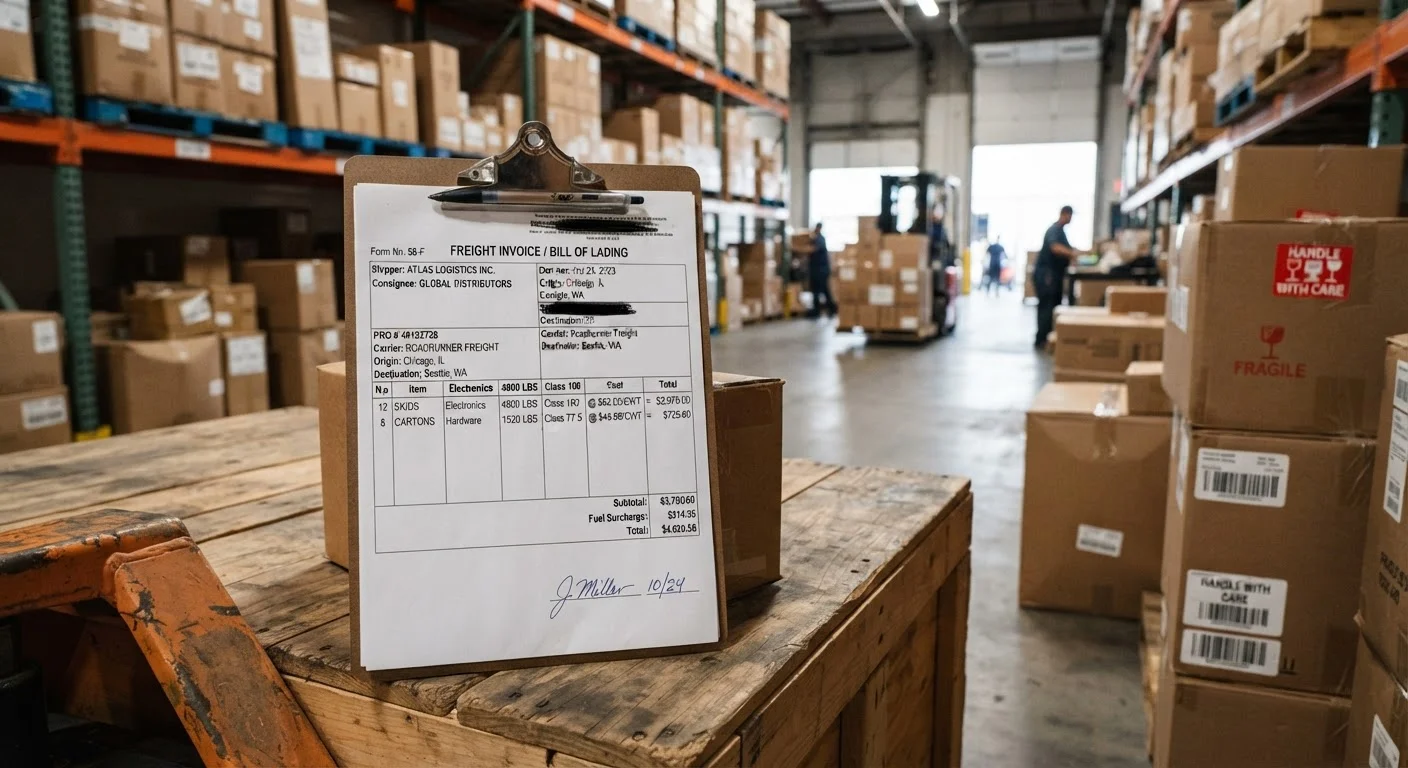
A freight bill-formally called a freight invoice-is the carrier's request for payment after goods have been transported. It functions as both a billing document and a record of the services rendered, tying together the original shipment details, applicable rates, and any additional charges incurred during transit.
Unlike a straightforward product invoice, freight bills are layered. A single shipment can generate charges from multiple sources: the base transportation rate, fuel-linked adjustments, and a range of accessorial fees depending on what happened during pickup, transit, and delivery. Knowing how to read each section is essential for accurate cost accounting and for catching billing errors before they become disputes.
For a broader grounding in how freight moves and is priced in the US, see our freight shipping overview.
| Document Type | Freight Invoice (Freight Bill) |
| Primary Charge | Base (line-haul) rate |
| Fuel Surcharge Basis | % of base rate or per-mile add-on (US DOE weekly diesel index commonly used) |
| Common Dispute Trigger | Carrier re-weigh differing from quoted weight |
| Accessorial Examples | Liftgate, residential delivery, detention, redelivery |
| Hazmat Handling | Requires additional DOT-compliant fee line |
Core Line Items on Every Freight Invoice
Regardless of carrier or shipping mode, most freight bills share a standard set of components.
Base (Line-Haul) Rate
This is the foundational transportation charge-the cost to move freight from origin to destination. For LTL shipments, the base rate is typically derived from the shipment's weight, freight class, and origin-destination lane. For full truckload (FTL) shipments, it's usually a flat per-mile or per-load rate. Freight class, determined by NMFC codes, has a direct and significant impact on this number.
Fuel Surcharge
Carriers apply a fuel surcharge to offset variable diesel costs. Most carriers tie this percentage to a published diesel price index-such as the US Department of Energy's weekly average-and update it weekly or monthly. The surcharge is calculated as a percentage of the base rate or as a per-mile add-on. This is one of the most volatile line items on any invoice.
Freight Weight and Dimensions
Carriers record the actual and/or dimensional weight of the shipment. If the billed weight differs from your original quote, it may indicate a re-weigh by the carrier-a common source of invoice disputes. Always compare these figures against your own documentation.
Line-Haul Rate
The base transportation charge covering movement of freight from origin to destination, exclusive of surcharges and accessorial fees. It is typically calculated using weight, freight class, and lane.
Fuel Surcharge
A variable percentage charge added to the base rate to help carriers recover fluctuating diesel fuel costs. Most carriers index this to a published weekly diesel price benchmark.
Accessorial Fee
A charge for services performed beyond standard pickup and delivery, such as liftgate use, inside delivery, or redelivery. These fees are itemized separately on the freight bill.
Dimensional (DIM) Weight
A calculated weight based on a shipment's cubic volume rather than its actual scale weight. Carriers bill whichever is greater-actual or DIM weight.
Detention
A fee charged when a driver is held at a shipper or consignee location beyond the free-time allowance stipulated in the carrier's tariff.
Minimum Charge
The lowest amount a carrier will bill for any shipment, regardless of weight or distance. Applies when the calculated rate falls below the carrier's floor threshold.
Accessorial Fees: What They Cover and Why They Appear
Accessorials are charges for services beyond standard point-to-point transport. They are among the most misunderstood-and most contested-elements of a freight bill. Common accessorial fees include:
- Residential delivery: Applied when goods are delivered to a home address rather than a commercial dock.
- Liftgate service: Charged when a truck-mounted hydraulic liftgate is needed because the receiving location lacks a loading dock.
- Inside delivery: Covers moving freight beyond the threshold of a building, such as into a specific room or floor.
- Limited access: Triggered by deliveries to locations carriers classify as difficult-schools, construction sites, churches, or rural addresses.
- Redelivery: Billed when a delivery attempt fails and the carrier must return.
- Detention and layover: Assessed when a driver waits beyond the allotted free time at pickup or delivery.
- Notification fees: Some carriers charge for appointment scheduling or advance delivery calls.
Accessorials account for a meaningful share of total freight spend. Reviewing them line by line-against the original rate confirmation-is the most reliable way to identify billing discrepancies. For deeper context on how these charges shape total shipping costs, see why freight quotes vary so much.
Verify Accessorials Against Your Rate Confirmation
Accessorial charges are only valid if they were either pre-agreed in your contract or genuinely triggered during the shipment. Always cross-reference each accessorial line item against your original rate confirmation or bill of lading notes. Carriers occasionally apply standard-tariff accessorial rates that differ from negotiated contract rates, which can result in overbilling. Keeping your shipping documentation organized is the first line of defense.
Other Common Charges and What to Verify
Beyond accessorials, several other charges may appear depending on shipment specifics and carrier agreements.
Minimum Charge
Most carriers set a floor rate regardless of how small or lightweight a shipment is. If the calculated rate falls below this threshold, the minimum charge applies.
Dimensional (DIM) Weight Adjustment
Carriers may bill based on dimensional weight when a shipment is bulky but light. DIM weight is calculated using a carrier-specific divisor applied to the package's cubic size. If the DIM weight exceeds actual weight, the higher figure is billed.
Hazmat Fees
Shipments containing hazardous materials regulated under DOT guidelines carry additional handling fees that cover compliance documentation and specialized handling protocols.
Spot vs. Contract Rate Alignment
If your shipment moved under a spot rate rather than a negotiated contract, the invoice figures will reflect market pricing at the time of booking-which can vary substantially from contract benchmarks. Understanding spot versus contract rate structures helps contextualize these differences.
If freight is damaged during transit, the invoice itself becomes relevant to a potential claim-keeping accurate records of all charges supports the documentation process. Learn more about avoiding freight damage claim errors.
This article is for general informational purposes only and does not constitute financial, legal, or professional logistics advice. Freight billing practices, carrier tariffs, and regulatory requirements vary by carrier, mode, and shipment type. Consult a qualified logistics professional or licensed freight broker for guidance specific to your operations.