

Key Takeaways
What Logistics Operations Actually Encompasses
For growing businesses, logistics is often reduced to a simple question: how do we get product to customers? In practice, logistics operations cover a far broader set of interconnected functions - warehousing, inventory planning, order fulfillment, transportation management, and reverse logistics - all of which must work in concert to support consistent service delivery.
Understanding how these systems fit together is foundational. As outlined in our overview of core logistics systems, the flow from storage to final delivery involves multiple handoffs where errors compound quickly. For businesses scaling from regional to national distribution, a gap in any one area creates downstream failures across the entire chain.
Logistics operations can be usefully organized into three layers:
- Strategic layer: Network design, supplier relationships, and make-vs-buy decisions for logistics capabilities.
- Operational layer: Daily execution of receiving, picking, packing, shipping, and returns processing.
- Analytical layer: Performance measurement, cost tracking, and continuous improvement cycles.
Growing businesses often over-invest in the operational layer while underbuilding the strategic and analytical foundations. This approach creates operational bottlenecks that become expensive to unwind at higher volumes.
Warehousing and Inventory Management
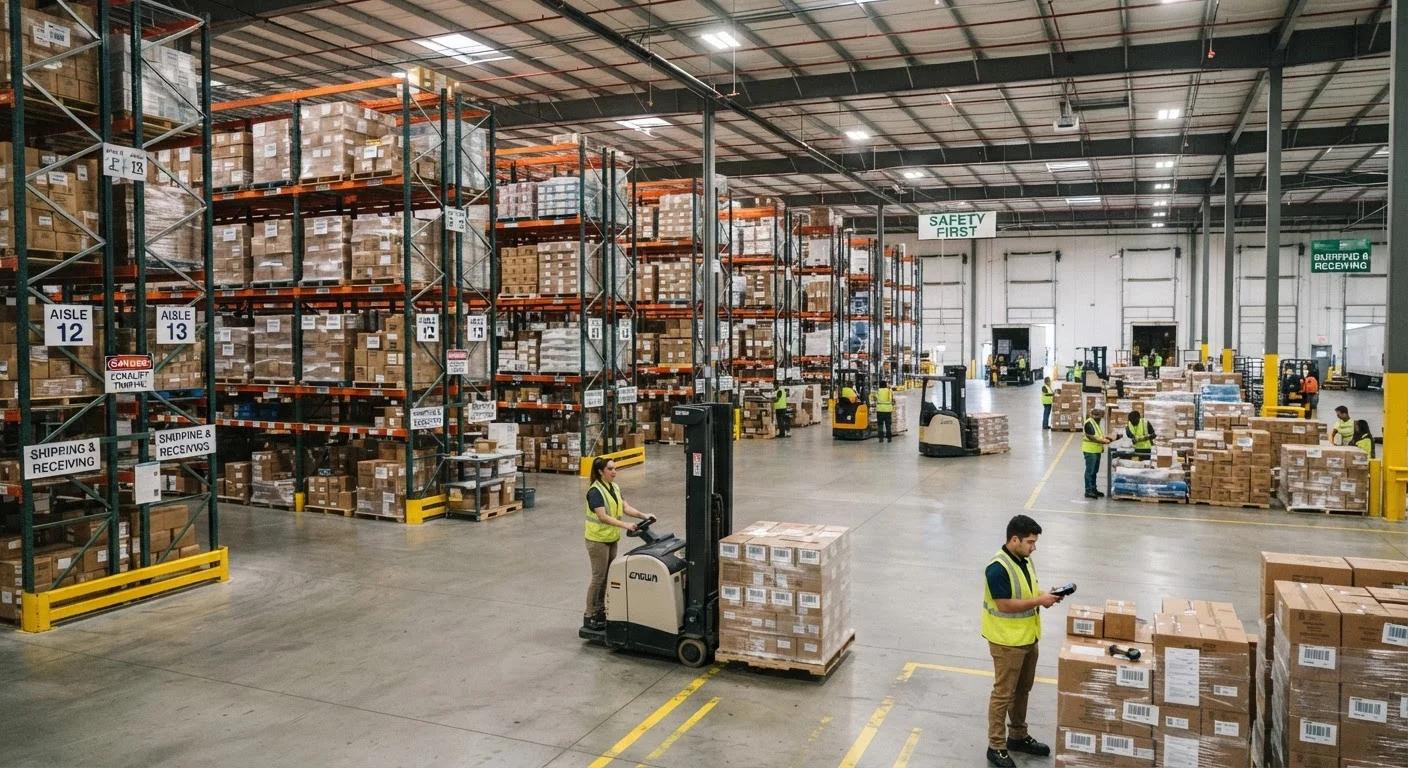
Warehousing is typically where logistics costs concentrate first. Whether a business operates its own facility, leases third-party space, or uses fulfillment center networks, the core challenge is the same: maintaining enough inventory to meet demand without tying up excessive working capital in stock.
Start with ABC Analysis for Inventory Slotting
Classify SKUs by pick frequency: 'A' items (highest velocity) should occupy the most accessible storage positions closest to packing stations. This simple principle reduces pick labor hours meaningfully even before any technology investment. Many growing businesses achieve double-digit efficiency gains in warehouse labor simply by reorganizing slotting based on actual order data.
Inventory management frameworks - particularly the interplay between reorder points, safety stock levels, and lead times - determine how efficiently a warehouse operates. A warehouse with poor slotting (the placement of SKUs based on pick frequency) or inadequate receiving workflows creates labor inefficiencies that compound as volume scales.
Key warehousing decisions for growing businesses include:
- Lease vs. own: Owned facilities provide long-term cost stability but limit flexibility; leased space offers adaptability but can tighten during peak demand periods.
- Single vs. distributed network: A single central warehouse minimizes overhead but increases last-mile shipping costs to distant customers. Multiple regional locations improve transit times but multiply fixed costs.
- Storage configuration: Racking systems, cold storage requirements, and pick path design all influence throughput capacity.
~8%
Logistics costs as share of US GDP
The Council of Supply Chain Management Professionals (CSCMP) annually estimates US business logistics costs as a percentage of GDP, reflecting the sector's scale.
65-70%
Transportation's share of total logistics costs
Transportation typically accounts for the majority of total logistics expenditure for US businesses, making carrier strategy a core cost lever.
2-4×
Cost multiplier of poor inventory positioning
Industry practitioners estimate that suboptimal inventory placement can multiply last-mile shipping costs significantly compared to well-designed distribution networks.
Transportation Modes and Carrier Relationships
Transportation typically represents the largest variable cost in a logistics operation. Mode selection - truckload (TL), less-than-truckload (LTL), parcel, rail, air freight, or intermodal - should align with shipment characteristics, service requirements, and cost constraints rather than habit or convenience.
For a deeper look at mode trade-offs and carrier selection principles, the Freight & Shipping hub covers foundational concepts applicable to businesses at every stage of growth.
When evaluating carriers, request their on-time delivery metrics segmented by lane, not just overall network averages. Lane-level performance data reveals where a carrier actually excels versus where it struggles.
Aggregate carrier scorecards mask lane-specific variability that directly affects your customers' experience. Informed lane-by-lane selection builds a more resilient carrier mix.
Negotiate accessorial charge caps - not just base rates - when finalizing carrier contracts. Fuel surcharges, liftgate fees, and address correction charges can easily exceed negotiated rate savings if left unaddressed.
Accessorial charges are among the fastest-growing components of freight invoices and are frequently overlooked during the rate negotiation process.
Beyond mode selection, carrier relationship management is a strategic function. Businesses that treat carriers purely as transactional vendors often find themselves deprioritized during capacity crunches - a structural disadvantage in volatile freight markets. Consistent volume commitments, accurate tender lead times, and clear communication on freight characteristics build the carrier goodwill that translates into reliable service.
Rate negotiation is one dimension of carrier management, but contract structure matters equally. Understanding fuel surcharge mechanisms, accessorial charge schedules, and claims procedures can prevent significant unplanned costs over time.
Technology Systems That Drive Logistics Efficiency
Two technology platforms underpin modern logistics operations at scale: the Warehouse Management System (WMS) and the Transportation Management System (TMS). A WMS governs inventory location, pick and pack workflows, labor management, and receiving accuracy inside a facility. A TMS manages carrier selection, rate shopping, shipment booking, tracking visibility, and freight audit functions across the transportation network.
For businesses earlier in their growth curve, enterprise-grade platforms may be premature. Many mid-market businesses operate effectively with cloud-based, subscription WMS and TMS solutions that integrate with e-commerce platforms and ERP systems without requiring significant IT infrastructure investment.
Integration Complexity Is Often Underestimated
Connecting a WMS or TMS to existing ERP, e-commerce, and accounting systems typically requires more configuration time and budget than initial vendor estimates suggest. Building in a 30-50% buffer on integration timelines and costs is a common practical guideline among logistics technology practitioners. Factor this into project planning before committing to go-live dates.
The sequencing of technology adoption matters. Businesses that implement a TMS before establishing clean inventory data and stable order workflows often find the system reveals - rather than solves - underlying process problems. Building operational discipline first yields better returns from technology investment.
Outsourcing vs. Building In-House Logistics Capacity
One of the most consequential decisions a growing business faces is whether to build proprietary logistics infrastructure or outsource to third-party logistics providers (3PLs) or fourth-party logistics partners (4PLs). Neither path is universally superior - the right choice depends on volume, product characteristics, service requirements, and the organization's operational competence.
Our analysis in Logistics Outsourcing: Weighing the Gains Against the Loss of Control explores these trade-offs in depth. At a high level, outsourcing accelerates scalability and converts fixed costs to variable costs, but it also shifts real-time visibility and process control to an external party - a trade-off that deserves careful evaluation before signing long-term 3PL contracts.
Read 3PL Contracts Carefully Before Signing
Long-term 3PL agreements often include volume commitment clauses, technology lock-in provisions, and termination fees that can be difficult and expensive to exit. Ensure contract terms align with your growth projections - not just your current volume - and that service level agreements include meaningful remedies for non-performance. Engage a logistics attorney or experienced operations adviser before finalizing any multi-year outsourcing agreement.
Businesses that retain in-house logistics operations gain direct control over service quality, data, and customer experience but take on significant capital requirements, workforce management complexity, and operational risk. The optimal structure for many mid-size businesses is a hybrid: in-house management of the highest-velocity, most differentiated fulfillment activities, with 3PL support for overflow, seasonal surges, or geographic expansion.
Financing Growth in Logistics Operations
Logistics infrastructure - warehouse space, material handling equipment, fleet assets, and technology platforms - requires sustained capital investment. Growing businesses frequently underestimate the working capital demands of scaling logistics before the revenue growth from that scaling materializes.
Strong business credit gives logistics-dependent businesses more leverage when financing equipment, negotiating supplier payment terms, and accessing credit facilities that smooth cash flow during high-growth periods. Companies that build credit profiles early are better positioned to access favorable financing when capital needs accelerate.
This article provides general educational information about logistics operations and business finance concepts. It is not personalized financial, legal, or operational advice. Businesses should consult qualified logistics advisers, accountants, and financial professionals before making significant operational or capital investment decisions.