

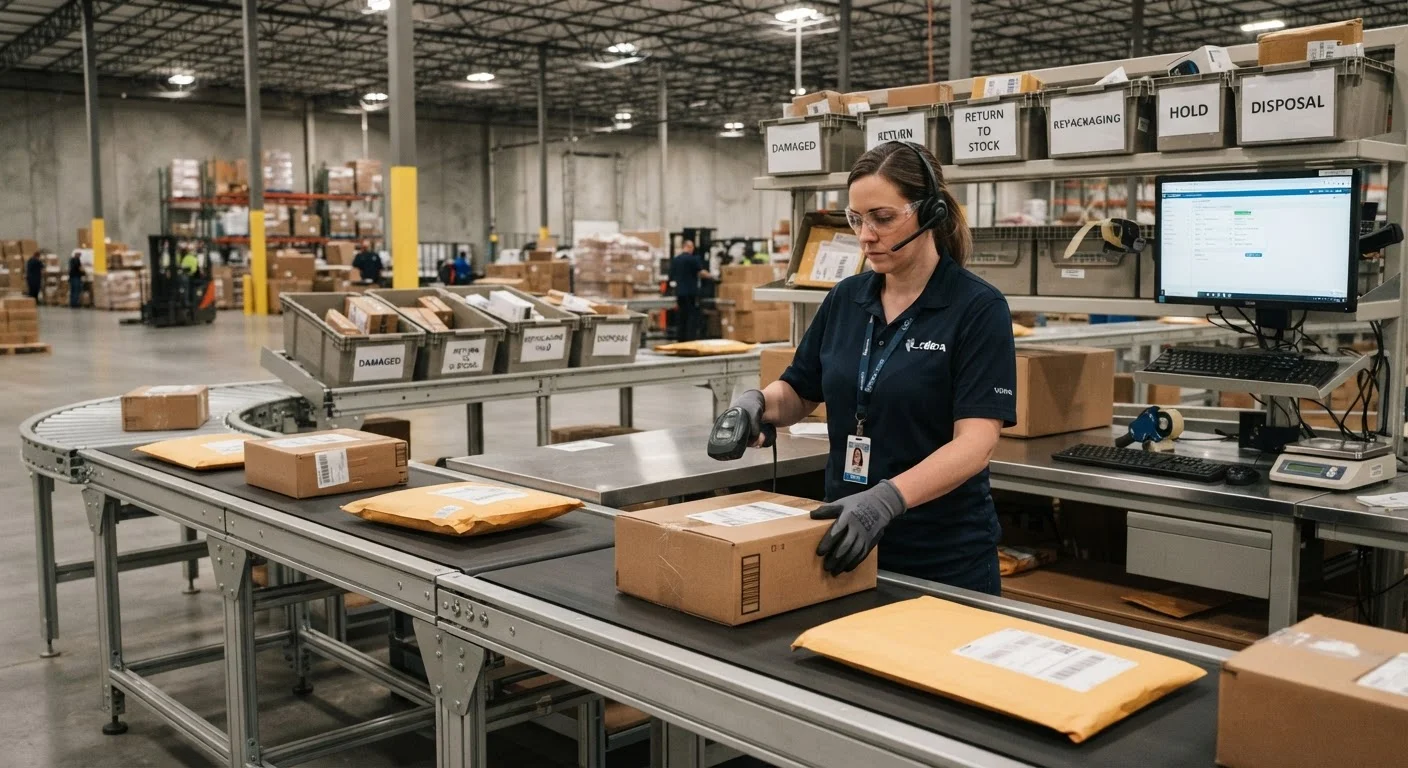
Key Takeaways
Why Reverse Logistics Deserves Its Own Strategy
Most logistics planning focuses on moving goods forward - from supplier to warehouse to customer. The return journey rarely gets the same attention, and that gap is expensive. Across US retail and e-commerce, product return rates commonly range from 15% to over 30% depending on category, according to industry estimates. Each returned unit triggers a sequence of decisions that, if unmanaged, consume labor, distort inventory records, and delay value recovery.
Reverse logistics - the process of moving goods from customer back through the supply chain - encompasses return authorization, transportation, receipt, inspection, sorting, and final disposition. Unlike forward logistics, the inputs are unpredictable: items arrive in varying conditions, with inconsistent packaging, and often without full documentation. That variability is precisely why a reactive approach consistently underperforms.
Understanding how returns fit into your broader operation is foundational. See our overview of core logistics systems for context on how reverse flows interact with warehousing and inventory management.
Up to 30%
Return rate for e-commerce apparel and footwear
Industry estimates consistently place return rates for soft goods categories between 20-30%, far above the general retail average of roughly 8-10%.
~$0.59
Cost to process every dollar of returned goods
Logistics industry analyses suggest that processing a return can cost retailers between $0.50 and $0.75 per dollar of the original sale, driven by labor, transportation, and disposition expenses.
Where Returns Operations Most Commonly Break Down
The most frequent failure points in reverse logistics are structural, not accidental. They appear when returns are processed using the same workflows designed for inbound supplier shipments - workflows that assume consistent quantities, known condition, and pre-established disposition.
Without a dedicated return merchandise authorization (RMA) process, returns arrive unannounced, creating receiving bottlenecks. Without an inspection protocol, items of salvageable quality get disposed alongside truly damaged goods. Without a disposition matrix - a decision framework that maps condition to action (restock, refurbish, liquidate, recycle, discard) - warehouse staff make inconsistent judgment calls that accumulate into margin losses.
Inventory accuracy is another common casualty. Returned items that sit in a staging area unprocessed for days or weeks are effectively invisible to the inventory system - neither available for resale nor accounted for as shrinkage. This creates phantom stock problems that ripple outward into order fulfillment and demand forecasting. The root causes of inventory inaccuracy are well documented, and unprocessed returns rank among the most common triggers.
Returns Visibility Starts with Your WMS
Many warehouse management systems (WMS) have native returns processing modules that go underutilized. Before building manual workarounds, review whether your existing WMS supports RMA tracking, condition grading, and automatic inventory updates on receipt. Enabling these features often requires configuration rather than new software. If your WMS lacks this capability, it's worth factoring returns processing into any future system evaluation.
Best Practices for a Recoverable Returns Process
Businesses that consistently recover value from returns share a set of operational disciplines. These aren't high-cost transformations - most can be implemented incrementally within existing warehouse and systems infrastructure.
Implement a formal return merchandise authorization (RMA) process before goods ship back.
Requiring customers to initiate a return through a structured RMA system gives your operation advance notice of incoming volume and condition. It also captures the reason for return, which feeds quality and product data that improves upstream decisions.
Establish a written disposition matrix tied to inspection outcomes.
Without a documented decision framework, disposition relies on individual judgment - which is inconsistent and difficult to audit. A matrix maps condition grades (e.g., unopened, functional, damaged, non-resalable) to specific actions, removing ambiguity and accelerating throughput.
Process returns within a defined time window - ideally within 48 hours of receipt.
Delayed processing compounds every downstream problem: inventory remains inaccurate, resalable goods lose time-to-market, and staging areas become congested. A defined processing SLA creates accountability and prevents returns from becoming a perpetual backlog.
Separate the physical returns flow from your standard inbound receiving dock.
Commingling returns with supplier inbound shipments creates congestion, mislabeling risk, and workflow confusion. A dedicated returns lane - even in a small facility - preserves the integrity of both processes.
Evaluate outsourced returns processing for high-volume or complex categories.
Third-party logistics providers (3PLs) that specialize in reverse logistics often have refurbishment capabilities, liquidation networks, and compliance infrastructure that are expensive to replicate in-house. For businesses with high return rates, outsourcing the reverse flow can be more cost-effective than building internal capacity. See our analysis of logistics outsourcing trade-offs for a structured framework.
Metrics That Reveal Returns Performance
Returns management should be measured independently of forward logistics performance. A low overall cost-per-shipment figure can mask a costly returns operation if the two are tracked together. Key metrics to monitor include: return rate by SKU or category, average processing time from receipt to disposition, recovery rate (the percentage of return value recaptured through resale or liquidation), and cost-per-return including labor, transportation, and disposal fees.
These metrics also expose systemic product or process issues. A high return rate on a specific SKU often signals a quality, packaging, or product description problem - information valuable far beyond the logistics team. Integrating returns data into broader operational reviews is a practice covered in our guide to logistics KPIs.
This article provides general operational and educational information about logistics practices. It is not financial, legal, or professional consulting advice. Businesses should evaluate their specific circumstances and consult qualified advisers when making significant operational or financial decisions.