

Key Takeaways
Option A
Integrated Campaigns
The coordinated, multi-touchpoint approach.
Best for: Best for brands building awareness, nurturing complex buyer journeys, or reinforcing a message across diverse audience segments.
Option B
Single-Channel Campaigns
The focused, high-depth channel strategy.
Best for: Best for lean budgets, time-sensitive promotions, or when one channel demonstrably reaches the full target audience.
If you have a limited budget and a tightly defined audience
Single-Channel Campaigns
Concentrating spend on the one channel where your audience is most active typically delivers stronger frequency and clearer attribution than spreading the same budget thinly across platforms.
If you are driving a long, consultative B2B buying cycle
Integrated Campaigns
Complex purchases involve multiple stakeholders and research touchpoints; coordinated messaging across email, paid search, and content reinforces credibility at each stage.
If you need rapid results and clear performance data
Single-Channel Campaigns
Fewer variables make attribution straightforward, allowing faster optimization cycles without the overhead of cross-channel reporting.
If you are launching a new brand or repositioning an existing one
Integrated Campaigns
Brand building requires repeated, consistent exposure across the channels where prospects already spend time - no single platform delivers sufficient reach on its own.
What Each Approach Actually Means
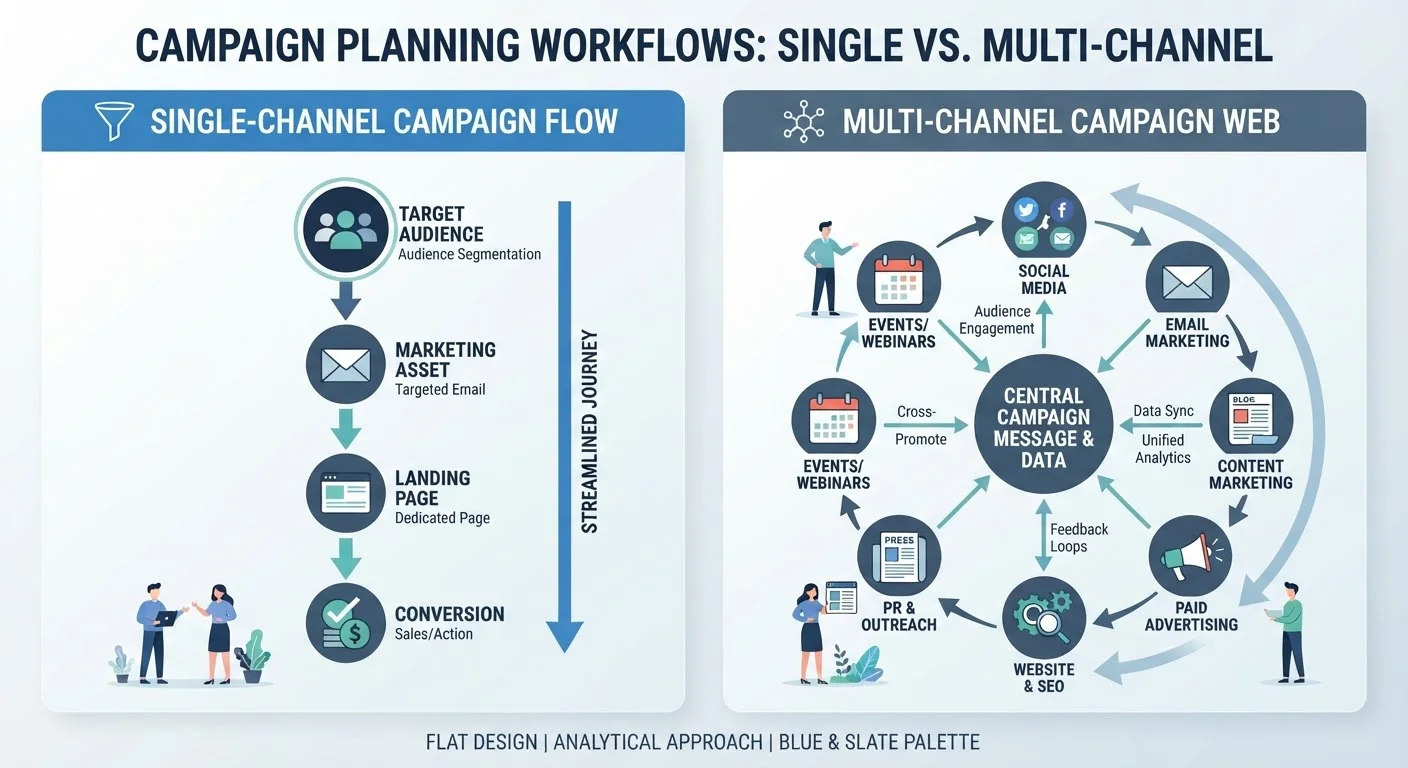
An integrated campaign coordinates messaging, creative assets, and targeting across two or more channels - paid search, social, email, display, content, or out-of-home - so that each touchpoint reinforces the others. The goal is a coherent experience regardless of where the prospect encounters the brand.
A single-channel campaign concentrates all planning, creative, and budget within one platform or media type. Rather than orchestrating multiple executions, the team goes deep on one environment: refining targeting, testing creative variations, and maximizing reach within that channel's mechanics.
Both structures can be legitimate strategic choices. The error most teams make is defaulting to one without evaluating whether it suits the objective. Clearly defined campaign objectives are the prerequisite that makes this decision meaningful.
| Criterion | Integrated Campaigns | Single-Channel Campaigns |
|---|---|---|
| Channel count | Two or more coordinated channels | One platform or media type |
| Budget requirement | Higher - spread across channels | Lower threshold to meaningful depth |
| Attribution complexity | High - requires cross-channel modeling | Low - straightforward measurement |
| Creative production demand | High - adapted assets per channel | Lower - focused on one format |
| Best journey stage fit | Awareness through consideration | High-intent decision or conversion |
| Optimization speed | Slower - more variables to isolate | Faster - fewer moving parts |
| Brand building potential | High - reinforces across touchpoints | Limited to one audience environment |
The Case for Integrated Campaigns
Integrated campaigns earn their complexity when the buyer journey is non-linear. A prospective customer may discover a brand through a display ad, research it via organic search, re-engage through a retargeted social post, and convert after an email. Leaving gaps in that sequence risks losing them to a competitor who maintains presence.
Consistent cross-channel messaging also compounds brand recognition. When the same value proposition appears across multiple environments, recall improves - an effect sometimes described as the mere exposure effect in behavioral research. For category-defining launches or competitive repositioning, this breadth is difficult to replicate from a single channel.
The trade-off is real: integrated campaigns demand more creative production, stronger coordination between teams or agencies, and more sophisticated attribution modeling. Spreading budget without structure is one of the most common failure modes, making disciplined channel prioritization essential.
3-5x
Typical touchpoints before B2B purchase decision
Research on B2B buyer behavior consistently finds that prospects engage with multiple content sources before contacting a vendor, underscoring the value of multi-channel presence in complex sales.
~60%
Marketers citing attribution as a top multi-channel challenge
Industry surveys regularly identify cross-channel attribution as one of the most difficult operational problems for teams running integrated campaigns, reflecting the measurement overhead involved.
The Case for Single-Channel Campaigns
A single-channel approach is not a fallback for under-resourced teams - it is often the strategically correct choice. When the audience is concentrated on one platform, budget depth on that channel beats shallow reach across many. Paid search, for instance, captures demand at the moment of intent; for a service business with a narrow, high-intent audience, additional channels may add noise rather than signal.
Single-channel campaigns also simplify performance measurement. With fewer variables, teams can run controlled creative tests, attribute conversions with confidence, and iterate quickly. This is particularly valuable early in a product's life, when the goal is learning what message resonates rather than maximizing reach.
Understanding how channel selection criteria apply to your specific audience and objective is the foundation of this decision. A channel dominant in one vertical may be peripheral in another.
How to Choose: A Decision Framework
Three factors should drive the decision:
- Buyer journey length and complexity. Short, transactional journeys often suit single-channel depth. Long, multi-stakeholder journeys typically require integrated presence.
- Budget relative to channel costs. A budget that funds meaningful frequency on one channel may produce negligible impact if split across four. Review business budgeting principles to ground campaign spend in sustainable financial planning.
- Creative and operational capacity. Integrated campaigns require adapted assets for each channel's format and audience context. Launching integrated with thin creative production often yields inconsistent execution - a worse outcome than a disciplined single-channel effort.
The choice also interacts with campaign direction. Push and pull strategies each map differently to channel structures: pull campaigns anchored in search intent may need only one channel, while push campaigns building awareness generally benefit from multi-channel reach.
Hybrid Structures Are Common in Practice
Many campaigns combine elements of both approaches: a primary channel receives the bulk of the budget and creative focus, while one or two secondary channels provide light-touch reinforcement. This reduces integration complexity while preserving some cross-channel benefit. The key is intentionality - secondary channels should serve a defined role, not simply absorb leftover budget. See how paid social and paid search serve different campaign goals as an example of deliberate channel pairing.
This article provides general marketing information and education. It does not constitute personalized business, financial, or legal advice. Consult qualified professionals before making significant campaign or budget decisions for your organization.