

Key Takeaways
Option A
Push Marketing
The proactive, audience-initiated broadcast approach.
Best for: Best for businesses launching new products, entering new markets, or needing to generate immediate awareness at scale.
Option B
Pull Marketing
The demand-driven, audience-attracted content approach.
Best for: Best for businesses building long-term brand authority and capturing high-intent buyers who are already searching for solutions.
If you need to generate immediate awareness for a new product launch
Push Marketing
Push tactics - paid media, direct outreach, trade promotions - can rapidly expose a new offering to a broad audience before organic demand has formed.
If you want to reduce customer acquisition costs over the long term
Pull Marketing
SEO, content marketing, and community building accumulate authority over time, attracting high-intent buyers without proportional increases in media spend.
If you are entering a competitive, established market with strong alternatives
Push Marketing
Standing out in a crowded field often requires proactive placement in front of buyers before they default to familiar competitors.
If your product has a long consideration cycle and education-dependent decision making
Pull Marketing
Content that answers buyer questions at each research stage builds trust and positions your brand as the credible authority when purchase decisions are made.
If you are balancing immediate results with sustainable brand growth
Push Marketing
Use push tactics to fund short-term revenue while simultaneously investing in pull infrastructure - each model reinforces the other in a mature campaign architecture.
Defining the Two Directions
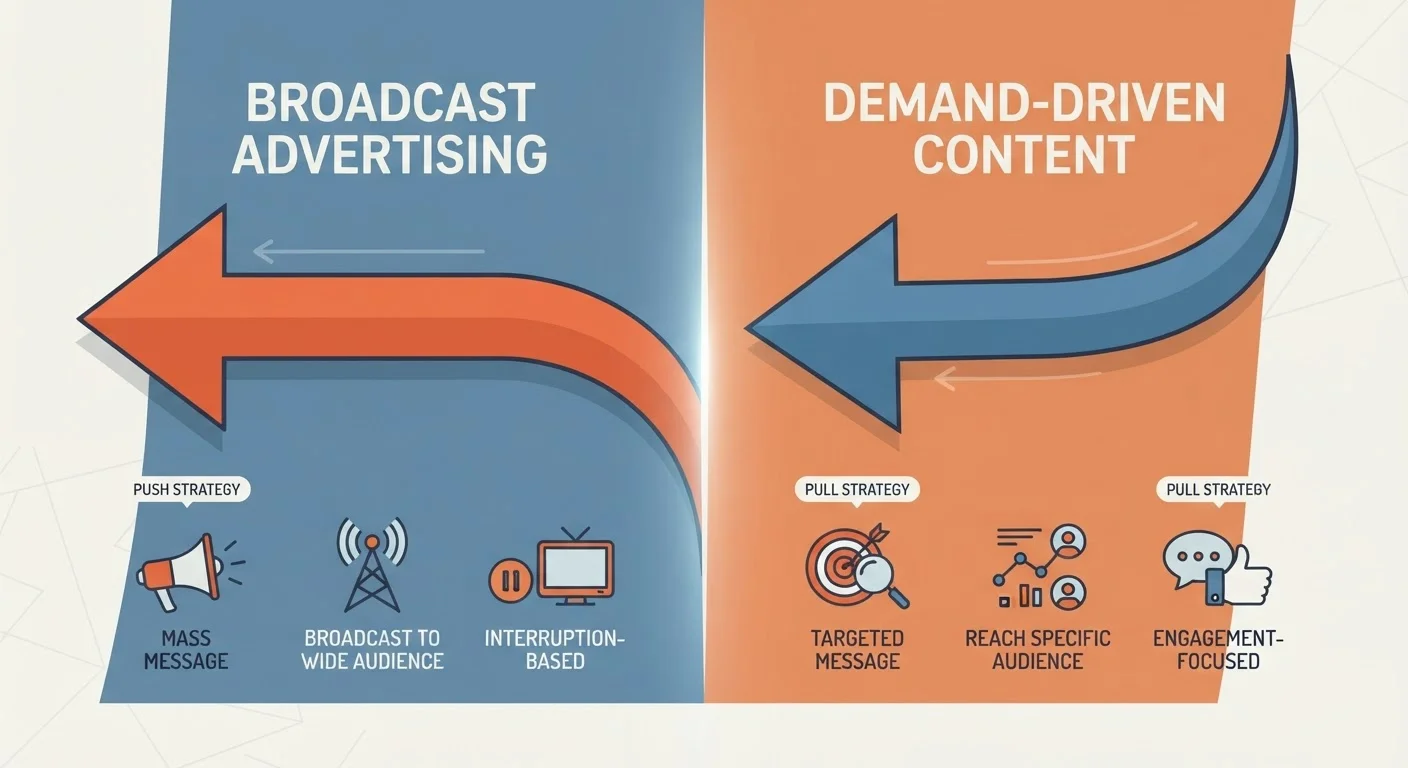
At its core, the push-pull distinction describes the direction of marketing effort relative to buyer intent. Push marketing means taking your message directly to an audience that has not yet expressed interest. Pull marketing means creating conditions that attract buyers who are already seeking what you provide.
Push tactics include paid display advertising, direct mail, cold outreach, trade show promotion, and broadcast media - channels where the brand initiates contact. Pull tactics include search engine optimization (SEO), content marketing, social proof, referral programs, and inbound lead generation - channels where the buyer takes the first step. Understanding this structural difference is foundational to sound campaign strategy.
Neither approach is inherently superior. Each is suited to different market conditions, buyer readiness states, and business objectives. The strategic question is not which model is better, but which is better right now for your specific situation.
How Each Strategy Works in Practice
Push marketing works by placing your message in front of defined audience segments before they initiate a search. A B2B software company running LinkedIn sponsored content to job-title-targeted audiences is pushing. A consumer packaged goods brand negotiating retail shelf placement is pushing. The mechanism is reach-first: create awareness, then move audiences toward consideration.
Pull marketing works by making your brand visible and credible at the moment buyers are actively looking. A company that ranks on the first page of search results for high-intent queries, publishes a respected industry blog, or earns consistent word-of-mouth referrals is pulling. The mechanism is relevance-first: earn attention at the point of need.
| Criterion | Push Marketing | Pull Marketing |
|---|---|---|
| Buyer intent at contact | Low - brand initiates | High - buyer initiates |
| Time to results | Fast (days to weeks) | Slower (months to years) |
| Cost structure | Ongoing media spend | Upfront investment, lower marginal cost |
| Typical channels | Paid ads, direct mail, outbound sales | SEO, content, referrals, inbound |
| Scalability | Scales with budget increases | Compounds over time organically |
| Best market condition | New or low-awareness markets | Active search demand exists |
| Audience relationship | Interruption-based | Permission-based |
Your marketing funnel structure should inform which model leads at each stage. Push tactics are typically strongest at the awareness layer; pull tactics compound value in the consideration and decision layers.
Choosing Based on Market Conditions and Campaign Goals
Several variables should guide which direction leads your campaign planning:
- Market maturity: In nascent markets where buyers don't yet know they have a problem, pull strategies have limited reach because no one is searching. Push creates the category awareness that enables pull to work later.
- Timeline: Pull marketing - particularly SEO and content - takes months to produce measurable results. If your campaign has a 30-day window, push tactics are the primary lever.
- Budget structure: Push campaigns often require ongoing media spend to maintain reach; pull investments may require higher upfront content or technical investment but lower ongoing costs per acquisition.
- Buyer intent signals: If your analytics show high search volume for problems your product solves, pull strategies can capitalize on existing demand. Absent that signal, push must create the demand.
Push and Pull Are Not Channel Labels
It's common to conflate push marketing with paid media and pull marketing with organic content - but the distinction is about buyer intent, not channel type. Paid search, for instance, can function as a pull tactic when it captures high-intent queries. Email marketing can be push (cold outreach) or pull (opted-in nurture). Evaluate tactics by the intent state they target, not simply the medium they use.
For guidance on matching each strategy to the right media environment, see ad channel frameworks that map channel characteristics to push and pull mechanics.
Combining Push and Pull in Campaign Architecture
The most durable campaigns use both strategies in a coordinated structure. Push tactics generate top-of-funnel awareness and drive traffic to pull assets - landing pages, content hubs, email sequences. Pull assets then do the sustained work of converting interest into intent.
A practical example: a B2B services firm runs paid search ads (push) targeting broad category terms, sending traffic to a detailed thought-leadership resource (pull). Readers who engage are enrolled in a nurture sequence (pull). Over time, organic search traffic to the resource grows, reducing dependence on paid spend while the ads continue seeding new audiences. This compounding structure is what separates tactical execution from integrated campaign thinking.
3x
More leads from content than outbound
Research from HubSpot has consistently found that inbound (pull) tactics generate significantly more leads per dollar than traditional outbound (push) approaches, though results vary by industry and execution.
6-12 months
Typical SEO ramp time for pull results
Industry practitioners widely cite a 6-12 month horizon before SEO investments produce meaningful organic traffic, underscoring why push tactics often lead in early campaign phases.
49%
Of marketers report organic search as top ROI channel
According to Search Engine Journal's State of SEO reports, organic search consistently ranks among the highest-ROI channels - a core advantage of pull strategy at scale.
When evaluating execution models - whether in-house or through an agency - the push-pull balance also affects resource requirements. Pull-heavy strategies require sustained content production and technical SEO capability; push-heavy strategies require media buying expertise and real-time optimization. See a full comparison in our analysis of in-house vs. agency campaign management.
This article is for general informational and educational purposes only. It does not constitute personalized marketing, financial, or business advice. Consult qualified professionals before making significant strategic or financial decisions for your organization.