

Key Takeaways
Marketing Funnel
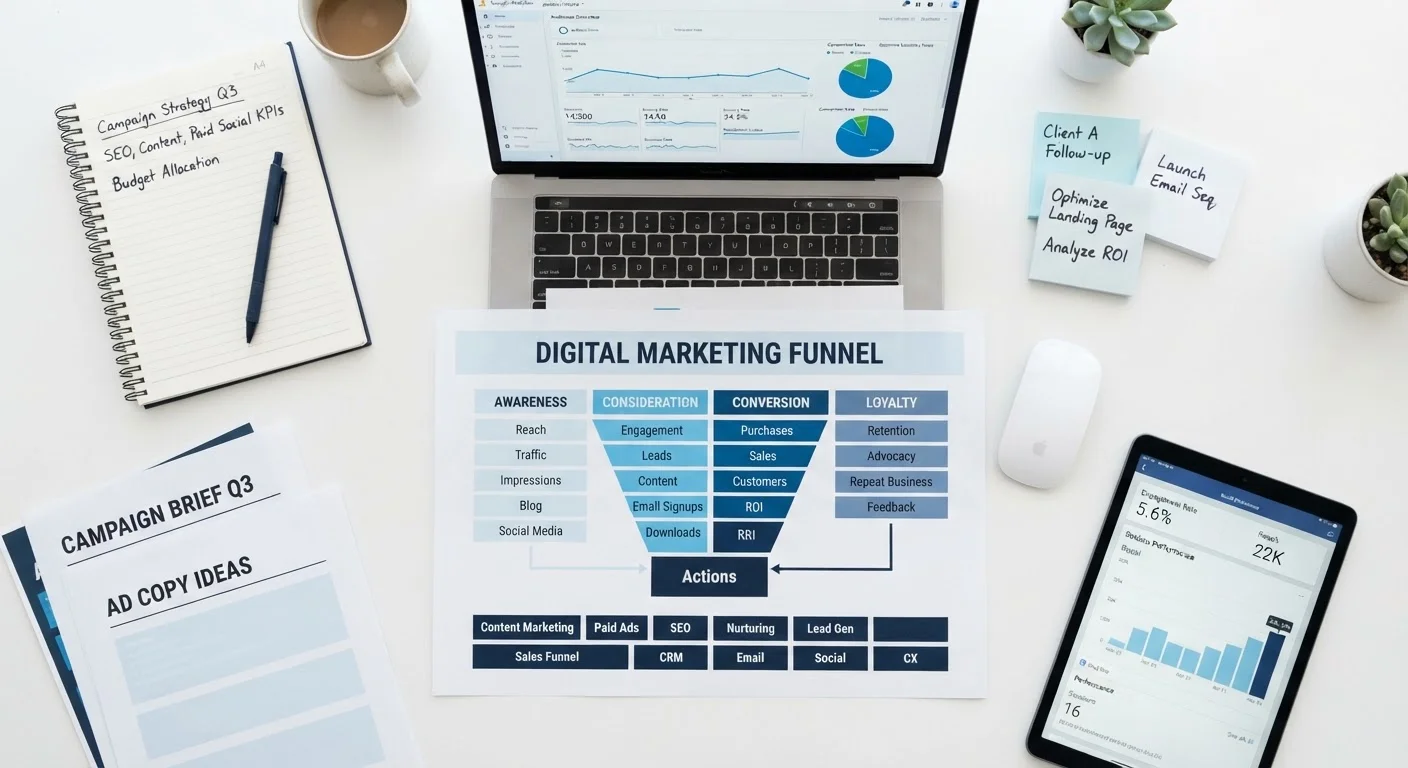
The marketing funnel is a strategic model that maps the stages a prospective customer moves through - from first becoming aware of a brand to making a purchase decision. It is typically divided into three broad phases: awareness (top of funnel), consideration (middle of funnel), and conversion (bottom of funnel). Marketers use this structure to plan campaigns with appropriate messaging and channels at each stage.
Some practitioners extend the classic three-stage funnel to include retention and advocacy stages, reflecting the full customer lifecycle rather than just acquisition.
Why the Funnel Is a Planning Tool, Not Just a Concept
The marketing funnel is frequently described as a theoretical model, but its practical value lies in structuring decisions before a campaign launches. When campaign planners use the funnel as an organizational tool, it forces clarity on three fundamental questions: Who is the audience right now? What do they need to believe before taking action? And which channels reach them at that moment in their journey?
Without this structure, campaigns often become unfocused - combining awareness messaging with conversion offers in a single execution, or directing high-intent budget toward audiences who have never heard of the brand. The funnel prevents these misalignments by creating a planning hierarchy.
For a broader view of how strategy shapes campaign outcomes, see campaign strategy fundamentals.
96%
Website visitors not ready to buy on first visit
Research from Marketo has indicated that the vast majority of site visitors are in awareness or consideration stages, not conversion-ready.
3-5x
Higher conversion rates with funnel-aligned nurture
Marketing automation studies consistently show that leads nurtured through stage-appropriate content convert at significantly higher rates than those who are not.
79%
Marketing leads that never convert due to poor nurture
MarketingSherpa research has reported that a large share of marketing-qualified leads fail to convert when no structured consideration-stage follow-up exists.
Mapping Funnel Stages to Messaging and Creative
Each funnel stage demands a different communication objective, and that difference should drive creative decisions directly.
Awareness (top of funnel): The goal is recognition and relevance. Messaging at this stage should introduce the brand's core value proposition in terms the audience immediately connects with. Formats that work here - video, display, and native content - prioritize reach over depth. Avoid calls to action that presuppose knowledge the audience does not yet have.
Consideration (middle of funnel): Prospects know the brand exists but are evaluating options. Content here should demonstrate credibility, address objections, and differentiate. Case studies, comparison guides, webinars, and email sequences are appropriate formats. Messaging frameworks help ensure this content stays coherent across multiple touchpoints.
Conversion (bottom of funnel): The audience is ready to act, and friction is the primary barrier. Messaging should be direct, benefit-forward, and paired with a single, unambiguous call to action. Retargeting, paid search, and conversion-optimized landing pages are the primary tools at this stage.
Align Creative Briefs to Funnel Stage
Before briefing any creative team, specify which funnel stage the campaign serves. This single decision should govern format, message depth, and call-to-action strength. A creative brief that conflates awareness and conversion objectives typically produces work that achieves neither. Funnel stage clarity is the most efficient filter a campaign strategist can apply early in the process.
Channel Selection Through a Funnel Lens
Channel decisions are most defensible when they follow funnel logic rather than habit or assumption. A channel suited to one stage can actively underperform at another - not because the channel is poor, but because the audience's readiness level does not match the channel's typical use case.
Paid social platforms, for example, excel at building awareness because their targeting capabilities can surface a brand to large, cold audiences efficiently. The same platforms can support consideration through retargeting sequences. But using broad social placements to drive direct purchase from cold audiences often produces weak return on ad spend.
Search advertising operates differently: users actively querying a product category are already in consideration or conversion mode. Investing heavily in search before building awareness can leave a brand competing for demand it did not help generate.
The ad channels hub explores how individual channels align with campaign objectives across the funnel. For a methodical approach to channel decisions, see channel selection in campaign strategy.
Budgeting and Measurement Across Funnel Stages
Budget allocation should reflect a clear diagnosis of where the business currently has the greatest gap. A company with strong brand awareness but a stalled pipeline should weight investment toward consideration. One with healthy engagement but poor close rates should examine conversion stage execution and landing experience.
Measurement frameworks must also shift by stage. Applying cost-per-acquisition benchmarks to awareness campaigns produces misleading conclusions - those campaigns are not designed to convert directly. Awareness metrics (reach, frequency, aided recall) are the appropriate lens. Similarly, optimizing consideration campaigns purely on impressions ignores their actual function: moving prospects toward a decision.
Building a campaign from the ground up provides a structured walkthrough of how these measurement decisions integrate with the broader planning process. Teams new to funnel-based planning may also find this practical starting point useful for grounding these concepts in execution.
The funnel's enduring usefulness as a planning tool rests on one principle: different buyers need different things at different moments, and campaigns that recognize this consistently outperform those that do not.
This article is for informational and educational purposes only. It does not constitute personalized marketing, financial, or business advice. Consult a qualified marketing or business professional for guidance specific to your organization's circumstances.