

Key Takeaways
Campaign Strategy
A campaign strategy is a structured plan that defines what a marketing effort is trying to achieve, who it's meant to reach, and how it will use messaging and channels to get there. It provides the overarching logic that guides every tactical decision - from ad copy to media spend. Without a strategy, campaigns risk being a collection of disconnected activities rather than a unified push toward a business goal.
In practice, a campaign strategy is distinct from a marketing plan: it is time-bound, objective-specific, and built around a single organizing idea or value proposition.
Strategy vs. Tactics: Why the Distinction Matters
Many marketing teams confuse being busy with being strategic. Posting frequently, running ads, and sending emails are all tactical activities - useful only when they are guided by a clear strategic direction. A campaign strategy sits one level above those actions. It answers the foundational questions: What outcome are we driving toward? Who are we trying to move? What message will resonate with them, and through which channels?
This distinction matters because tactics without strategy tend to generate activity metrics - impressions, clicks, opens - rather than business outcomes like qualified leads or revenue. When a campaign underperforms, the root cause is often the absence of a coherent strategy, not a failure of execution.
“Strategy without tactics is the slowest route to victory. Tactics without strategy is the noise before defeat.”
— Sun Tzu, Ancient Chinese military strategist, widely cited in business and marketing literature
The Core Components of a Campaign Strategy
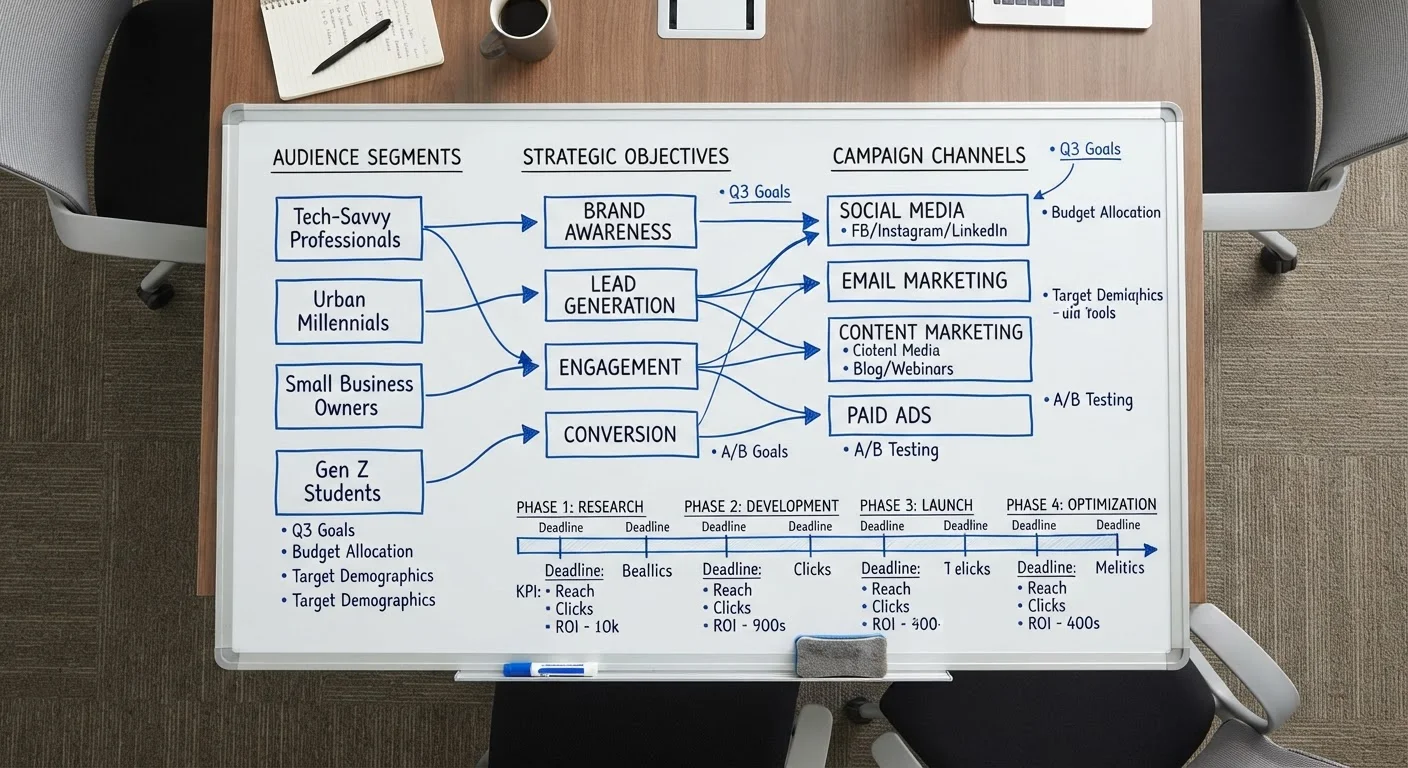
A sound campaign strategy is built from several interdependent elements that together create a coherent plan:
- Objective: A specific, measurable goal - such as generating 500 qualified leads in 60 days or increasing brand recall among a target segment. Vague goals produce vague campaigns.
- Target audience: A defined profile of the people the campaign is designed to reach, including their needs, behaviors, and decision-making context.
- Core message: The single idea the campaign communicates. Everything in the campaign - headlines, visuals, calls to action - should reinforce this message.
- Channel mix: The paid, owned, and earned media through which the campaign will reach its audience. See ad channel options for an overview of how different channels serve different objectives.
- Budget framework: How resources are allocated across channels and campaign phases, based on where the audience is most reachable and where conversion likelihood is highest.
- Key performance indicators (KPIs): The specific metrics that will determine whether the campaign succeeded. These must be established before launch, not retrofitted afterward.
72%
Marketers with documented strategy report greater success
According to the Content Marketing Institute's annual research, marketers who document their strategy consistently report higher effectiveness than those who do not.
3x
More likely to report success with a written plan
CoSchedule's State of Marketing research found that marketers with a documented plan were roughly three times more likely to report success than those working without one.
How Strategy Shapes Campaign Structure
A campaign strategy is not a static document - it actively structures how a campaign is built and run. The objective determines the funnel stage being addressed: an awareness campaign requires different channels and creative formats than a conversion campaign. See how the marketing funnel shapes campaign structure for a deeper look at this relationship.
The target audience informs channel selection - reaching senior financial decision-makers requires different placements than reaching early-career professionals. Explore the criteria for those decisions in channel selection in campaign strategy.
The core message determines creative direction and ensures consistency across every touchpoint. When strategy is clear, execution teams - creative, media, analytics - are all working from the same organizing logic, which reduces rework and internal misalignment.
Write Your Strategy Before Your Creative
Resist the temptation to start with ad concepts, visuals, or copy. Creative work should express a strategy, not substitute for one. A one-page strategic brief - objective, audience, message, channels, KPIs - takes hours to write and can save weeks of misaligned execution. Teams that brief well, produce better work faster.
Putting Strategy Into Practice
Understanding what a campaign strategy is only creates value when that understanding is applied. The practical starting point is to write a concise strategic brief before any creative or media work begins. This brief should be no longer than one to two pages and should answer each of the core components described above. Brevity signals clarity - if you cannot summarize the strategy simply, it is not yet ready to execute.
From there, the strategy should inform every downstream decision: building a marketing campaign from the ground up walks through the full planning process stage by stage. For teams running across multiple channels, it is also worth considering whether an integrated approach or a focused single-channel effort better serves the objective - a question explored in integrated campaigns vs. single-channel campaigns.
Finally, before launch, confirm that your KPIs are in place and trackable. Key metrics every campaign strategy should track provides a practical reference for the indicators that matter most, from reach and engagement to conversion rate and return on ad spend.