

Key Takeaways
Same-day linen turnaround improves operational agility
On-site processing means linens can be washed and returned to circulation within hours, reducing dependency on external delivery schedules and supporting tighter inventory management.
Direct quality control over every linen cycle
Management sets wash temperatures, detergents, and handling standards, reducing the risk of inconsistent results that can affect guest satisfaction scores.
Long-term cost advantages at high volume
For properties processing large volumes consistently, in-house operations can yield lower per-unit costs over time once capital equipment is amortized.
Greater flexibility for sustainability upgrades
Operators can invest in energy-efficient equipment, water recycling, and eco-certified detergents on their own timeline, aligning laundry operations with property-wide sustainability commitments.
No dependency on vendor availability or delivery schedules
Eliminating a third-party dependency reduces risk during peak periods, local supply disruptions, or unexpected occupancy surges.
High upfront capital investment required
Commercial washers, dryers, flatwork ironers, and folding equipment represent a significant capital outlay, plus ongoing maintenance and eventual replacement costs.
Dedicated space and staffing add fixed overhead
In-house laundry requires square footage that could otherwise generate revenue, along with a staffing complement that adds fixed labor costs regardless of occupancy.
Operator absorbs equipment failure risk
A breakdown during a high-occupancy period can create an immediate operational crisis, with repair lead times that a vendor contract would otherwise absorb.
Variable cost structure less flexible for seasonal properties
Fixed laundry costs continue during low-occupancy periods, whereas outsourced contracts typically scale with actual volume processed.
Compliance responsibility rests entirely with the property
Chemical handling, wastewater management, and equipment safety standards must be managed internally, adding regulatory burden to smaller operations.
Our Verdict
Neither model is universally superior. In-house laundry suits properties with high, consistent occupancy and the capital to invest in equipment, staffing, and space. Outsourced linen services offer flexibility and predictable per-unit costs that work well for smaller, seasonal, or limited-service properties. The right choice depends on a careful analysis of your property's operational profile, budget structure, and long-term service commitments.
Full-service hotels with stable, high occupancy and sufficient back-of-house space will generally benefit most from in-house laundry, while limited-service and seasonal properties are often better served by outsourcing.
Why This Decision Matters More Than It Looks
Linen management is one of those back-of-house functions that rarely surfaces in strategic conversations - until something goes wrong. A missed delivery from an external vendor before a fully booked weekend, or a laundry machine breakdown during peak season, quickly reveals how central this function is to guest experience and operational continuity.
For hotel operators evaluating this choice, the stakes extend well beyond laundry logistics. The decision touches capital allocation, staffing models, utility costs, storage requirements, and brand standards. It also intersects with broader questions about which functions belong in-house and which are better managed by specialists - a question explored across many service categories in the outsourcing and control trade-off literature. Understanding both models clearly is the starting point for a sound operational decision.
The Case for In-House Laundry
Running an on-property laundry operation gives hotel management direct control over one of the most visible quality indicators in hospitality: the condition of linens and towels. That control has real operational value.
Same-day linen turnaround improves operational agility
On-site processing means linens can be washed and returned to circulation within hours, reducing dependency on external delivery schedules and supporting tighter inventory management.
Direct quality control over every linen cycle
Management sets wash temperatures, detergents, and handling standards, reducing the risk of inconsistent results that can affect guest satisfaction scores.
Long-term cost advantages at high volume
For properties processing large volumes consistently, in-house operations can yield lower per-unit costs over time once capital equipment is amortized.
Greater flexibility for sustainability upgrades
Operators can invest in energy-efficient equipment, water recycling, and eco-certified detergents on their own timeline, aligning laundry operations with property-wide sustainability commitments.
No dependency on vendor availability or delivery schedules
Eliminating a third-party dependency reduces risk during peak periods, local supply disruptions, or unexpected occupancy surges.
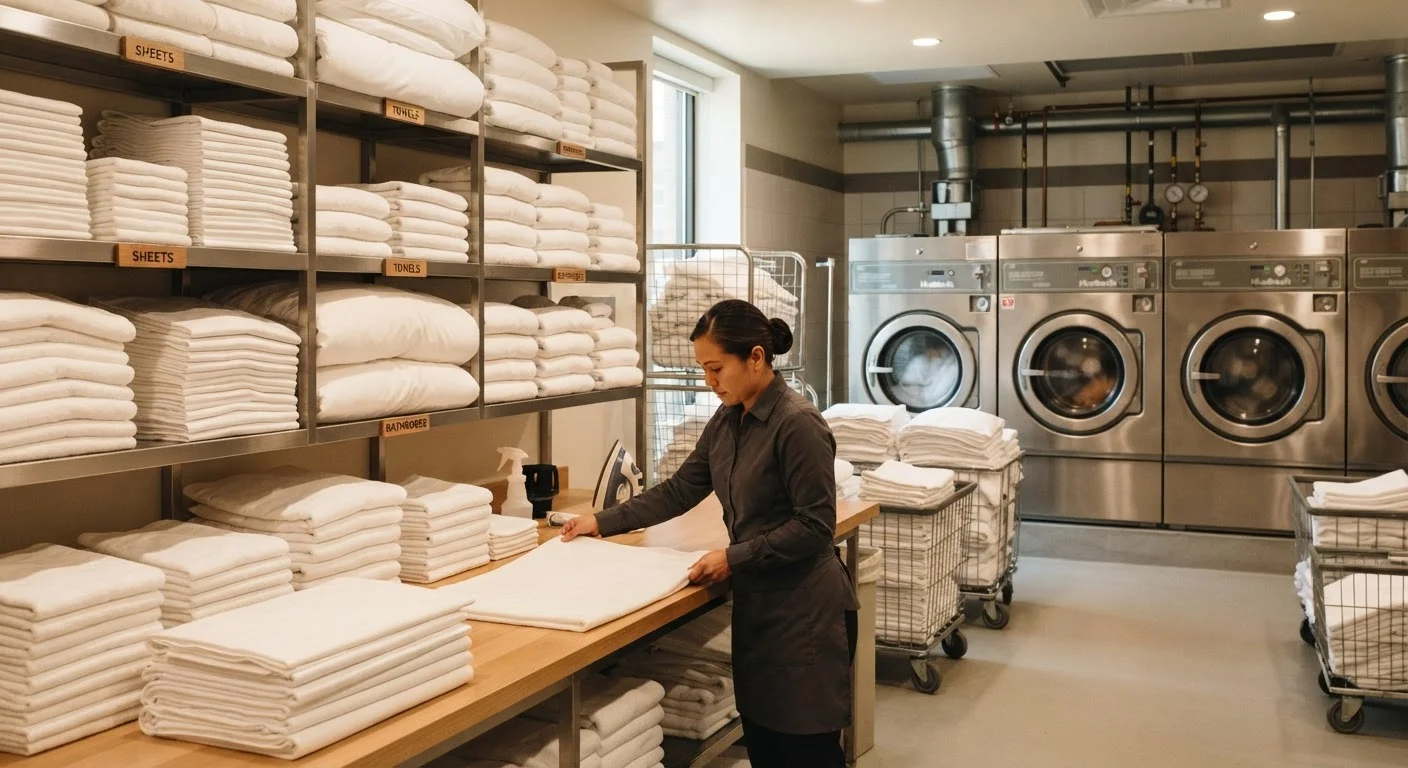
Properties that operate in-house laundry typically report faster turnaround on high-demand items - bath towels, bed sheets, and pool linens can be processed and returned to rotation the same day, rather than waiting on a vendor's delivery schedule. This agility is particularly important for full-service properties where service expectations are higher and inventory buffers narrower.
There is also a sustainability dimension. On-site facilities can be upgraded with energy-efficient washers, water recycling systems, and lower-temperature washing programs - steps outlined in broader discussions of hotel sustainability operations. This level of customization is harder to achieve when a third-party vendor controls the process.
The Case for Outsourced Linen Services
Commercial linen service providers operate at scale, which translates into processing efficiencies that a single hotel property is unlikely to match. For many operators - especially those in limited-service or seasonal segments - outsourcing is the more financially rational choice.
High upfront capital investment required
Commercial washers, dryers, flatwork ironers, and folding equipment represent a significant capital outlay, plus ongoing maintenance and eventual replacement costs.
Dedicated space and staffing add fixed overhead
In-house laundry requires square footage that could otherwise generate revenue, along with a staffing complement that adds fixed labor costs regardless of occupancy.
Operator absorbs equipment failure risk
A breakdown during a high-occupancy period can create an immediate operational crisis, with repair lead times that a vendor contract would otherwise absorb.
Variable cost structure less flexible for seasonal properties
Fixed laundry costs continue during low-occupancy periods, whereas outsourced contracts typically scale with actual volume processed.
Compliance responsibility rests entirely with the property
Chemical handling, wastewater management, and equipment safety standards must be managed internally, adding regulatory burden to smaller operations.
The core financial argument is the shift from fixed to variable costs. An in-house laundry requires capital outlay for washers, dryers, ironing equipment, and back-of-house space - plus ongoing costs for utilities, maintenance, and dedicated staff. Outsourcing replaces much of that with a per-piece or per-pound contract, which scales with occupancy. This structure can meaningfully improve cash flow predictability, a topic directly relevant to operators managing hospitality financing decisions.
30-40%
Typical linen cost as share of housekeeping budget
Industry estimates from hospitality operations consultants suggest linen-related costs - including laundering - can represent 30 to 40 percent of total housekeeping department expenses.
2-3x
Linen inventory multiple needed for outsourced rotation
Hotels using outsourced linen services typically need to maintain two to three par levels of linen inventory to accommodate vendor pickup and delivery cycles without service disruption.
Outsourcing also removes the operator from the business of equipment maintenance, staff scheduling, and regulatory compliance around laundry operations - including chemical handling and wastewater standards. For smaller properties without dedicated facilities managers, this reduction in operational complexity has real value.
Factors That Should Shape Your Decision
Neither model is right by default. A structured evaluation should weigh the following variables specific to your property:
- Occupancy and volume: High, stable occupancy makes in-house investment easier to justify. Seasonal or variable occupancy makes the flexibility of outsourcing more attractive.
- Available space: Industrial laundry equipment requires dedicated, ventilated back-of-house space. If that space doesn't exist or would displace revenue-generating areas, the economics shift toward outsourcing.
- Staffing capacity: In-house laundry requires trained, reliable staff. In tight labor markets, this adds hiring and retention costs that factor into the true cost comparison.
- Linen inventory investment: Outsourced providers often supply the linens themselves, which reduces the hotel's linen inventory investment - a meaningful capital consideration.
- Brand and quality standards: Luxury and upper-upscale properties may find that in-house control better supports consistent guest experience standards than vendor SLAs can guarantee.
Consider the True Cost of Each Model
A meaningful cost comparison should go beyond the laundry contract price or equipment purchase price. In-house models carry hidden costs including utilities, water, maintenance contracts, depreciation, and HR overhead for laundry staff. Outsourced models may carry minimum volume commitments, surcharges for specialty items, and linen loss or damage fees. Requesting a detailed cost-per-occupied-room analysis for both scenarios is a sound starting point before committing to either model.
A hybrid model - processing high-turnover items like towels in-house while outsourcing specialty items or overflow volume - is worth exploring for mid-scale properties that fall between the two clear-cut scenarios. Budget modeling for each scenario is recommended; business budgeting frameworks can help structure that comparison systematically.