

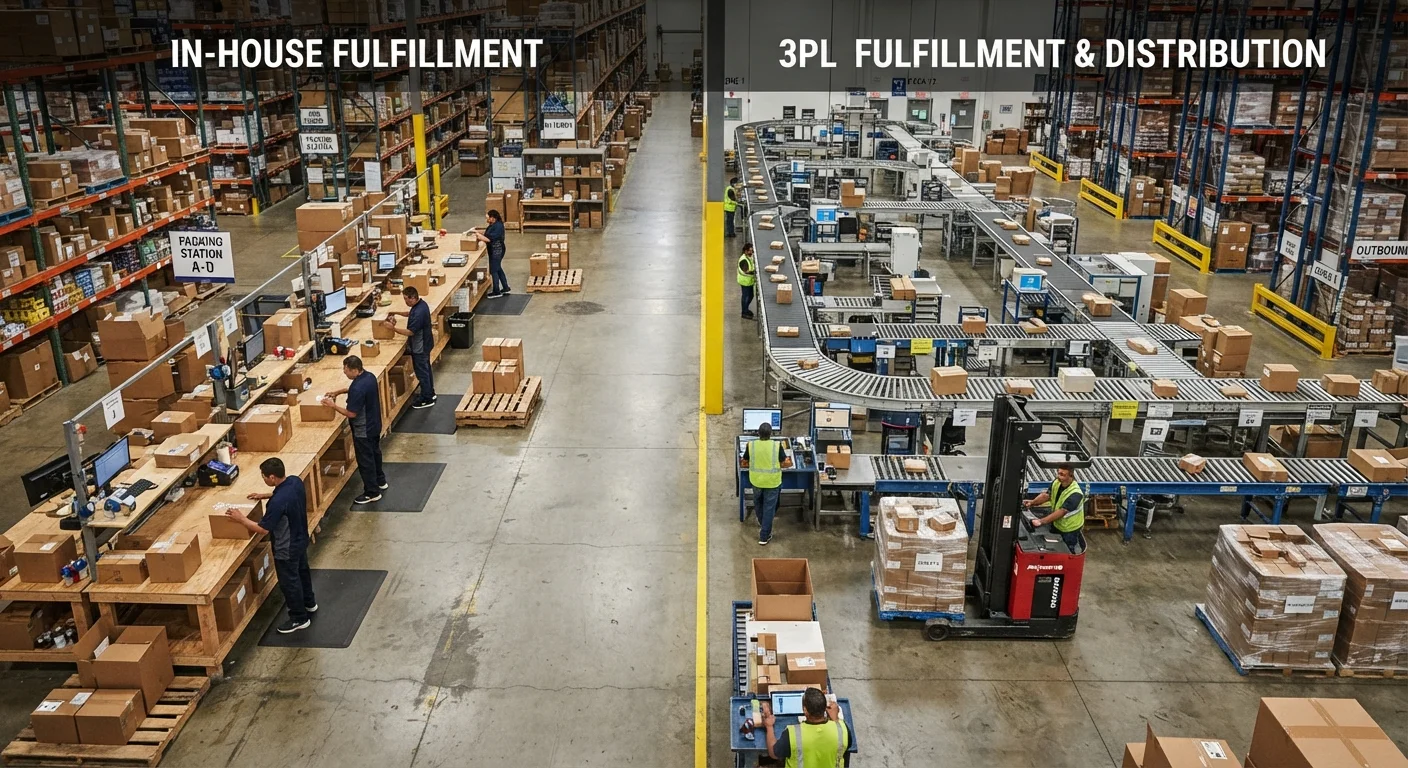
Key Takeaways
Option A
In-House Fulfillment
Full operational ownership with direct control over every step.
Best for: Businesses with specialized handling requirements, high-margin SKUs, or the resources to build and staff a dedicated fulfillment operation.
Option B
Third-Party Logistics (3PL)
Scalable, outsourced fulfillment backed by specialized infrastructure.
Best for: Growing businesses seeking variable cost structures, geographic reach, and logistics expertise without the capital investment of owned facilities.
If you handle fragile, regulated, or highly customized products
In-House Fulfillment
Direct oversight of packing procedures and quality control is easier to enforce when your own team manages every order.
If your order volume fluctuates significantly by season or campaign
Third-Party Logistics (3PL)
3PL pricing scales with volume, meaning you avoid paying for idle warehouse space and excess staff during slow periods.
If you are expanding into new regions or markets rapidly
Third-Party Logistics (3PL)
Established 3PL networks provide immediate access to distributed fulfillment centers without the lead time of building or leasing new facilities.
If brand experience and custom unboxing are central to your customer proposition
In-House Fulfillment
In-house teams can implement and iterate on packaging standards far more directly than a 3PL operating across many clients.
If capital preservation is a priority and logistics is not a core competency
Third-Party Logistics (3PL)
Outsourcing avoids large upfront investments in warehouse leases, equipment, and workforce, freeing capital for product, marketing, or operations.
The Core Trade-Off: Control vs. Flexibility
Every fulfillment decision ultimately pivots on a single tension: how much operational control your business needs versus how much flexibility it requires to scale efficiently. In-house fulfillment places the entire process-receiving inventory, picking and packing orders, coordinating outbound shipments-under your direct management. A third-party logistics provider, or 3PL, assumes operational responsibility for those same functions using its own facilities, staff, and systems.
Neither model is universally superior. The right choice depends on your order volumes, product characteristics, growth stage, and how central fulfillment quality is to your customer experience. For a structural look at how outsourcing shifts both operational and financial accountability, see our piece on weighing the gains against the loss of control in logistics outsourcing.
| Criterion | In-House Fulfillment | Third-Party Logistics (3PL) |
|---|---|---|
| Cost structure | Primarily fixed (lease, staff, systems) | Primarily variable (per unit, per order) |
| Upfront capital required | High | Low to moderate |
| Operational control | Direct and complete | Indirect, via SLAs and integrations |
| Scalability speed | Slow (facility, hiring, systems) | Fast (existing network) |
| Geographic reach | Limited by owned/leased locations | Broad, through 3PL network |
| Brand and packaging control | High | Moderate (provider-dependent) |
| Best volume fit | High, stable order volumes | Variable or rapidly growing volumes |
| Expertise required | Internal logistics competency needed | Leverages provider's expertise |
Cost Structure: Fixed Overhead vs. Variable Spend
In-house fulfillment carries a predominantly fixed cost structure. Warehouse leases, equipment, warehouse management systems (WMS), and a core fulfillment workforce represent ongoing expenses whether you ship 500 orders a month or 5,000. This creates operational leverage when volumes are high but becomes a financial drag during slower periods.
3PL pricing is typically structured around activity: storage fees per pallet or bin, pick-and-pack fees per order, and outbound shipping. This variable model aligns costs more closely with actual throughput. For businesses with seasonal spikes-holiday retail, for example-this can meaningfully reduce overhead during off-peak periods.
~$150B+
US 3PL market annual revenue
According to Armstrong & Associates, US third-party logistics revenues have consistently exceeded $150 billion annually in recent years, reflecting widespread adoption across industries.
73%
Shippers using 3PL services
The 2023 Third-Party Logistics Study, produced by Penn State University and Penske Logistics, found that approximately 73% of surveyed shippers use 3PL services for at least some logistics functions.
That said, 3PL fees can compound quickly at scale. Once order volumes reach a threshold where fixed in-house costs are absorbed efficiently, the per-unit economics of a 3PL may exceed those of a well-run internal operation. Modeling both scenarios at projected volume bands is a necessary step before committing to either model. This decision also intersects with broader financial planning frameworks for sustainable growth.
Scalability and Geographic Reach
One of the most cited advantages of 3PLs is the speed at which they enable geographic distribution. Many mid-size and enterprise 3PL providers operate networks of fulfillment centers across the US, allowing businesses to position inventory closer to end customers without independently securing and staffing multiple facilities. Shorter shipping zones translate directly into lower carrier costs and faster delivery windows-both of which affect customer satisfaction and last-mile delivery performance.
In-house operations scale differently. Adding capacity means negotiating new leases, hiring and training staff, and implementing systems at each new location-a timeline that can span months. For businesses whose products require specialized storage (temperature control, hazmat compliance, secure handling), building that capability internally may be unavoidable, but it comes with corresponding lead time and capital requirements.
For a broader view of how storage model choices interact with fulfillment strategy, the comparison in warehousing models: public, private, and contract storage provides useful context.
Visibility, Brand Control, and Operational Risk
In-house fulfillment gives you real-time visibility into inventory levels, packing accuracy, and order status without depending on a third party's reporting systems or integration. When issues arise-a mispick, a labeling error, a carrier delay-your team identifies and corrects them directly. This matters most for businesses where fulfillment quality is a brand differentiator: custom packaging inserts, specific wrapping standards, or high-value items that require careful handling.
3PLs introduce a layer of operational distance. You are one client among many, and your priorities compete for attention against others on the warehouse floor. Reputable 3PL providers mitigate this through service-level agreements (SLAs), dedicated account management, and technology integrations that surface order data in near real time. However, it is worth reading past common assumptions about how these partnerships actually function-our article on misconceptions about third-party logistics providers addresses several that routinely affect business decisions.
Risk profiles also differ. In-house operations concentrate risk internally-a facility disruption, a staffing shortage, or a system failure affects your business directly. A 3PL distributes some of that risk but introduces dependency on a vendor whose performance, financial stability, and contractual terms must be assessed carefully. Businesses navigating this build-vs-buy logic in other functions-such as HR outsourcing vs. in-house HR-will recognize the same structural questions here.
This article is for general informational and educational purposes only. It does not constitute financial, operational, or legal advice tailored to your business's specific circumstances. Consult qualified logistics, financial, and legal professionals before making significant operational or investment decisions.