

Key Takeaways
Option A
Brand Positioning
The strategic foundation that defines where you stand in the market.
Best for: Organizations establishing competitive differentiation, entering new markets, or realigning how they are perceived relative to competitors.
Option B
Brand Messaging
The expressive layer that communicates your value to real audiences.
Best for: Teams crafting campaign copy, sales narratives, website content, and any customer-facing communication that needs a consistent voice.
If you are launching a new business or entering a new market segment
Brand Positioning
Before crafting any copy, you need a defensible market stance. Positioning determines which segment you serve, what unique value you deliver, and why customers should choose you over alternatives.
If your brand strategy is solid but campaigns lack a consistent voice
Brand Messaging
A documented messaging framework - covering tone, key statements, and audience-specific language - gives every channel a coherent and recognizable expression of the brand.
If you are experiencing customer confusion or poor conversion despite high visibility
Brand Positioning
Confusion at the decision stage often signals a positioning problem, not a messaging execution problem. Revisiting how you are differentiated in the market is the higher-leverage fix.
If you are scaling a campaign across multiple channels and team members
Brand Messaging
Consistent messaging frameworks prevent brand drift as more people produce content. Documented tone, value statements, and audience language keep execution aligned at scale.
Two Distinct Brand Disciplines
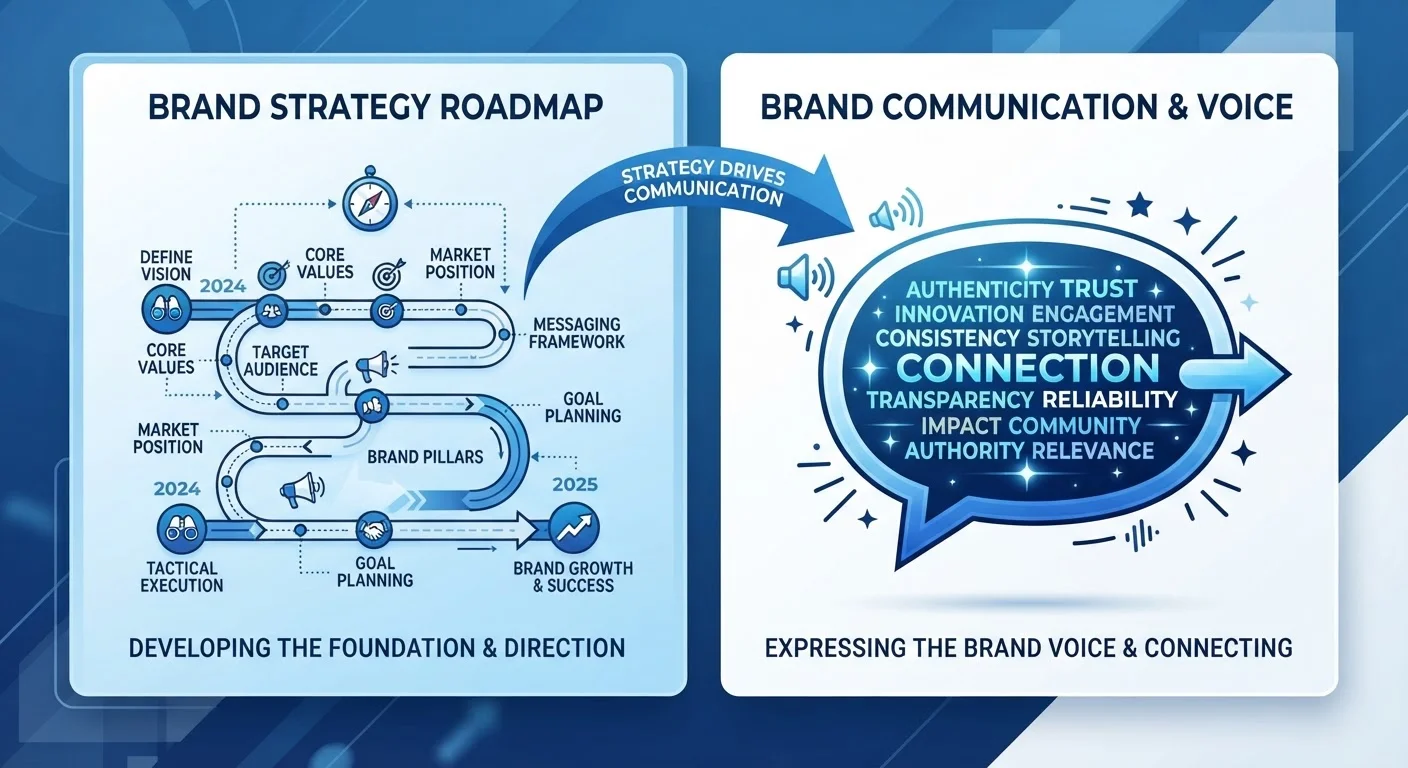
Brand positioning and brand messaging are frequently used interchangeably, but they operate at different levels of brand strategy. Conflating them leads to a common and costly mistake: investing heavily in communications before the strategic foundation is set.
Brand positioning is the internal strategic work that establishes where a business competes and why it is distinctive. It answers questions like: Who is our target customer? What category do we operate in? What is our primary point of difference? What do competitors offer, and where do we deliberately diverge? The output is typically an internal positioning statement - a compact document that guides decisions across product, pricing, distribution, and communication.
Brand messaging is what becomes public. It translates positioning into language that resonates with specific audiences across specific channels. A messaging framework might include a brand narrative, a hierarchy of key claims, audience-specific value propositions, tone-of-voice guidelines, and proof points that substantiate core promises.
The relationship is directional: positioning precedes and informs messaging. You cannot write credible, differentiated brand copy without knowing what ground you actually occupy. This is part of the full scope of brand building.
| Criterion | Brand Positioning | Brand Messaging |
|---|---|---|
| Primary purpose | Define competitive market stance | Communicate value to audiences |
| Audience | Internal teams and leadership | External customers and prospects |
| Typical output | Positioning statement, strategic brief | Messaging framework, copy guidelines |
| Update frequency | Infrequent - years-long horizon | Iterative - updated with campaign data |
| Key question answered | Where do we compete and why do we win? | What do we say and how do we say it? |
| Risk if neglected | No clear differentiation in the market | Inconsistent voice across channels |
How Each Element Functions in Practice
Positioning is developed in strategy sessions, market research, and competitive analysis. It rarely changes quarter-to-quarter - a well-constructed positioning statement should hold for years, shifting only when the market, product, or competitive landscape changes materially. Because it is internal, it does not need to be written in consumer language; it needs to be precise and actionable for internal teams.
Messaging, by contrast, is iterative. Campaigns test different framings, headlines, and calls to action. A/B tests surface which language converts. Customer interviews reveal the words real buyers use to describe their problems and goals. The best messaging teams treat their framework as a living document, updated with market feedback and campaign learnings.
Consider a B2B software company that positions itself around implementation speed - a genuine operational advantage over slower legacy competitors. That positioning drives a messaging hierarchy where the lead claim across all channels is time-to-value, supported by customer proof points and feature explanations that reinforce speed. Without the positioning anchor, each copywriter might emphasize a different attribute - reliability one week, integrations the next - creating brand drift that erodes clarity over time.
3-5x
Revenue premium for consistent brand presentation
Lucidpress research has suggested that consistent brand presentation across channels can significantly increase revenue, though exact multipliers vary by company size and sector.
23%
Average revenue increase from brand consistency
Industry surveys have attributed measurable revenue gains to consistent branding, though figures vary; businesses should treat these as directional rather than guaranteed outcomes.
For teams building out campaign communications, established messaging frameworks provide structured approaches - from value proposition canvases to message hierarchies - that keep execution coherent across channels.
Common Mistakes and How to Avoid Them
The most frequent error is treating messaging as a substitute for positioning. A business with a vague or undifferentiated market stance cannot write its way to clarity. Clever taglines and polished copy will not resolve a fundamental question that customers cannot answer: Why this brand, rather than that one?
A second mistake is developing positioning in isolation from real customer insight. Positioning built entirely inside a conference room often reflects what internal stakeholders wish customers valued - not what actually drives decisions. Validation through customer interviews, win/loss analysis, and market research grounds positioning in reality.
On the messaging side, the most common failure is inconsistency. When messaging is undocumented, each team member - from sales to social media to PR - defaults to their own interpretation of the brand. Over time, the brand voice fragments, and audiences receive contradictory signals about what the business stands for.
Positioning Statements Are Not Tag Lines
A positioning statement is an internal strategic document - typically one to three sentences - that defines target customer, competitive frame, point of difference, and reason to believe. It is not intended for external publication. Tag lines and headlines are downstream messaging artifacts that distill positioning into consumer-facing language. Confusing the two leads teams to either over-publicize internal strategy or treat creative copy as a substitute for strategic clarity.
Brands operating across multiple product lines face additional complexity - the branded house vs. house of brands decision directly shapes both what you position and how flexibly you can message across offerings. Likewise, the distinction between internal and external branding is relevant here: positioning must be internalized by the team before it can be credibly communicated outward.
Once positioning and messaging are aligned, they provide the strategic foundation for effective campaign strategy - where specific channels, offers, and creative executions translate brand clarity into measurable results.
This article is intended for general informational and educational purposes only. It does not constitute professional marketing, legal, or financial advice. Consult qualified professionals for guidance specific to your business circumstances.